

This is part two of a W5 investigation into the phenomenon of “stock spoofing,” a market manipulation tactic that a Canadian biotech company says nearly derailed a promising medical treatment.
In a lab east of Toronto, Dr. Andrzej Chruscinski’s team is testing a fine white powder that they believe could be a breakthrough in the treatment of a debilitating nerve disease.
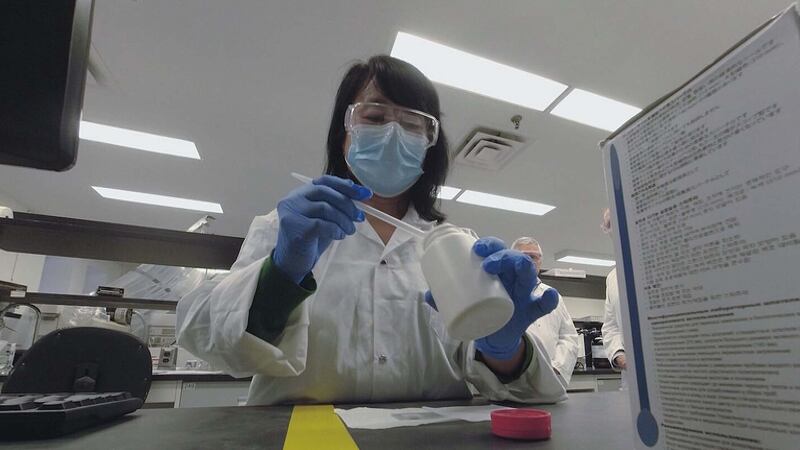
As W5’s cameras watch, a lab technician places a sample inside an instrument that uses x-rays to test the product’s purity. A tell-tale pattern appears on a computer screen: one unique to the drug, called Lucid-MS.
“This is an important step in the quality control of our product,” said Chruscinski. He’s excited about the potential for Lucid-MS to treat multiple sclerosis, a disease that damages nerve coverings called myelin.
“Most drugs work for multiple sclerosis by inhibiting the immune system. Our drug is very different,” Chruscinski said. “It works by preventing the myelin from unraveling. It works on a totally different aspect of this disease.”
But in a series of interviews with W5, Quantum BioPharma executives say the lab work has not been the hardest part of getting Lucid-MS through clinical trials, on the way to patients.
What was far more threatening, they said, was the company’s experience on the stock market.
The founder of the company, Anthony Durkacz, described how his company’s stock price collapsed even as its products moved forward.
“The fact that the share price was continually going down over these periods of time made us question (what was happening),” he said. “We had to start thinking that something was wrong.”
That mismatch sparked the company’s investigation into millions of trades across American and Canadian exchanges, pulling together clues to point the finger in a lawsuit against major Canadian banks.
“We discovered that there’s a stock manipulation tactic that’s called stock spoofing,” he said.
Stock spoofing is a market manipulation tactic where a trader places big buy or sell orders that they never plan to actually complete. The point is to trick other traders about where the stock market is heading.
According to Durkacz, such tactics are difficult to detect where most of Quantum BioPharma’s shares are traded, including U.S.-based exchanges like the Nasdaq. The company had little visibility into who was buying and selling its own shares.
But in Canada, they found things were different.
“The main exchanges in Canada are much better at being able to provide information on the trading,” he said.

Company seeks US$700M in damages: lawsuit
In Quantum BioPharma’s lawsuit, they detail the process where they matched millions of orders in the United States with orders that happened within seconds on Canadian platforms.
That Canadian data formed the basis of a lawsuit filed in the United States District Court for the Southern District of New York, alleging stock spoofing on a massive scale. The company claims 16 million fictitious orders came from Canadian bank platforms.
The company alleges around 12 million came from CIBC, 267,000 from Royal Bank and 3.7 million from someone their lawsuit calls “John Doe.”
Quantum claims in court filings those orders “were intended to – and did – send false and misleading pricing signals to the marketplace that interfered with the share price being determined by the natural forces of supply and demand.”
The company is seeking US$700 million in damages.
“It is the banks and the brokers that have the responsibility to act as gatekeepers, to ensure that their clients and their traders are not breaching rules and regulations of their trade,” Durkacz said in an interview.
In a joint response, the banks denied they spoofed the stock and said Quantum’s data is “cherry-picked.”
“Quantum fails to address the obvious cause of Quantum’s declining stock price: its own mismanagement. Quantum never turned a profit, and lost tens of millions of dollars each year,” their response said.
The case will proceed in an American courtroom. None of the allegations have been proven in court.

Even with the Canadian information, it’s not yet clear who would have profited from the trades themselves, and the company believes the court’s discovery process could shed more light.
In October, Quantum BioPharma took another unusual step: offering a reward of up to US$7 million for proof of manipulation of its stock, suggesting in a news release that it believes there could be other potential defendants.
The stock collapse was difficult for Saleem Ahmed, who bought about C$100,000 in shares, thinking it would provide for his retirement.
“It’s worth about C$7,000 today,” he said. “It’s been stressful, definitely ... the stock just went down, down, down.”
Back at the lab, Chruscinski acknowledges the difficulty the financial roller coaster has had on his mission.
But he says the product is going through stages of clinical trials and getting positive results.
“There’s toxicology studies that need to be performed. There’s other non-clinical studies. And then we got it into a phase one clinical trial,” Chruscinski said.
“We had excellent results. This was a trial that’s done in healthy volunteers, and we found that Lucid-MS is safe and well tolerated.”
According to Chruscinski, a phase two clinical trial, which would be the first time Lucid-MS would be given to anyone with MS, is slated for 2026.

