
The latest numbers by Health Canada of reported influenza cases show a spike across the county.
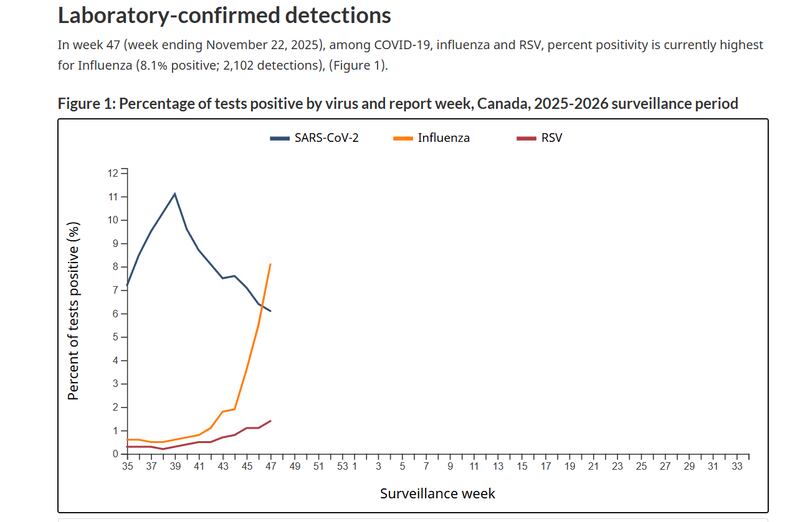
For the week ending Nov. 22, cases of the flu were trending upwards, with 8.1 per cent of tests being positive. There were 2,102 total cases of the flu, compared to 1,394 the previous week. The population most affected by the flu were those 65 and older.
According to FluWatchers, a volunteer online health surveillance program that tracks activity of common viruses, 1.4 per cent of the 9,525 participants reported cough and fever.
Isaac Bogoch, an infectious disease specialist, said the numbers are in line with what’s expected for this time of the year.
“It’s late fall, early winter in Canada and to no one’s surprise, we’re seeing the flu circulate,” he told CTVNews.ca.
Bogoch explains that researchers look to the southern hemisphere to gage how significant Canada’s flu season is going to be, which he admits isn’t perfect, but is helpful.
This year, that region, particularly Australia, had a pretty severe flu season.
“They had a large number of cases and it was a tough year,” Bogoch said. “They had two difficult seasons in a row. We may be in for a tough flu season.”
He explained that there are three strains of the influenza virus that are circulating: two are influenza A, H3N2 and H1N1, and one is influenza B.
Influenza B picks up in the latter part of the flu season, while more cases of influenza A are reported earlier. While this year’s vaccine may be a bit of a “mismatch” to the H3N2 component, Bogoch stressed that doesn’t mean it won’t provide any protection.
“It just means it might provide less protection than what we’d want against that component,” he said. “The vaccine has components to protect us against all three of those strains. One of those three components still has some protection, just less than we’d like.”
Bogoch said the best thing people can do is go out and get their flu shots.
“We know flu shots aren’t perfect but they still do a very good job at reducing the risk of severe illness,” he said. “They can reduce the risk of severe infection and flu shots are free and widely available across the country.”

