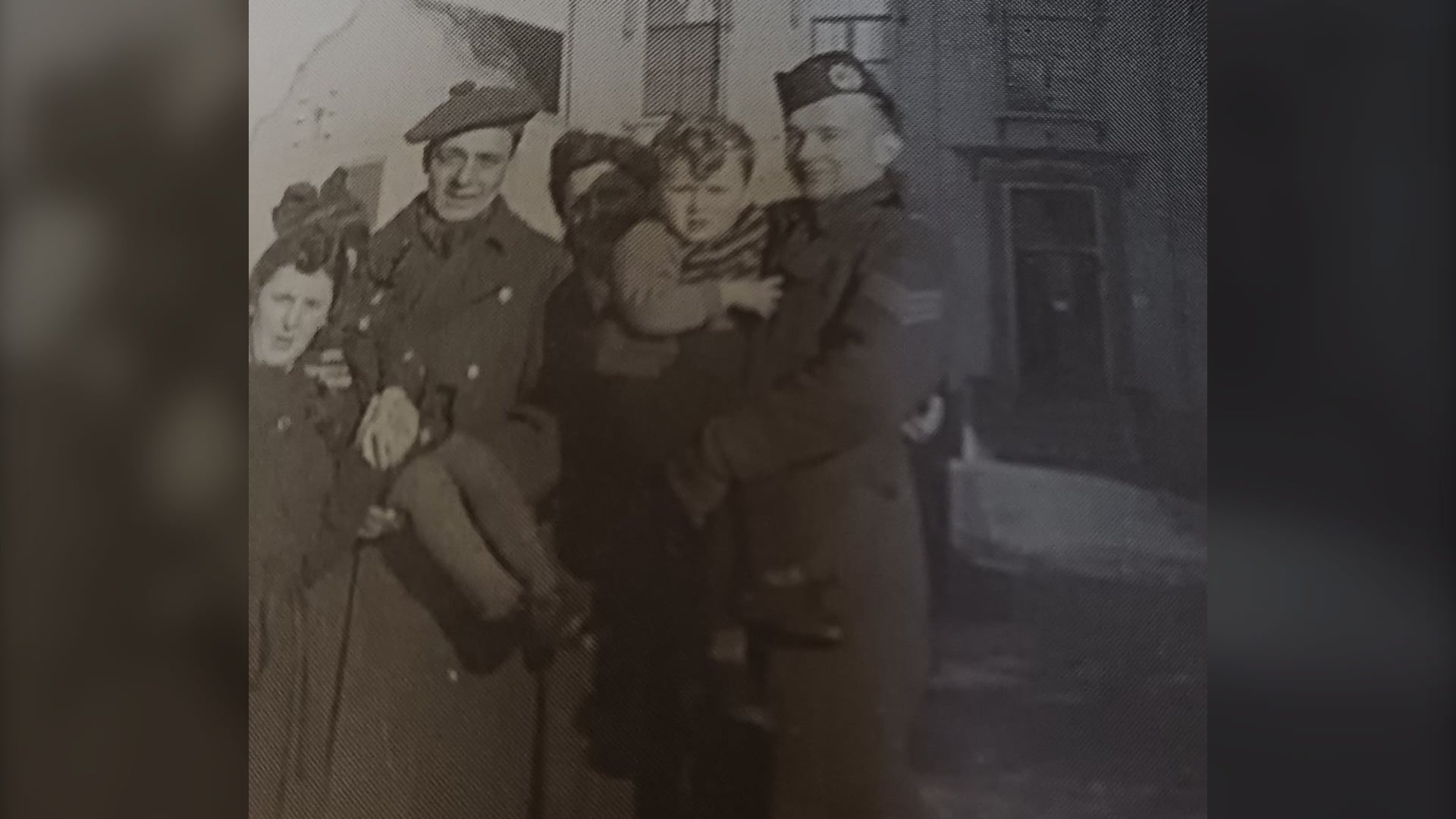
There’s a story to tell in an old grainy black and white photograph.
It’s one that stretches from Winnipeg to the Netherlands, where a young researcher is trying to unravel a mystery and ensure this story won’t be lost or forgotten.
Two Canadian soldiers stand in the centre of a small village in the Netherlands, just a few short kilometres away from the front line, where Nazi shells and snipers were a constant threat.
Yet this photograph shows a moment of peace—the soldiers’ faces are bright and smiling. In their arms, they’re holding two young children, with two women standing by their side.
The photograph is more than 80 years old, taken during the Second World War in Cuijk—a small town in the southeastern part of the Netherlands. That’s where 25-year-old researcher Jan Meijer lives and works to make sure the story of the Canadian soldiers who liberated his home is not forgotten.
“I’m afraid that when the years go on that people just don’t remember anymore,” he said. “I mean, the Canadians bought us freedom that we should cherish.”
For Meijer, preserving those stories starts with a photograph.
Stories hidden in decades-old photos
He’s been collecting decades-old photos for years and attempting to uncover the stories they hold.
“Most pictures I got myself from house clearances and stuff,” he said. “I just visit all the people who knew the Canadians, and they sometimes have pictures as well.”
He said this specific photo was taken in the first week of December 1944. An eight-month campaign to liberate the Netherlands from Nazi Germany—a campaign that cost more than 7,600 Canadians their lives—was nearing its end.
Meijer said Canadian soldiers were stationed in his hometown for a couple months.
“A lot of the times, the people I speak to mention all the white bread the Canadians gave away, and the chocolate and the cigarettes,” he said. “It was like one big party, I think, for the Dutch population.”
How a photo found in the Netherlands could be connected to Winnipeg
But this specific photo still holds some secrets. Who were these two smiling Canadian soldiers who helped bring freedom to the Netherlands?
That’s what Meijer is trying to find out. He’s turned to Winnipeg for help.
He believes the soldiers were part of the Queen’s Own Cameron Highlanders of Canada, which originated in the Manitoba capital.
Meijer said the infantry regiment was one of six that stayed in Cuijk during the war. But in his search for answers, Meijer knows time is against him.
“There’s none left that I’m aware of,” said Hugh O’Donnell, a retired regimental Sgt. Maj. for the Camerons and the current secretary of the Cameron Association in Canada.
O’Donnell said about 1,500 members served in an active service battalion that went overseas during the Second World War. He said 417 of them were killed in action.
The last known Cameron veteran of the Second World War, Harold ‘Timer’ Earl Hyndam, died in May 2024 at the age of 98.
CTV News showed O’Donnell the photo of the two smiling soldiers. He said he does believe they were Cameron Highlanders based on their uniforms. As for whether both these soldiers were from Winnipeg, he said that is harder to confirm.
“By the end of the war, by the time that picture was taken, we were well past the conscription crisis… Guys were coming in from out of area,” he said.
Without names on the photograph, O’Donnell said it is hard to identify the soldiers. Still, he is hopeful Meijer’s research may one day give them back their identities.
“I think it’s immensely important for them, certainly for closure for families,” he said. “A lot of these guys died far away. Some of them are remembered vaguely by uncles or cousins if they’re remembered at all.”
‘The memories are scattered‘: hope remains while chances are slim
Meijer knows the chances are slim, but he hasn’t given up hope.
“I want to make sure that I’ve done everything that I could to record their story and connect them to the bigger story of Cuijk,” he said.
Meijer has made some progress in his hunt for answers. He was able to track down the brother of one of the children in the photo, perched in the arms of the soldiers. However, Meijer said the man, now in his late eighties, doesn’t remember much about the picture.
“It was a turbulent time, also for children. So the memories are scattered,” Meijer told CTV News in a message.
What the man did remember well was the kindness of the Canadians.
“His house was a storage room for jerrycans. It got hit by a German grenade and it was completely destroyed,” Meijer wrote. “Next door, the Canadians had a field kitchen; they went to eat there. The Canadian cooks happily served them.”
So, the search continues for Meijer. He hopes this photograph—and ones like it—will eventually lead him to any surviving Canadian veterans who stopped in his village during the liberation, so he can hear their stories firsthand.
“That’s probably the most thrilling part about doing history, because it gets personal. All of a sudden, everything just seems to click. I can’t describe it otherwise.”
Until then, he said the story of Canadians in Cuijk is a reminder for him—there are always people willing to stand up and fight for freedom.
“We should never forget it.”

