New federal legislation would deem murders motivated by hate or femicide first-degree offences, as well as make it illegal to distribute deepfake sexual images without someone’s consent.
The wide-ranging 158-page bill called the “Protecting Victims Act” aims to tackle both intimate partner violence and protect kids.
It attempts to both follow through on some 2025 Liberal campaign promises as well as carry over elements from the beleaguered Trudeau-era Online Harms Act, the roots of which go back to 2019.
“We have an opportunity to better protect kids who are at risk of exploitation and to address very real concerns about violence against women, including violence that could be fatal,” Justice Minister Sean Fraser said at a news conference Tuesday.
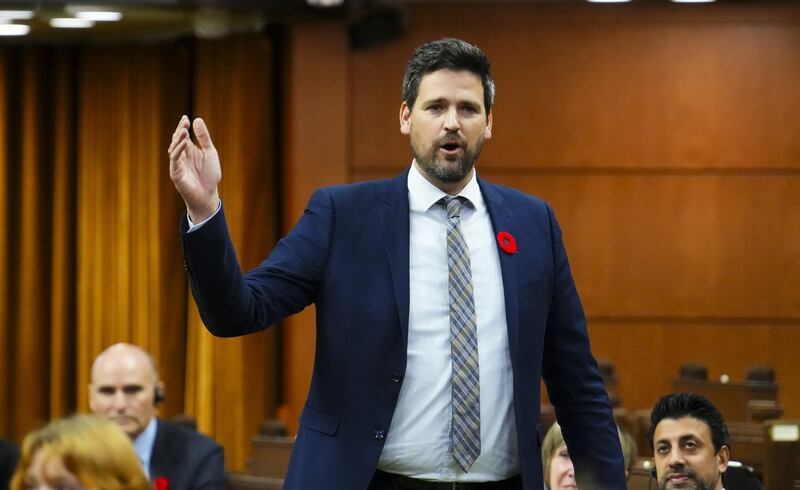
Fraser highlighted there is currently a “gap” in legislation that doesn’t cover deep fakes. The new Bill C-16 tabled today will cover deepfakes and extend the maximum penalty from five to ten years.
The legislation would change the Criminal Code to classify murders driven by hate, or accompanied by a pattern of controlling or coercive behaviour of an intimate partner, as first-degree.
Speaking to reporters on a not-for-attribution basis ahead of the news conference, government officials explained that currently, if the murder isn’t pre-meditated, the perpetrator could be found guilty of second-degree murder or manslaughter instead.
The bill also adds a new offence to criminalize “coercive control” and target patterns, so the justice system can intervene before a case potentially turns lethal.
“It is not enough to simply punish bad actors on the back end of a tragedy, but to do everything we can to prevent violence from taking place in first instance,” said Fraser.

Officials said Canada’s goal is to “eliminate” gender-based violence, although they did not detail exactly how this plan will do that. CTV News asked the minister about whether he believes this bill can accomplish that, and Fraser said if you set your goal any lower than eliminating gender-based violence, “you’re failing from inception.”
According to the same officials, the main element carried over from the old Online Harms Bill is a strengthening of mandatory reporting rules, requiring internet service providers to notify police when they know child pornography is being circulated on their platforms. The new bill applies to more entities, including social media platforms, but does not mandate a process to have them removed.
“It’s essential that we adopt measures that better keep our children safe, who increasingly are growing up in an online environment, in a world where the difference between the real world and online environments is indivisible,” said Fraser. He also said the new bill is not “copying and pasting” from the old Online Harms Act.
If passed, C-16 would also restore about a dozen mandatory minimum penalties of imprisonment that were previously found unconstitutional.
Government officials said many mandatory minimums have been struck down by courts on the basis they violate the section of the Charter which protects against cruel and unusual punishment. Officials gave the example of R. v Senneville, where the Supreme Court of Canada struck down one-year mandatory minimum penalties for possessing and accessing child sexual abuse and exploitation material.
At the same time, the legislation will give courts some leeway to order a sentence shorter than the mandatory minimum.
Officials told reporters this will give courts “limited discretion” to make sure the sentences are “constitutionally sound,” and address the problem of offences being struck down not due to the basis of the case, but on the possibility that the mandatory minimum would violate charter protections.
Proposed changes to the criminal harassment offence removes the onus on the victim to prove they subjectively feared for their own security, and changes it to an objective standard for law enforcement and the prosecution to show a reasonable person would have feared for their security. The offense will also be modernized to make sure modern technologies are included, for example if a victim is tracked electronically.
C-16 also aims to crack down on court delays and reduce the number of stays. A stay means prosecution is terminated and there is no verdict. The bill aims to reduce the number of stays by requiring courts to consider alternative options.
With files from CTV News’ Senior Political Correspondent Mike Le Couteur

