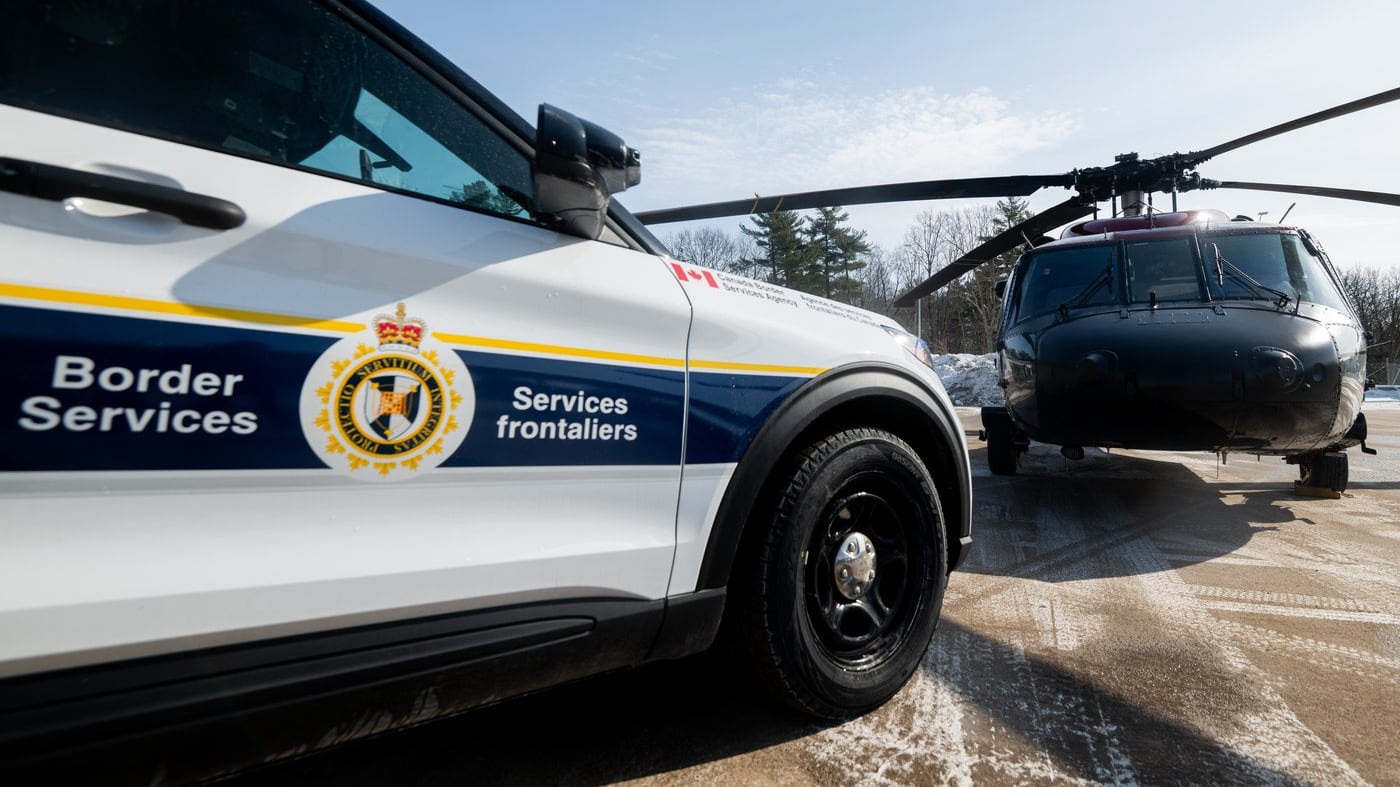
The Canada Border Services Agency (CBSA) released national statistics from Jan. 1 to Oct. 31, showing what they found at 1,200 Canadian and 40 international locations.
Drug enforcement
The CBSA made 44,486 drug-related seizures this year, resulting in more 47,056.6 kilograms (kg) of material. Cannabis was seized 13,431 times for a total of 42,439 kg. Outside of cannabis, there were 27,320 other drug seizures, totalling 2.6 kg of fentanyl, 87 kg of heroin, 922 kg of other opioids, 3,243 kg of cocaine and 24,497 kg of “other drugs, narcotics and chemicals.”
“(CBSA officers’) vigilance in intercepting fentanyl and other illicit substances before they reach our communities has had a profound impact on the safety of all Canadians,” Kevin Brosseau, Canada’s fentanyl czar, said in a press release. “As a vital part of Canada’s enforcement ecosystem, their work with partners helps stop harm before it starts.”
Aaron McCrorie, vice-president of Intelligence and Enforcement at the CBSA, told CTVNews.ca Wednesday that fentanyl is being produced and used significantly within Canada.
“You’re not seeing fentanyl being imported into Canada. You’re not seeing it being exported to Canada,” he said. “Precursors are coming in, and we’re making efforts to stop precursors coming in, but then it’s getting produced and it’s being used domestically. We’re not a source of fentanyl for the U.S.”
General contraband seizures
Tobacco was seized 2,874 times, resulting in 783,424 kg. Child pornography was found by the agency 81 times, down from 279 last year.
“The CBSA stopped transnational organized crime networks at our front door, found foreign companies that undervalue their goods and charged them, and stopped and removed inadmissible foreign nationals who try to come to Canada under false pretenses,” said CBSA president Erin O’Gorman.
McCrorie said all the contraband connected to child pornography has been seized physically.
“It’s driven by our intelligence. It’s driven by our targeting,” he said.
Meanwhile, the tobacco was seized “largely” in southern Ontario and Quebec coming in illegally through the U.S., McCrorie said.
“It’s depriving the provinces of Ontario and Quebec, as well as the federal government of duties, excise taxes and impacting revenue,” he said. “Tobacco is a great concern because it’s enriching organized crime, and we want to disrupt that.”
Weapons
CBSA reports 742 firearms being seized across 585 incidents.
The majority of seized firearms were handguns, coming in at 445, but 55 rifles were found, as well as eight fully automatic carbines and 29 shotguns. The CBSA also reported 26,189 “miscellaneous” firearms, which include “replica firearms, firearms parts, large capacity magazines, silencers. It also reported finding three antique firearms.
The CBSA says it seized 13,576 non-firearm weapons in 6,948 encounters, including knives and brass knuckles.
For the most part, McCrorie says firearms are being intercepted at the land border, while some others are being seized via the postal mode.
“You’re not seeing firearms or weapons leaving Canada,” he said. “It really is firearms coming into Canada, and firearms coming primarily from the U.S.”
Travellers
CBSA reported removing 841 people for reasons related to “national security, war crimes or human rights violations, organized crime, and criminality.”
Most people entering Canada came on the highway, with the CBSA recording 35,871,858. Air travel was a close second, coming in at 31,131,262. Marine and rail travel had 3,214,526 and 226,590 respectively.
Commercially, the highway still led the way at 4,267,922 trucks, while air shipments came second at 3,191.036; marine saw 1,688,846 containers, and 1,518,317 rail cars rounded it out. Those commercial goods paid $39.2 billion in duties, and the CBSA imposed $2,391,400 in agricultural and agri-food administrative monetary penalties for 3,144 import violations.
After an initial screening by Immigration, Refugees and Citizenship Canada, information about the travellers is sent to the CBSA.
“We’ll look at intelligence sources to determine if somebody is inadmissible,” McCrorie added. “We’re stopping them before they come to the country.”
The CBSA has done nearly 18,000 removals so far in 2025, McCrorie added, focusing on criminality.
Stolen vehicles
A separate enforcement statistics report from the CBSA shows where stolen vehicles were intercepted at the border since 2018. Quebec saw the most seizures, with the Greater Toronto Area (GTA) and the Atlantic region close behind. Outside of the GTA, Ontario saw relatively few stolen vehicles being intercepted, and until 2024, the Pacific region also had relatively few.
Minister of Public Safety Gary Anandasangaree said he had “seen the enthusiasm of the newest cohort of CBSA graduates as we begin to hire the 1,000 new border officers we promised. We are continuing to bolster these efforts by hiring more officers and investing in our border plan to keep Canadians safe.”
According to McCrorie, the reason that Quebec showed the highest number of vehicle seizures was due to the Port of Montreal being used a gateway from Eastern Canada and other parts of the world.
“Some are being used for joy rides, some are using being used for criminal enterprise domestically, or being sold domestically,” McCrorie said.
“We’re still playing a very active role, from CBSA’s point of view, to stop those storm vehicles from leaving the country.”
Meanwhile, the CBSA is actively participating in operations with the police agencies in Ontario where stolen vehicles are being seized at the port of entry through tips and referrals, he added.

