Winter weather warnings were in effect Wednesday morning for vast swathes of the country, with Environment Canada issuing statements in each province and territory outside of Atlantic Canada.
Up to 30 centimetres of snow is expected in the Prairies as a potentially hazardous weather system moves across the central part of the country. Much of southern Saskatchewan and Manitoba are under blizzard warnings, with high winds and snowfall of up to 20 cm expected.
“A strong Alberta Clipper will bring heavy snow and strong, gusty winds leading to blizzard conditions over portions of southern Saskatchewan (and Manitoba) beginning Wednesday morning,” Environment Canada said on its website.
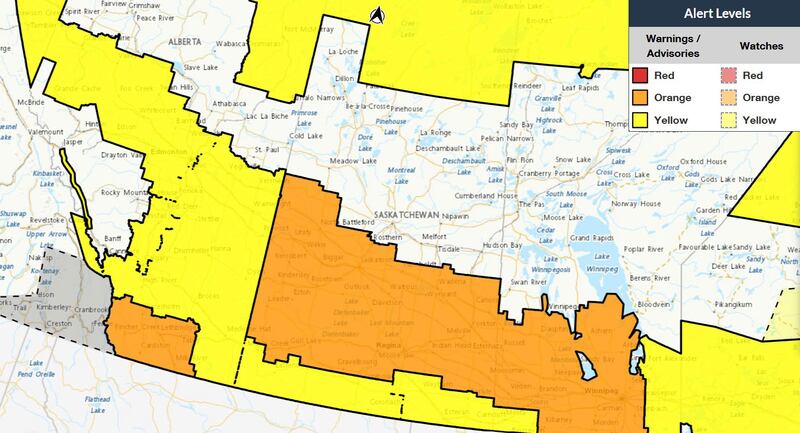
Parts of the two provinces are also expected to experience freezing rain Wednesday “before precipitation transitions to snow and blowing snow early this evening,” the department said.
“Some areas will be above freezing and will only experience rain.”
Further west, much of Alberta is under a winter storm warning, with up to 30 cm expected in and around Edmonton.
“Snow has developed over northwestern Alberta and will spread east through the Edmonton area this morning. Snow will fall heavy at times, with rapid accumulation likely affecting the morning commute in some areas,” Environment Canada said.
“Snow will taper off from northwest to southeast this afternoon, with heavy snow ending in the Edmonton area this evening.”
Meanwhile, a special weather statement was issued for the B.C. Interior, where a cold front is expected to bring strong westerly wind gusts, according to Environment Canada.
“These strong winds may lead to possible tree damages, local power outages and travel delays,” it said. “Winds will ease later this morning as the front tracks eastward.”
Ontario and Quebec
In Ontario, a winter storm is expected to hit the northwestern part of the province this evening, when up to 50 cm of snow could fall overnight and into Thursday.
A large area east of the Manitoba border stretching across the province north of Lake Superior all the way to the Quebec border is expected to experience potentially heavy snowfall later Wednesday and into Thursday. Areas further east could see snowfall continue until Friday night.
“Snow at times heavy will affect the area beginning tonight. In addition to the snow, strong northerly winds gusting as high as 70 km/h are expected to develop on Thursday easing through the day on Friday,” Environment Canada said.
“The strong winds will cause blowing snow that could lead to near zero visibility at times in combination with the heavy snowfall.”
Further south, a large area encompassing Sudbury, Sault Ste. Marie and North Bay was under a flash freeze warning Wednesday morning, as temperatures were expected to fall rapidly.
Moving east, “brief, intense snowfall is expected to develop” in a large area of Ontario that includes Ottawa, with the same weather warnings in place for much of western Quebec.
“A cold front will move across (Quebec) today. As this front passes, snow squalls may develop and suddenly reduce visibilities to zero. Snow accumulations of two to four cm are possible,” said Environment Canada.
“In addition, a sudden drop in temperatures is expected following the passage of this front. Roads may become icy and slippery.”
Extreme cold warnings
Meanwhile, parts of Canada’s territories are under extreme cold warnings Wednesday, as temperatures in some places are expected to reach -55 with the wind chill.
“An Arctic ridge of high pressure is bringing mainly clear skies and very cold conditions” to an area of the Yukon to the north and east of Whitehorse, Environment Canada said.
“Light winds combined with frigid temperatures will result in extreme windchill.”
A similar alert was issued for an area of the Northwest Territories just north of Yellowknife.
In Nunavut this morning, cold warnings were issued for Baker Lake, Rankin Inlet, Chesterfield Inlet and Whale Cove.
“Watch for cold related symptoms: shortness of breath, chest pain, muscle pain and weakness, numbness and colour change in fingers and toes,” Environment Canada said.
“Dress warmly. Dress in layers that you can remove if you get too warm. The outer layer should be wind resistant.”

