The City of Calgary doesn’t know why the Bearspaw South feeder main failed again this week.
Since a catastrophic break in the key water artery in summer 2024, the city has known another was possible.
After this week, the city knows it’s probable.
“It has reached the end of its reliable life,” Mayor Jeromy Farkas said Thursday.
“We can keep patching (the main), and we can keep reacting (to it), but it will continue to fail until there is an alternative built.”
Work to that end is happening now, city officials say.
And after Tuesday’s break, it will happen even faster.
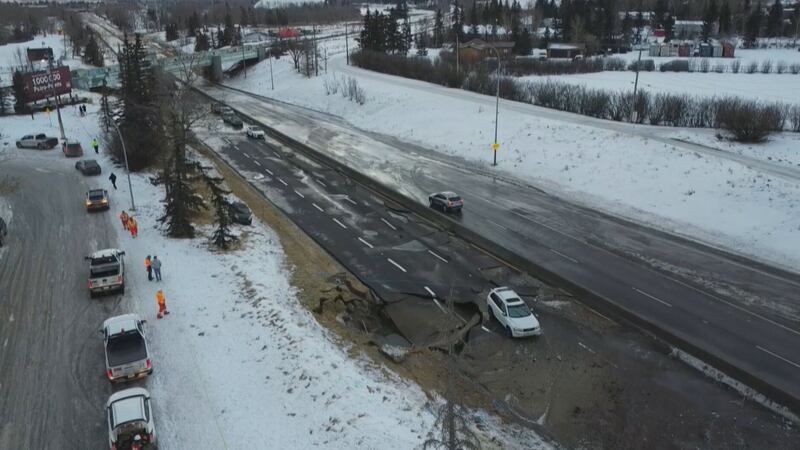
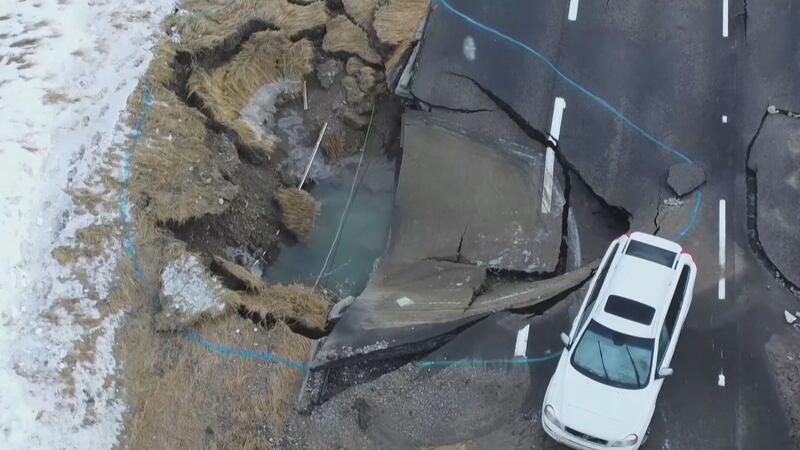
Tuesday’s break happened in the area of the Sarcee Trail and 16 Avenue N.W. interchange.
It was only a few blocks away from the site of the summer 2024 break.
Back then, the entire length of pipe was inspected.
Michael Thompson, infrastructure services manager, said, “239 deteriorated pipes out of approximately 2,000 four-metre-long pipe segments” and “23 additional segments requiring urgent repair” were identified.
“The feeder main still contains segments with minor to moderate structural deterioration today,” Thompson said on Thursday.
“We completed the 23 urgent repairs in 2024.”
“We understood the pipe would need to continue to operate in its current condition while we developed a plan for a long-term replacement,” he said.
Thompson said meanwhile, that stretch of pipe was being monitored.
“In the two months leading up to Dec. 30, we had not heard a wire snap along the pipe or anything in that area,” he said.
“We don’t know why the pipe failed.”
Multiple projects
On Thursday, city officials outlined work already underway to deal with aging infrastructure.
The Bearspaw South Feeder Main Improvement Project will add a parallel pipe of the same size as the existing one.
Design started and finished in 2025.
“We’re building a new water feeder main almost six kilometres in length, crossing the Bow River, the CPKC tracks, multiple roadways and it runs beside or underneath hundreds of homes and businesses,” Thompson said.
“The project is now out for construction and will start construction in Q1 of this year.”
“We were already moving this project forward on an accelerated schedule, but given the events of this week, we will be doing everything that we can to accelerate this project even more,” he said.
The North Calgary Water Servicing Project, “a 22-kilometre feeder main to support city growth and system redundancy,” began construction in 2025.
The South Calgary Water Servicing Project, “a new 25-kilometre feeder main designed to increase water capacity and system resilience,” is in the planning stages.
Thompson said there are also “a number of other projects across the city.”
Today’s problem
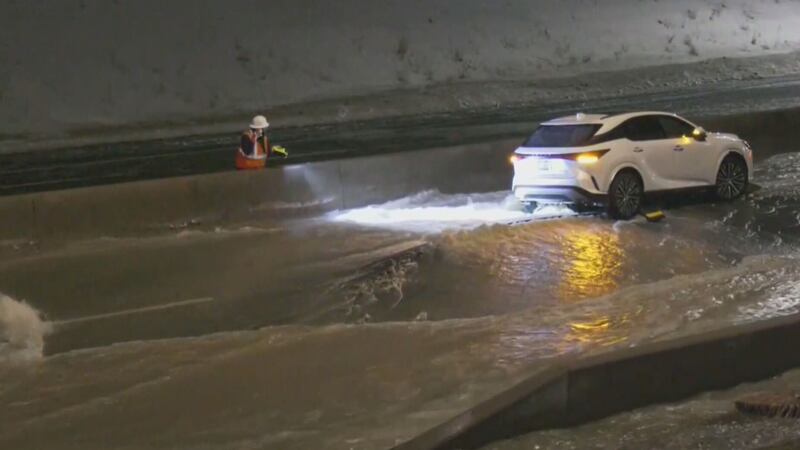
Water billowed up from under the road in northwest Calgary again on Tuesday, causing significant flooding.
Water on the road rose almost to the height of its median.
Water could be seen flowing off both sides of the road, taking over pathways and continuing into the park.
Multiple vehicles became stuck, and more than a dozen people had to be rescued.
No injuries were reported.
A boil water advisory issued by Alberta Health Services remains for parts of Montgomery, Parkdale, Point McKay and West Hillhurst.
All Calgarians remain under water use restrictions.
Calgary’s underground storage for treated water held about 600 million litres before the break.
In the immediate aftermath, that dropped to 459 million litres.
As of Thursday afternoon, it was back to 468 million litres.
Chris Huston, drinking water distribution manager, said the city needs to get back to 485 million litres, which would still be considered “strained.”
“It doesn’t take that much,” he said.
“If each person can save 10 to 30 litres per day, which isn’t a ton of water, it becomes a ton of water (collectively).”
Sue Henry, Calgary Emergency Management Agency chief, suggested running dishwashers and laundry machines only when necessary and with full loads, keeping showers to three minutes or less and reducing toilet flushing.
“These may seem like small actions, but they make a huge difference,” she said.
Huston said the target for immediate repairs is “two weeks from the moment the break happened.”
He said he expects the current restrictions will be in place for the duration of the repairs.
Mayor on the ground
Farkas spent Thursday morning at the site of Tuesday’s break.
He praised crews he’d spent time with.
“They’re working incredibly long hours in the cold (and) under pressure,” he said.
“This is heavy, technical, high-risk work, and in this kind of work, there are no shortcuts (and) no margin for error.”
“I saw teamwork, and people who understand—quite rightly—that Calgarians are depending on them,” he said.
Farkas also spent time checking in with local residents and business owners, facing what he acknowledged were a lot of “very fair questions.”
He asked Calgarians to help businesses in the area.
“I heard about lost customers, staffing challenges and the real uncertainty they’re facing,” he said.
“I want to make a direct appeal to Calgarians to go out and support those small business owners, especially in Montgomery and Bowness.
“They’re still open,” he said.
“Do heed the travel advisories, (but) transportation and access are still possible into those areas.”

