A growing number of Canadians feel that crime in their community is worse now than it was five years ago, although statistics show major crime is down in some of Canada’s largest cities.
“Perception vs. reality are often two different things,” Ret. OPP commissioner Chris Lewis told CTV News. “But what’s really important here is that people don’t feel safe.”
An Angus Reid survey found that about three-in-five Canadians (62 per cent) believe crime has been rising in their communities over the last five years, while only five per cent believe there’s been a decrease.
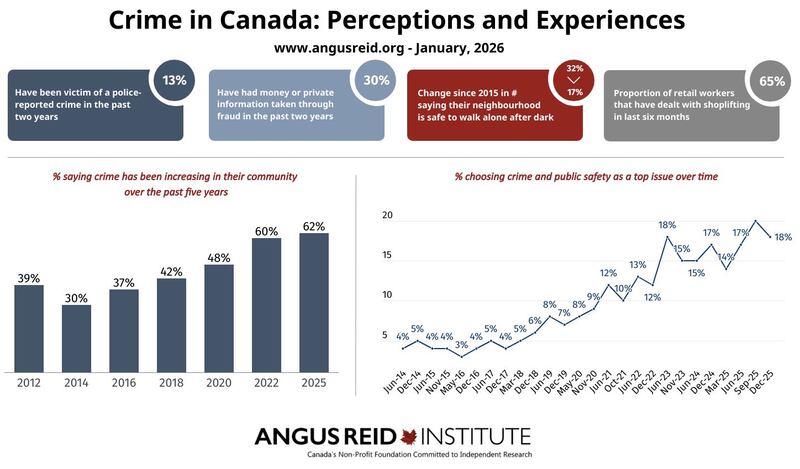
But in Ottawa, both homicides and shootings were down in 2025 by more than 20 per cent year over year. Last year also marked the fewest homicides in Calgary in the last decade, and the latest data in Vancouver says assaults and robberies were down year over year. Toronto also recorded its lowest homicide total (42) since 1986.
“Public perception, a lot of times, comes from the media (and) social media,” said Toronto Metropolitan University criminology professor Kim Varma. “Most people aren’t cheeking out Statistics Canada to find out what’s actually happening.”
Videos shared on newscasts and social media can also leave a lasting impression, according to Lewis.
“Exceedingly alarming videos of people breaking into jewelry stores with sledgehammers and liquor-store grabs do fuel fear in people, when the reality is it’s not as bad as they think,” said Lewis.

Those public feelings, according to one criminologist who spoke with CTV News, may have been formed over time, regardless of what factual year-end data actual reveals.
For example: In 2022, auto thefts across Canada were at record highs, and home invasions linked to stolen cars led one of Toronto’s top police officers to suggest publicly that residents should leave their car keys at the front door to avoid a violent confrontation with intruders.
“A lot of people picked up on that particular piece of information that was really concerning, which is (the police) can’t do anything for you, so you might as well not get hurt,” Varma said. “That erodes trust and a feeling of safety.”
Some public anxiety around messaging was “based off very high-profile coverage of some very dynamic videos,” shared far and wide on social media and elsewhere, says Lewis.
Another concern that has been raised publicly by politicians of nearly every leaning: repeat violent offenders in Canadian communities. Last year, the federal government introduced legislation to tighten bail reforms, but that bill is still making its way through Parliament.
METHODOLOGY:
The Angus Reid Institute conducted an online survey from Nov. 5-7, 2025, among a randomized sample of 2,038 Canadian adults who are members of Angus Reid Forum. The sample was weighted to be representative of adults nationwide according to region, gender, age, household income, and education, based on the Canadian census. For comparison purposes only, a probability sample of this size would carry a margin of error of +/- 2 percentage points, 19 times out of 20.

