With less than nine months to go before the provincial election in Quebec, Premier François Legault’s sudden resignation on Wednesday has raised questions about the path forward for the party he co-founded in 2011 and how it could shape Quebec’s political landscape.
Political pundits all agree that Legault’s Coalition Avenir Québec (CAQ) party, which has been plummeting in the polls, needs to find a new leader quickly as the October election approaches.
As Daniel Beland, a political science professor and the head of the McGill School for the Study of Canada, points out, making way for a new leader can really shake things up.
Last year, federal Conservative Party Leader Pierre Poilievre was dominating the polls until then-prime minister Justin Trudeau stepped down, opening a path to a surprise victory for newcomer Mark Carney.
“The campaign has already begun in a way … it’s election year in Quebec,” said Beland in an interview with CTV News Channel. “There are a lot of things going on, and we know looking back at what happened last year on the federal scene, especially during the first few [months] of 2025, a lot of things can happen in politics in just a few months.”
For more than a year, the Parti Québécois (PQ) has surged in the polls, all while promising a new referendum on Quebec’s independence from Canada.
All the same, Beland pointed out that leader Paul St-Pierre Plamondon should not take anything for granted.
- Political leaders react to François Legault’s resignation
- A timeline of Quebec Premier François Legault’s political career as he resigns
With the CAQ and the Quebec Liberal Party (PLQ) now searching for new party leaders, those races could shape the course of the eventual election campaign.
“At least the Liberals, and maybe even the CAQ, can rejuvenate themselves and certainly improve their standing ahead of the next provincial election. They still have time, but it’s better to hurry up,” Beland said.
Despite the PQ’s lead in the polls, analysts say sovereignty remains relatively unpopular, and some polls suggest there is little appetite for a referendum.
There is, however, some polling that shows young people are interested in separatism.
Salim Idrissi, a senior political adviser for past Liberal governments who now works as a political analyst and consultant, said the push for a so-called referendum election in October by the PQ, in addition to the economic uncertainty linked to frosty Canada-U.S. relations, makes for a “volatile” electoral campaign.
“The CAQ has largely been a one-man show for years and François Legault kind of managed to strike a delicate balance between federalists and sovereigntists voters,” Idrissi told CTV News. “Maintaining that balance will be extremely challenging in a leadership race where we could see those two camps openly competing against each other.”
Who could replace Legault?
Legault said he was stepping down “for the good of his party and the good of Quebec,” acknowledging that Quebecers want a new premier.
It’s not yet clear who might be up for the task, but some names are floating around, including Christine Frechette, Quebec’s Minister of Economy, Innovation and Energy.
Idrissi said other possible contenders include Justice Minister Simon Jolin-Barrette and Municipal Affairs Minister and former deputy premier Geneviève Guilbault.
He suggested another name: Finance Minister Éric Girard, “given the current economic context.”
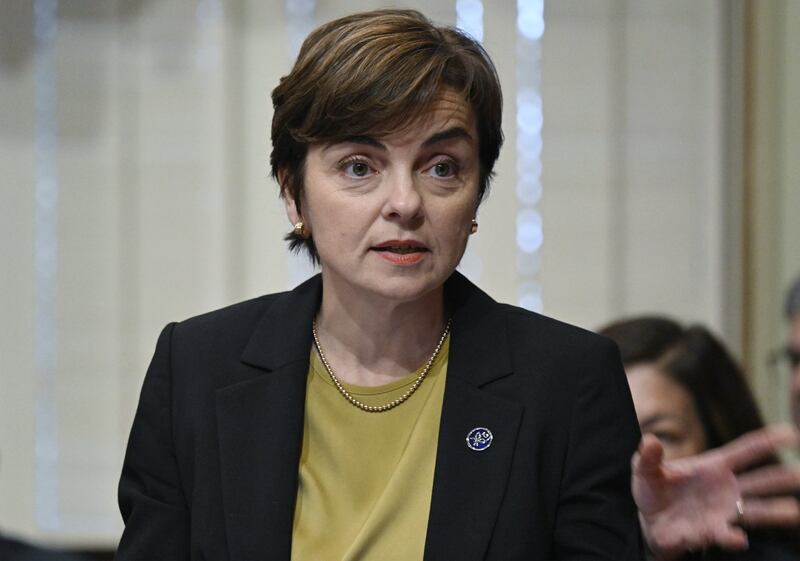
Political analyst Justine McIntyre said she also believes Frechette could put her name forward, as well as Education Minister Sonia LeBel.
“Maybe it’s time for the party to choose a female leader,” McIntyre said.
David Heurtel, a political analyst and former Quebec Liberal cabinet minister, said Guilbault’s chances might be hurt by the SAAQclic scandal.
When asked if he would run for the CAQ leadership, former Public Security Minister François Bonnardel told CTV News it’s too early to say.
“We will assess the situation when the rules for the leadership race are announced in the coming days. I imagine that in the next few days, we will be able to talk and then assess the situation afterwards,” Bonnardel said.
Whoever puts their name forward will face the challenge of resurrecting the party ahead of October.
“Does it have the type of organization with grassroots to mount an incredible leadership campaign in a very short amount of time? This party was founded in François Legault’s living room. The people that are there are close, personal friends, advisers to François Legault,” Heurtel said. “It’s going to be very difficult to get people excited about this party again.”
Political analyst Victor Henriquez added the CAQ should also be searching outside the party for Legault’s successor and look for their “Carney moment.”
“I think that an option from outside the party is maybe going to be more helpful for the CAQ to make people forget that they have been there since 2018,” he said.
In his resignation speech on Wednesday, Legault stated that he would remain in his role as premier and leader of the CAQ until his replacement is chosen.

