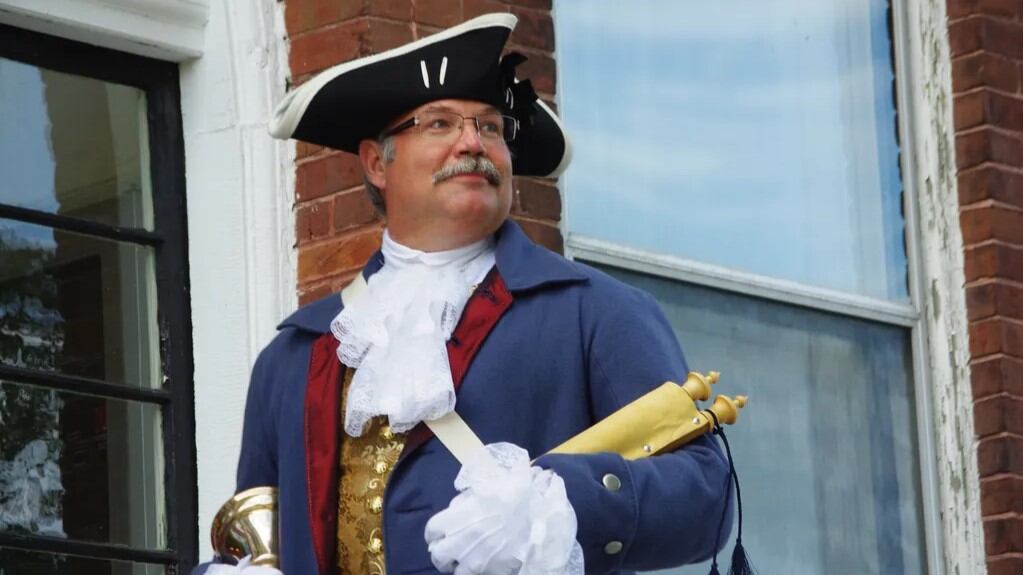
In 2006, Canada Day celebrations were fast approaching in the Sackville area of Nova Scotia and the committee organizing the event noticed they were missing one thing: a town crier.
The community had been without a crier for a few years, so the committee hosted a competition to see if someone would take up the bell. Greg Fenwick decided to throw his hat (and voice) in the ring.
“Someone had given them (the committee) my name and said I had a loud voice,” he said. “I thought it might be interesting. I went to the competition and there was only me and a 10-year-old who competed for the position.
“I had ordered a bell online when I knew I was going to be doing this. The clapper became unattached and flew across the room. I stayed calm and picked it up.”
Despite the bell mishap, Fenwick secured the role of town crier, a position he has held for 20 years. He’s part of a small but dedicated group in Nova Scotia that is keeping this old-fashioned way of communication alive.
The Nova Scotia Guild of Town Criers website notes the practice in the province stretches back to the time well before the arrival of French and English settlers on the continent. Eyapaha were types of town criers who would spread the word of elders for the Mi’kmaq First Nations people.
The guild notes that town criers were recorded to have worked in Halifax as far back as the 1830s, but by the mid-20th century, the practice was in need of a resurgence in Nova Scotia. Fenwick credits Peter Cox with leading that revitalization.
“He came from England,” Fenwick said. “He convinced the mayor and council that this would be a distinguished role that could add prominence to functions and help Halifax become more known.”
David Olie met Cox at a public speaking competition in Halifax, which set him down the path to eventually becoming a town crier.
“I got thinking it would be a fun thing to do when I got older,” he said. “I moved to Yarmouth in 1995. That first year I was here, myself and a group of people tried to organize a winter carnival. I said we had to have the town crier come in and do a proclamation. I was told we didn’t have a town crier anymore.
“I thought, well, this is my opportunity. I wrote a letter to town council, they had me do an audition. I officially debuted in 1996 and I’ve been doing it ever since.”
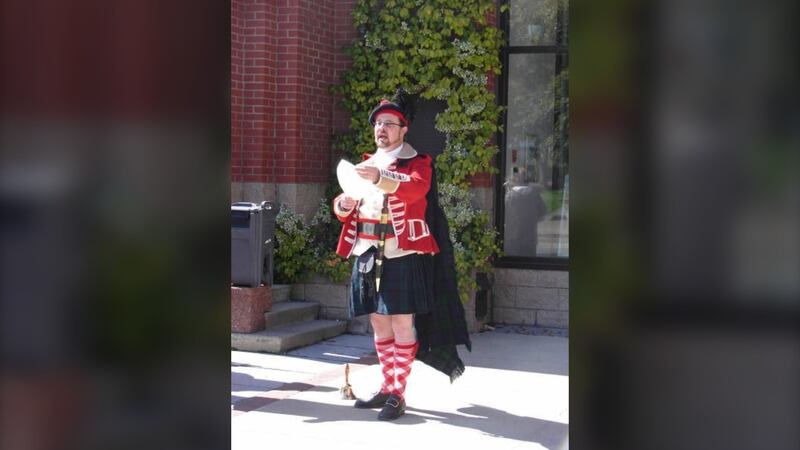
Fenwick and Olie, outfitted with their period-appropriate costumes, have loudly proclaimed at events like parades, birthdays and karate championships across Nova Scotia.
“It’s part of our heritage,” Olie said. “It’s a little touch of class. It’s something I know visitors appreciate very much.”
To be a town crier, Fenwick and Olie both said a strong voice is required, but other factors can also determine someone’s longevity in the role.
“Some criers are more gifted in that area than others,” Fenwick said. “It’s the enthusiasm to represent the community. To be a good crier, you need to be able to sustain the volume. I cry from my diaphragm, which puts less strain on my throat.”
“You have to be an eccentric,” Olie said. “There are not too many people who’d take this kind of thing on. That’s why it’s so hard to find a replacement when we lose a crier.”
In the last 20 years, Fenwick said he’s seen the Nova Scotia town crier community shrink as some towns are unable to replace their crier when one retires.
“There is concern that if we don’t maintain our role within the different communities, it could be (a lost art),” he said. “Hopefully it will continue.
“After COVID, I found there weren’t as many people looking for my services, but it seems to be growing again.”
Olie said he’s helping Digby find a new town crier.
“I’m happy to help them get started,” he said. “You’ve got to have that one particular or peculiar person willing to take it on.”
Fenwick, 73, said he plans to continue crying for as long as his voice will allow.
“As long as people are interested in having that bit of pomp and ceremony to their events, I could probably do it for at least another 10 years,” he said.
For more Nova Scotia news, visit our dedicated provincial page

