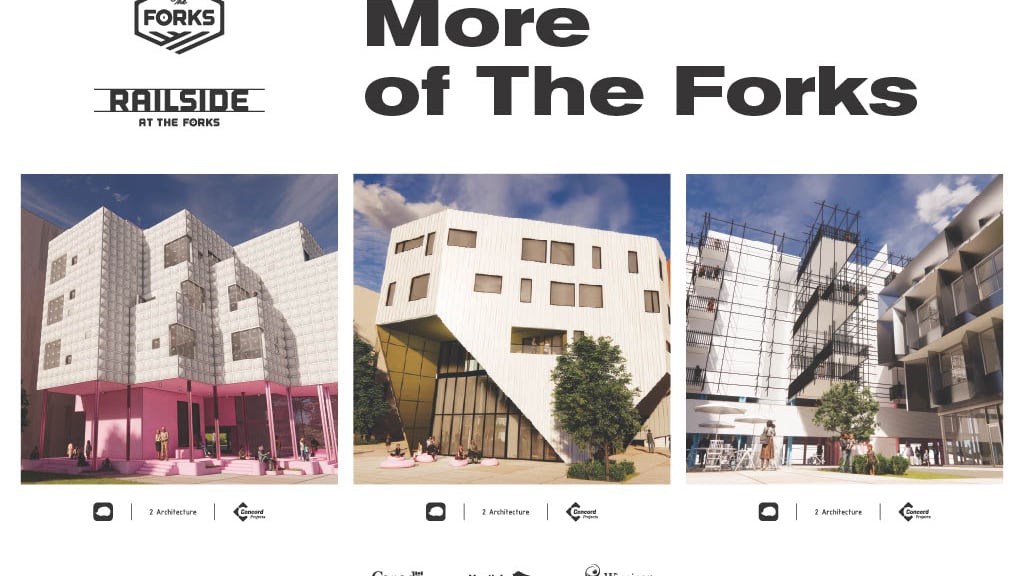
A long-planned development called Railside at The Forks in Winnipeg has officially started construction.
The plan is to develop a surface parking lot close to the city’s downtown into a mixed-use neighbourhood.
“Public spaces are not a nice-to-have,” said Sara Stasiuk, president and CEO of The Forks, at a news conference Thursday. “They are essential infrastructure, economically, socially, and culturally. Railside is grounded in that belief.”
The first phase of development will cover 3.5 acres and include 350 residential units across nine apartment buildings and one condominium building, with construction expected to continue through 2027.
The full development is expected to be complete by 2040 and will offer up to 1,200 housing units. It will also have a daycare centre, coffee shops, courtyards, and pedestrian-friendly alleyways.
“At the end of the day, this project isn’t just about buildings; it’s about building community, creating spaces where people feel they belong and designing public areas that bring us all together — like The Forks has done for so many years,” said Bernadette Smith, Manitoba’s housing minister.
Could this model work in other cities?
Daniel Foch is the chief real estate officer for Valery Real Estate, Canada’s first AI-powered real estate brokerage and technology program.
He believes the development at The Forks could serve as a model for other cities across the country, who are in desperate need of housing.
“The vast majority of Canadians live in urban areas and that’s a trend that is increasing,” he said. “We are urbanizing more and that’s happening around the world. We know people want to live in urban areas … It would only make sense to continue providing housing that makes it possible for them to do that in an affordable way.”
Foch said the model represents a shift away from car-dependent development that Canada and much of North America was built on, toward a walkable urban future that many Canadians say they want to see.
He said repurposing underutilized spaces, such as surface parking lots, makes sense, but cities face significant challenges.
“The infrastructure is lagging in most cases to step away from using cars,” Foch said. “Canada is very bureaucratic and we’re not exceptionally good in bringing mass infrastructure projects into existence.”
As an example, Foch pointed to the proposed high-speed rail line between Toronto and Montreal, which is not expected to be completed until the early to mid-2030s.
He said it’s also the same for many vacant or under-utilized spaces throughout Canadian cities.
“If you want to get rid of a large parking lot, you are eliminating the infrastructure that a bunch of citizens have paid for to get downtown and you have to replace it with something,” Foch said. “Otherwise, you have too many cars and not enough places for those cars to park. You either need a better bus system, subway, rail, etc …
“The pace that I think Canada’s infrastructure is progressing, they are more likely to get replaced by a network of automated taxis before we can ever build mass transit like a subway. But that’s the piece that’s missing, (a) high-quality infrastructure that makes things like this possible.”
Canadian housing starts rose in 2025: CMHC
Canadian housing starts rose 5.6 per cent in 2025 to 259,028 units, up from 245,367 the previous year, according to Canada Mortgage and Housing Corporation.
Prime Minister Mark Carney has pledged to improve housing affordability, reduce homelessness and increase home construction.
In September, Carney launched Build Canada Homes, a federal agency aimed at tackling the housing crisis.
One of its initiatives is to build 4,000 affordable, mixed-income housing units in six cities, including Winnipeg.
-with files from CTV’s Charles Lefebvre

