Montreal firefighters battled both flames and a bitter cold Wednesday that froze their hoses, as they tried to extinguish a fire in an abandoned building nestled up against the Jacques-Cartier bridge.
By mid-afternoon, some of the building was being torn down, and yet another fixture of the cityscape was being erased.
Heritage Montreal’s Dinu Bumbaru has been fighting to keep these monuments from the past standing for more than four decades, and says cities across Canada have to act on proposed solutions and policies that have been on the table for years.
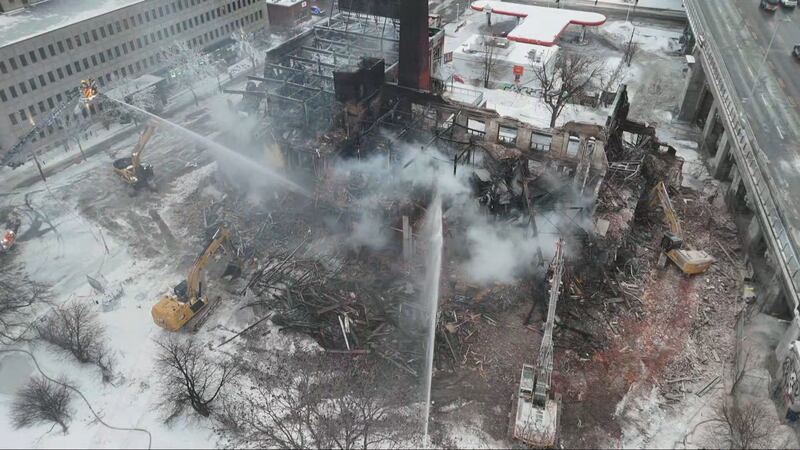
The burnt-out building had been vacant since 2019 and is slated for redevelopment.
“Could there have been temporary uses for the building that would have kept it alive and under some kind of surveillance and functionality?” asked Bumbaru. “If it had been used for temporary housing, it would serve society and provide a space for those who need it to live.”
Bumbaru says several cities in Europe and the United States have adopted that approach. Those occupying the building serve as guards, protecting the heritage sites with their mere presence, while also using the space for offices or housing.
Montreal has a Heritage Action plan on the books, but Bumbaru says little has been done to move on initiatives like temporary use.
In Montreal alone, there are dozens of vacant buildings, which Bumbaru says are targets and easy prey for vandalism. Twelve churches now sit empty.
Fire services in Montreal and many other cities in Canada have warned abandoned buildings pose a fire hazard. In several cases, investigators have pointed to squatters as the cause. Often, they build fires to keep warm, but the flames spread.
The issue has seemed to gain ground as homelessness has reached crisis levels, spreading through many cities.
The arson squad is investigating the fire in Montreal, but police say the cause is unknown for now.
The building had a storied past. Once a soap factory, its owner had defended it from demolition by refusing to sell it, to make way for the Jacques-Cartier bridge in the 1920’s. The bridge was built with a curve to accommodate the factory.
Now more than a century later, its brick chimney will no longer stand next to the bridge.

