Patrick Graham was there the night America started to lose its mind.
The opening scene of Beyond Fallujah, Graham’s spellbinding solo show about covering the war on Iraq in 2003 is a videotape of the opening moments of “shock and awe” over Baghdad, the night the U.S. rained 500 cruise missiles down on the Iraqi capital city.
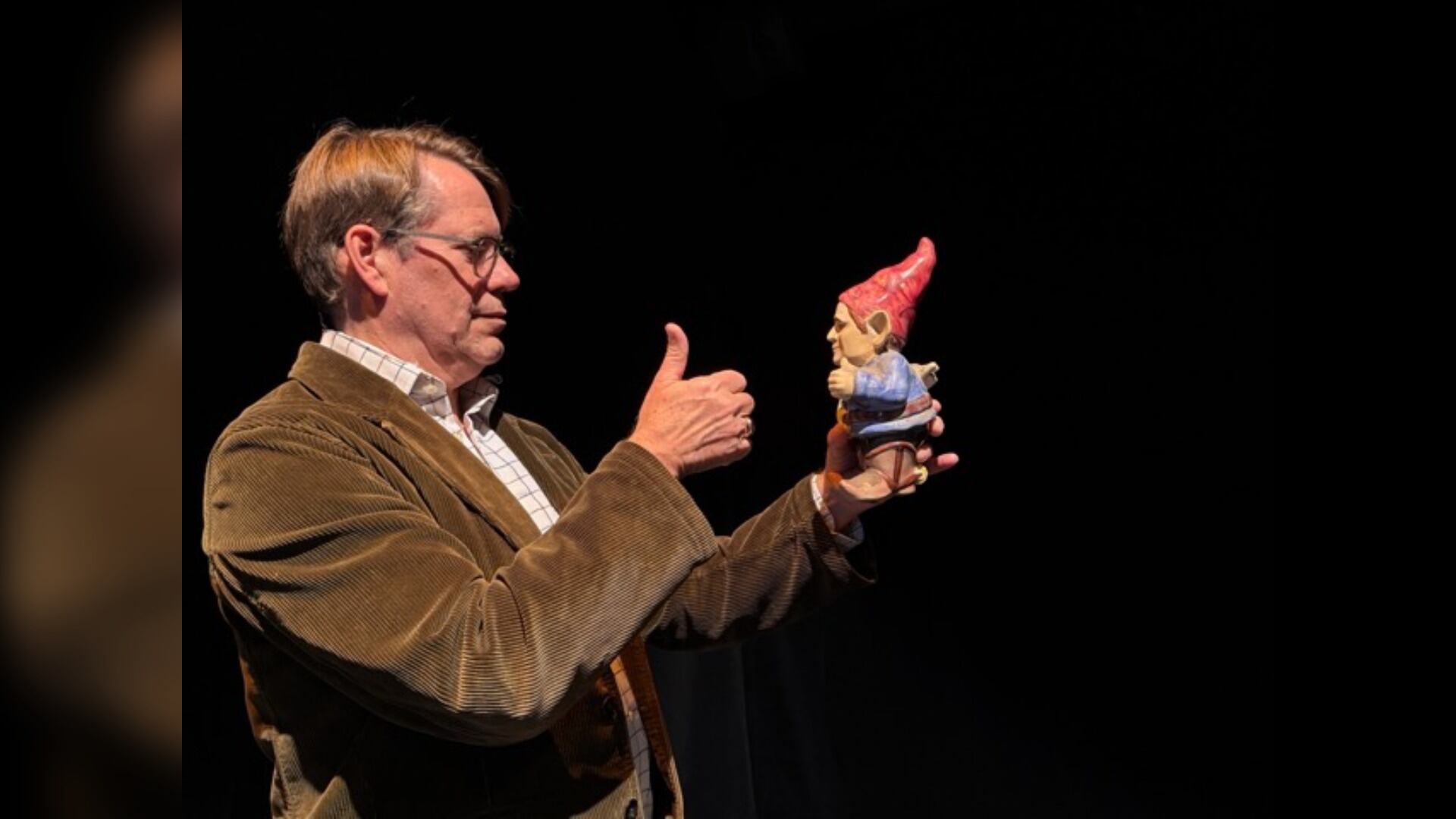
Graham, who was reporting for a variety of media outlets at the time including the National Post, walks onstage like an avuncular sort of professor and as the lights come up, points to a spot in the video that’s engulfed in flames and smoke.
“I was five minutes away from here,” he said. “On Shock and Awe.”
Beyond Fallujah, which is having its world premiere at the 2026 High Performance Rodeo, is a 75-minute long monologue that explores the long, strange trip Graham experienced as a foreign correspondent around the turn of the 21st century which, as luck would (or wouldn’t) have it, corresponded with a series of unfortunate wars launched by the U.S. in response to 9/11.
That’s highlighted by the American decision to go to war with a country that had nothing to do with 9/11 but had a really sketchy guy running it that nobody liked.
Beyond Fallujah is also a personal story that has Graham doubling back to a region where his father and uncle, who was also a Patrick, visited in 1960, when they were young adventurous men who ended up getting arrested in Iraq around the same time a coup was attempted by a rag-tag band of Iraqi teens, including a young teenager named Saddam Hussein.
Graham catches the details and absurdities of his life telling stories about foreign affairs in countries, he explains, where he doesn’t speak the language and spends most of his time trying to figure out what’s going on -- only to get paid by publications for his foreign affairs expertise.
He has the self-awareness and sense of irony to appreciate that there’s a bit of distance between who he is and our over-romanticized version of a grizzled foreign correspondent -- and that’s what makes his stories crackle, albeit in a low-key way.
He also humanizes and animates the Iraqis as he works to get behind the scenes in Fallujah later in the war, when that city becomes the source of resistance against the U.S.
It’s illustrated by the fate of a big assignment he lands from the New York Times Magazine about Fallujah, which he turns in only to learn they won’t publish it (but pay him anyway). He re-sells it to Outside Magazine, only to have the same thing happen before Harpers buys it, publishes it and it goes on to win a big national magazine award.
While Graham’s stories are stunners, he’s a little underwhelming as a performer. He’s stuck somewhere between on script and off, which creates an uneven delivery -- most of which he presents sitting at a desk, a la Spalding Gray (Swimming to Cambodia).
The hope is there late in show, when Graham’s talking about trying to get out of it and he’s in a car as a U.S. tank is firing across a river and he starts banging on the wooden desk to amplify the sound of what it’s like when a tank is firing at you.
War stories need a backbeat.
I loved the storytelling of Beyond Fallujah, but craved the soundscape of Baghdad and Iraq under Shock and Awe that wasn’t there until the very end of the show (even the Shock and Awe montage was delivered in silence).
Last week, I was at a show called Performs Tom Waits by L’Orchestre L’Homme-orchestres at the Bella Concert Hall. They turned everything onstage into a drum and Friday night I thought, if Patrick Graham got together with those Tom Waits guys from Quebec to tell the story of Shock and Awe in Bahgdad in 2003, when he lost his mind as the U.S. was losing theirs -- now that’s a hell of a show!
There’s a second story underneath the first that gets a little shortchanged as well. That’s the story of Graham, his dad and his uncle Patrick.
Their past adventures keep popping up in Patrick’s Baghdad present in amazing ways, but there’s a tragedy in there too that doesn’t ever get explored involving his uncle -- and there’s a traumatizing stint in boarding school and the weight of family expectations.
It turns out Graham isn’t any old Hunter S. Thompson-style foreign correspondent hitching a ride in a Mercedes to cross the desert in Iraq.
His father is Bill Graham, who was a lawyer, academic and served as Canada’s Minister of Foreign Affairs in Jean Chretien’s cabinet, leading to one surreal moment in Beyond Fallujah when Graham calls his dad in Washington to tell him he survived a bombing, only to have Graham Sr. go, “I have to go. I’m on my way to the White House.”
Beyond Fallujah is as much an examination of masculinity and how it shapes and shifts young men’s direction -- a theme that keeps popping up its head throughout the show but still feels a little bit theatrically undercooked.
That said, arriving when it does, at a moment when the world is looking at the United States and wondering what its turned into, Beyond Fallujah is a well-written, gripping glimpse of what’s going on now as it a ripping good yarn about what was going on in 2003.
Beyond Fallujah has one more performance, Saturday at 7:30 p.m. at the Engineered Air Theatre in Werklund Centre.

