The website “lcn.today” advertises itself as a trusted source for local and breaking news from across Canada, including Montreal.
Recently, CTV News received a link to a story LCN (Local Canadian News) published on May 12, 2025, that bore a remarkable similarity to one CTV News published on the same day about a two-year-old girl in need of a kidney donor.
The LCN version used the same photo of the girl that appeared with the CTV News article, but the headline, names and places mentioned in the article were changed.
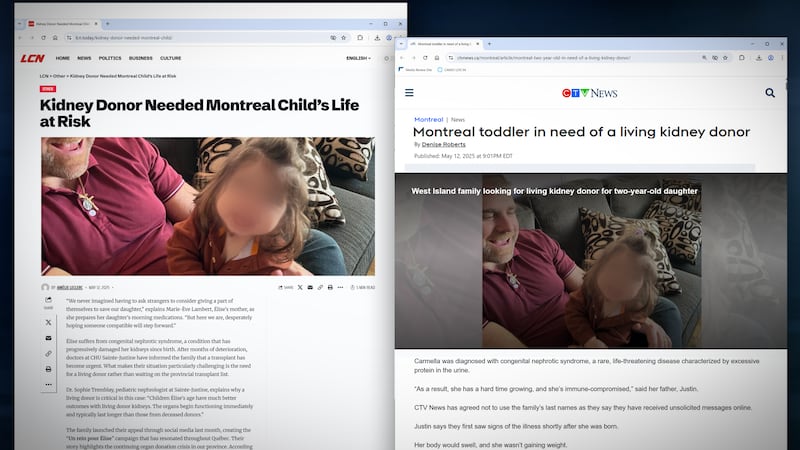
CTV News made attempts to contact LCN about the story, but was unable to reach anyone.
Emails to the editor bounced back, and the journalist whose byline appeared on the story, did not seem to exist.

McGill University computer science professor Derek Ruths said the site bears the hallmarks of artificial intelligence (AI), starting with an unusual domain address lcn.today.
After using standard internet tools to look up the IP address, Ruths found the site was coming from an address registered in Germany, not Canada.
“There’s a number of reasons why someone or some organization would set up these sites,” he said. “There are economic incentives, in terms of trying to make money off of ads and clickbait content.”
- ‘Predicts if somebody is going to die:’ How AI is revolutionizing health care in Canada
- ‘No safety rules’: Concerns grow as AI-generated videos spread hate online
The sites are not only profitable, but Ruths said they are easy to generate thanks to AI tools such as Chat GPT. With a few prompts, an article from a legitimate news site can be slightly altered and posted online. He said in some cases, little to no human effort is required to keep AI news sites running.
The volume of these news sites is multiplying fast all around the world, according to Dimitris Dimitriadis, director of research and development at NewsGuard, which rates news sites for reliability.
“We’ve been tracking those kinds of sites for the past three years, and we’ve identified up to and over 2,600 of those sites,” he said.
He said there are some red flags to look out for when scrolling for news online: if the site does not disclose who owns the site or who is behind it, the photos or names of the journalists seem to be made up or AI generated, the site appears to be low quality and has lots of ads and popups.
“You see these sites that are rife with advertisements, and you have to wonder, who is actually sending and who is channeling, who is funneling all those ads into those sites?” Dimitriadis adds.
Cutting off ad revenue from these sites is one way to fight back, according to Eric-Pierre Champagne, president of Quebec’s Federation of Professional Journalists.
“The money they take is not going into the real media, it’s not supporting press rooms and journalists doing real work,” he said.
The FPJQ has publicly called out several AI-generated news sites in Quebec and is asking all levels of government to verify sites are real, before they advertise.
Champagne said users can also fight back; by not clicking on these sites and doing a simple Google search of the journalist or news outlet to make sure they are a trusted and accountable source.

