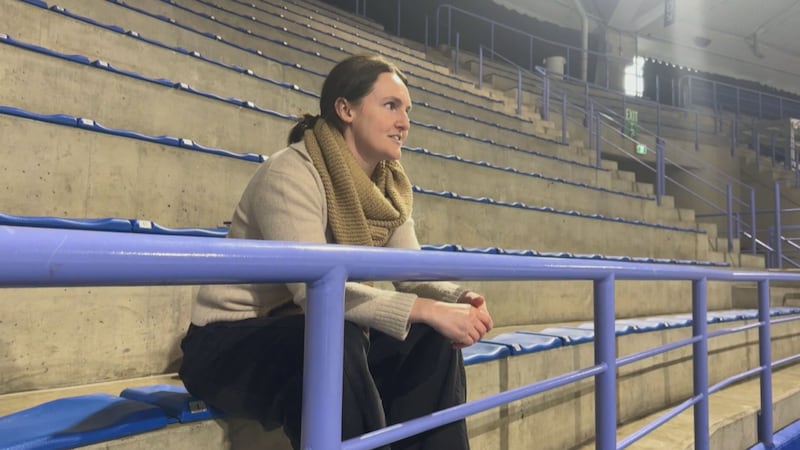
As skaters carved tight laps around the ice at Calgary’s Olympic Oval, Heather Carruthers watched from the stands, coaching members of the University of Calgary speed skating team in a building steeped in Olympic history.
With some events already underway ahead of Friday’s opening ceremonies in Milan, Carruthers said the thought that Calgary could have been hosting the games still sparks a visceral reaction.
“I immediately get butterflies in my stomach,” said Carruthers, a former Olympic speed skater who competed at the 2018 and 2022 games.
“The thought of having home Olympics in Canada and competing, I think, is the dream of any athlete.”
Carruthers said the impact of a home Olympics would have extended well beyond elite competitors.
“I think it’s life-changing,” she said.
Calgary voters rejected a bid to host the 2026 Winter Olympics in a 2018 plebiscite, halting what supporters saw as a chance to renew aging facilities and attract outside investment.
Deborah Yedlin, Calgary Chamber of Commerce president and CEO, said the decision still rankles, particularly as the city continues to grapple with the cost of maintaining Olympic-era venues.
“We had an opportunity to host the world again,” she said.
“We needed to upgrade the facilities.”
Yedlin said the opposition campaign successfully framed the bid as a financial risk.
“They hijacked the narrative,” she said.
Those opposed to hosting the games said the financial exposure and the International Olympic Committee (IOC) as a partner were unacceptable risks.
Erin Waite, a spokesperson for the No 2026 Olympics Bid Committee, said her concerns have not changed.
“It’s the ethics of the IOC and some of the issues there, and particularly the issues with the host city contract itself,” she said.
“That is terribly unfair to the city and favourable to the IOC … puts all the risk in the city’s hands.”
Waite said she would only reconsider her opposition if the IOC fundamentally changed.
“Unless it wildly reformed as an organization and became something quite different, probably athlete-led, then I could get excited.”

At the time of the vote, Jeromy Farkas was a Calgary city councillor and a vocal opponent of the bid.
Now Calgary’s mayor, Farkas said he believes voters made the right decision given the information available at the time.
“I think Calgarians made the right choice to choose not to opt for the Olympics this time around; there are significant challenges with the business case of that 2026 bid, significant details were lacking in terms of the finances, security costs,” he said.
Farkas said the city is “breathing a sigh of relief that we’re not hosting the Olympics this time around,” but added he would not rule out a future bid if the financial case is stronger.
“It’s not out of the question for us to consider a future bid at some point,” he said.
Stephen Carter, who campaigned in support of Calgary’s 2026 Olympic bid, said the city missed a chance to upgrade existing venues rather than rebuild them entirely.
“$27 million worth of changes that need to be done to the Olympic Oval that haven’t been done in eight years because we didn’t get the Olympics,” Carter said.
Carter said hosting the games could also have accelerated major infrastructure projects across the city.
“The arena would have already been done. We had to have a referendum on the games, which was going to cost us less than $500 million, and we built the BMO Centre for $500 million,” he said.
“We have no cost perspective. The cost of the arena alone is more than three times what it would have cost for us to host the Olympic Games, and we would have gotten the arena one-third subsidized by the province and one-third subsidized by the federal government.
“We chose to be small.”

David Legg, a professor of recreation and sport management at Mount Royal University who said he worked on the 2026 bid, said an Olympic Games could also have unlocked funding for large-scale transportation projects.
“A rail line from the airport to downtown, a rail network between Calgary and Edmonton, a rail system from Calgary to Lake Louise—all those could have been part of an Olympic/Paralympic bid,” he said.
“I think a lot of our spirit in Calgary was born of hosting the ’88 games—that sense of volunteering, that sense of camaraderie, that sense of connectivity and collectivity and coming together to do something that was maybe beyond our dreams.
“But yet we were able to do it, and arguably probably do it better than most other cities did, and I think Calgary could really benefit from that spark again.”
Back at the Oval, Carruthers said a home Olympics would have been powerful enough to change the trajectory of athletes’ careers—including her own.
“One hundred per cent, I think if Calgary had been granted the 2026 Olympics, I would have extended my career, or tried to at least extend my career for another four years,” she said.

