Amid ongoing debate about provincial sovereignty, most Albertans would vote to stay in Canada, according to a new survey from the Angus Reid Institute.
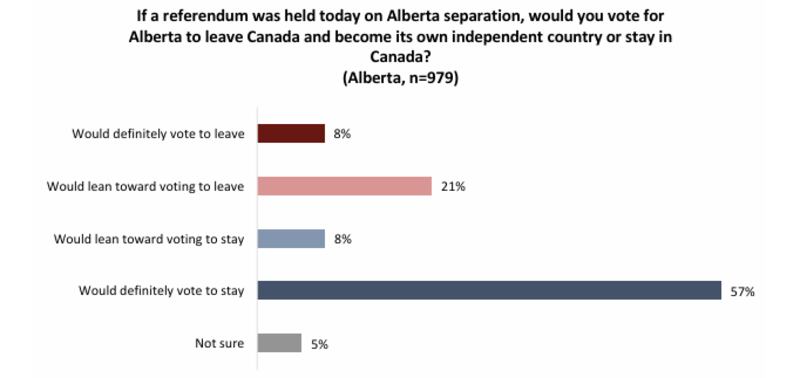
Fewer than three in 10 Albertans, 29 per cent, said they would vote for separation if a referendum were held today. Most of those respondents said they are leaning toward that position rather than firmly committed.
By contrast, about two-thirds, 65 per cent, said they would vote to remain in Canada, with most of them saying their decision is definite.
The findings come from the first of a three-part Angus Reid series examining separatist sentiment in Alberta and Quebec and what is driving opinions about Canada’s future.
While most Albertans oppose separation, the survey suggests many are still conflicted. Four in five respondents said their minds are mostly made up.
Arguments divide Albertans
Albertans who firmly oppose separation said the most convincing reasons to stay in Canada are a sense of Canadian identity and concerns about practicality.
More than nine in 10 cited those factors, including worries that an independent, landlocked Alberta could struggle to export its resources.
Those leaning toward staying agreed with those arguments, but at lower levels. Many in that group also said they find some separatist arguments convincing, including the idea that Alberta contributes more to Confederation than it receives and would benefit from full control over its resources.
Albertans who would vote to leave Canada said they were largely unconvinced by arguments to stay. Instead, they strongly supported claims that Alberta should break free from federal policies they see as harmful and gain complete control over provincial resources.
Mixed views on political leaders
The survey also asked Albertans how political leaders have handled the separatism debate.
Alberta Premier Danielle Smith’s approach had a net approval of -17, while Prime Minister Mark Carney had a +7.
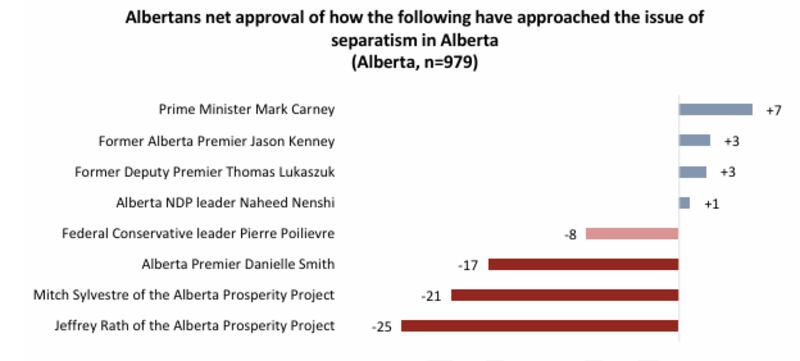
Smith has faced criticism after her government lowered the threshold for citizen-led referendums and extended the time allowed to gather signatures, changes that critics say make a separation vote easier to trigger.
Support for separation is higher among United Conservative Party voters. Sixteen per cent said they would definitely vote to leave Canada, while another 41 per cent said they lean that way.
Different sources of information
The poll found differences in where Albertans get their information about separatism.
Those who would vote to stay in Canada said they mostly rely on mainstream media and social media. Those leaning toward leaving said they are more likely to rely on alternative media and conversations with friends and family.
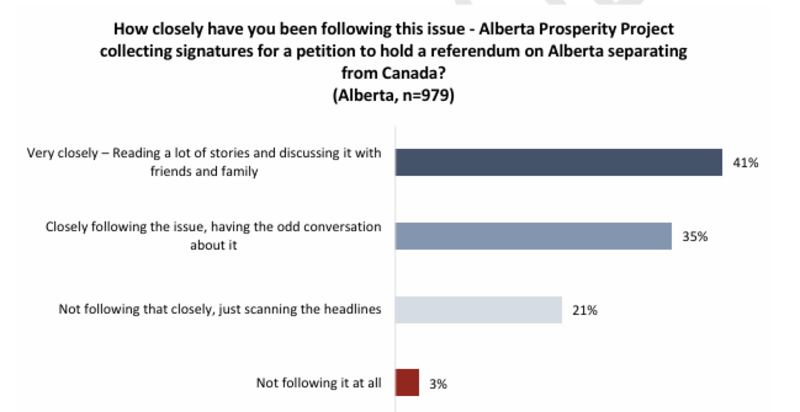
Three-quarters of Albertans said they have been following news about separatism closely in recent months.
Many say they would leave Alberta
The survey suggests a separation vote could lead to significant population movement.
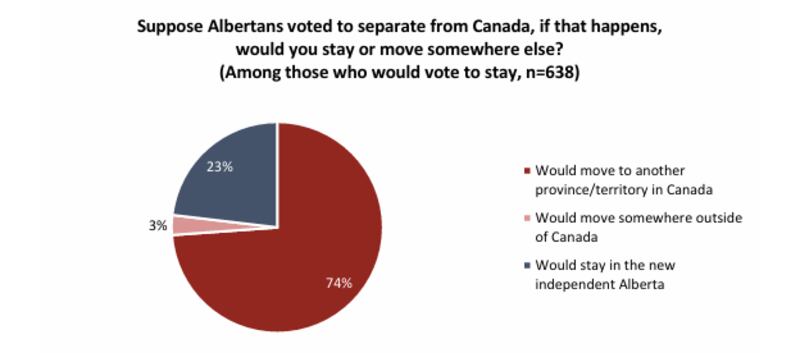
Among Albertans who said they would vote to stay in Canada, nearly three quarters said they would leave the province if Alberta became independent. Just under a quarter said they would remain.
Respondents were also asked about the possibility of Alberta aligning with or joining the United States. Most said they believe the U.S. would definitely or probably try to use political, economic or military means to pressure an independent Alberta to join. However, more were unsure about military pressure.
Most Albertans, especially those opposed to separation, said joining the United States would be a bad outcome for the province.
Methodology
The Angus Reid Institute conducted an online survey from Feb. 2 to 6, 2026, among a randomized sample of 979 Canadian adults who are members of the Angus Reid Forum. For comparison purposes only, a probability sample of this size would carry a margin of error of plus or minus three percentage points, 19 times out of 20.

