Prime Minister Mark Carney will no longer travel to Germany to attend the Munich Security Conference.
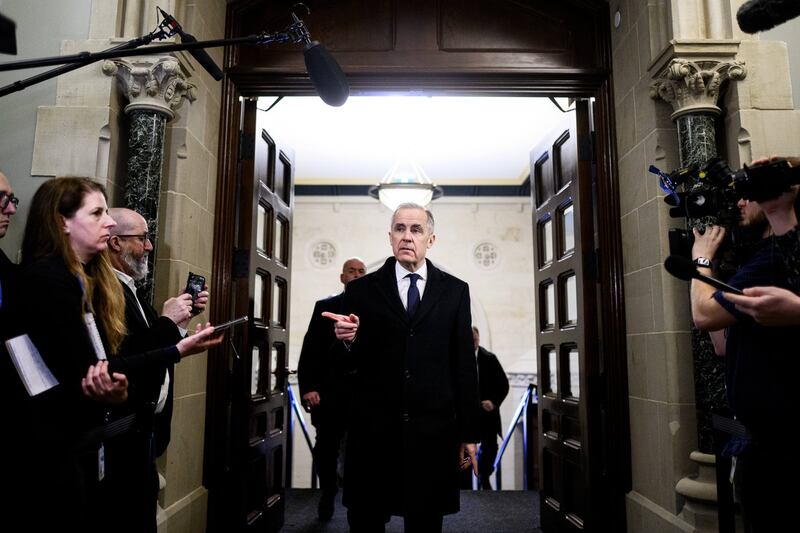
As the country waits to learn more information about the mass shooting in Tumbler Ridge, B.C., the Prime Minister’s Office announced Wednesday that Carney has decided to stay in the country.
Three federal cabinet ministers, who were already planning to accompany Carney on the trip, will still be attending the conference: National Defence Minister David McGuinty, Foreign Affairs Minister Anita Anand, and Artificial Intelligence Minister Evan Solomon.
Carney was also planning to unveil the federal government’s new defence industrial strategy in Halifax on Wednesday afternoon, before heading overseas. That planned announcement remains postponed until further notice.
The impetus of the trip to the annual summit in southern Germany — which officially gets underway on Friday — was for Carney to continue his push to attract investment to Canada, expand defence partnerships, and articulate the role the prime minister sees Canada playing in an evermore complicated and contested global environment.
Now, his focus will be on attending to the domestic situation.
World leader, CEO meetings were expected
The Munich Security Conference is considered the world’s leading forum for discussions about global security and defence policy. Attendees this year include decision-makers and thought leaders from more than 115 countries, including dozens of heads of state and government.
According to senior government officials who briefed reporters on a not-for-attribution basis about Carney’s trip before it was cancelled, Carney was set to meet with several of his European counterparts, including German Chancellor Friedrich Merz, Ukrainian President Volodymyr Zelenskyy, Denmark Prime Minister Mette Frederiksen and Greenland Prime Minister Jens-Frederik Nielsen.
Carney was also set to speak with the CEOs of major companies, as well as business leaders in investment management, critical minerals, energy, defence, advanced technology and manufacturing.
The prime minister was set to also participate in a sit-down conversation with European Commission President Ursula von der Leyen about “the state and future of the international order,” and meet with members of a bipartisan American delegation, which is being led by U.S. Secretary of State Marco Rubio.
Carney’s office has yet to detail how, and whether the prime minister’s planned itinerary will be taken on by the ministers now making their way to Munich.
‘Moment of exceptional urgency’
Taking place in what conference organizers are characterizing as “a moment of exceptional urgency,” organizers of the conference say the three-day gathering will be focused on garnering global support for efforts to promote stability and international cooperation amid myriad security crises and escalating conflicts.
Among the pressing challenges that delegates will discuss are the future of multilateralism, international order, economic security and trade, climate action, hybrid warfare, nuclear security, and the global AI race.
Transatlantic security will also be a leading focus, and debates will be had about the future of regional conflicts such as those in Sudan, Venezuela, Gaza, and Ukraine. For the first time in its history, the conference will feature a designated “Ukraine House” intended to symbolize the continued support for the war-torn country as the four-year anniversary of Russia’s invasion approaches.
Late last year, Carney finalized an agreement making Canada a participant in the European Union’s (EU) Security Action for Europe (SAFE) program, an initiative that promises industries in this country preferential access to the European market for large-scale defence projects as nations on both sides of the Atlantic look to enhance their readiness.
Before his change of plans, Carney was also expected to witness the signing ceremony of this agreement, as well as the signing of a memorandum of understanding regarding defence co-operation between Canada and Denmark, according to officials.
Time to talk ‘wrecking ball politics’
As has been the case at other similar gatherings of world leaders in the last year since U.S. Donald Trump’s return to the White House, the president’s approach to geopolitics will be looming large at this conference.
To underline how omnipresent Trump is likely to be, without either he or his vice-president JD Vance being in the Bavarian city, one has to look no further than the 2026 Munich Security Report, published on Monday and meant to act as the basis for discussion at the conference.
The report details in considerable length how — in the view of those behind the Munich Security Conference — the world “has entered a period of wrecking-ball politics,” and the international order as it’s long been known, is “under destruction.”
Noting widespread disenchantment with democratic institutions among electorates globally, the report’s authors argue that political figures who favour destruction over reform receive admiration far before their promises prove to be serving their people.
“The most prominent of those who promise to free their country from the existing order’s constraints and rebuild a stronger, more prosperous nation is the current U.S. administration,” the report states at the outset.
The report warns that without collective efforts to address the “elephant in the room,” great powers could dominate over international norms, and transactional deals could replace principled cooperation.
This thesis echoes the views Carney expressed in his widely lauded foreign policy speech in Davos last month, though officials said they don’t anticipate the overall ethos of the conference would have much impact on Canada’s position in various meetings.
That said, the report also includes polling data that plainly states half to two thirds of respondents in select European countries and Canada feel that the U.S. has become a less reliable partner in the last six months.
Chair warns about Trump’s threats
The report picks up where this year’s conference chairman Wolfgang Ischinger — a former German ambassador to Washington — left off in an op-ed published in the New York Times last month, writing that Trump’s threats “will boomerang on America.”
In the opinion piece, Ischinger said that while Trump can credibly point to NATO strengthening under his influence — specifically pushing countries to meet, and eventually exceed the defence spending target — an attack on Greenland would effectively end the decades-long military alliance.
Canada just days ago officially opened its first-ever consulate in Nuuk, Greenland. And while the pledge to do so predates Trump setting his sights on the territory, Global Affairs officials have sought to emphasize the strategic significance of this country having an Arctic presence beyond our borders at this precise moment.
The Munich Security Conference chairman also wrote about how, in the eyes of Europeans, threatening to annex territory that belongs to a NATO ally “strikes at the very foundation” of an alliance that helps keep the U.S. safe.
And, Ischinger called on Americans, who will have their “largest ever” conference delegation including several U.S. governors, to “remind their leaders” of the value of strong allies.
The heads of the EU, NATO, ASEAN, the World Bank, the World Trade Organization, and various UN agencies will also be among the leaders from more than 50 international organizations working convention rooms, in which Carney’s cabinet ministers will now be, in the prime minister’s stead.

