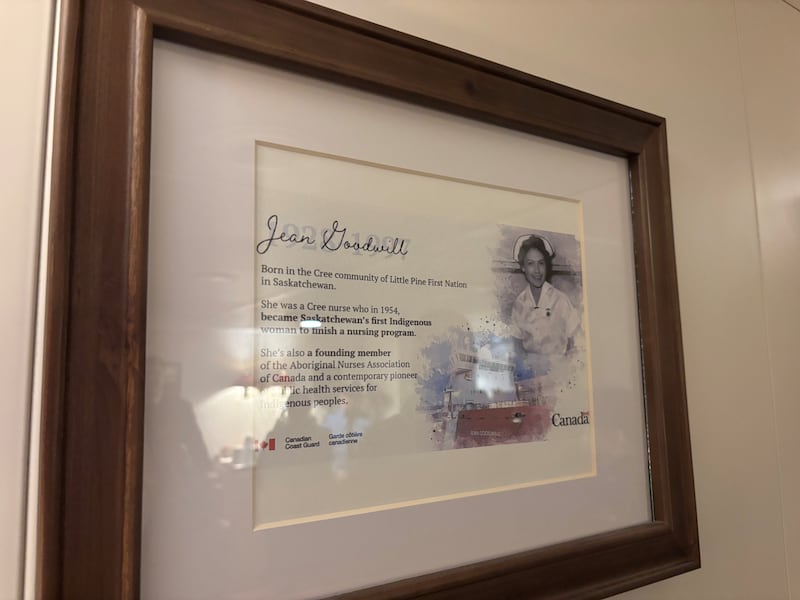
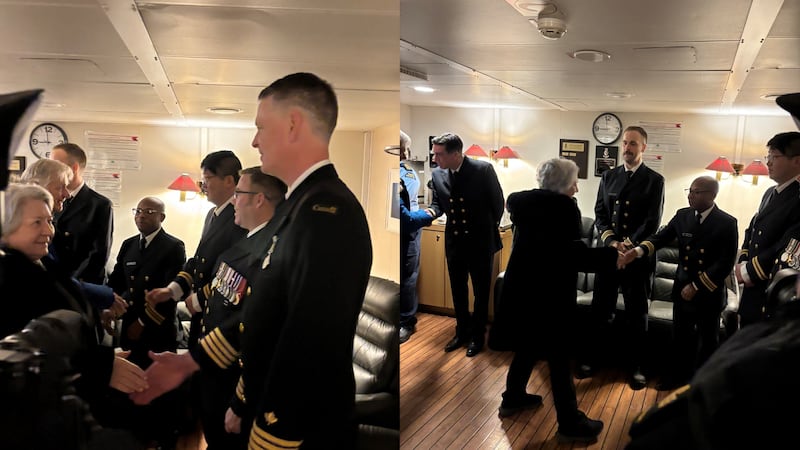
NUUK, Greenland -- A surprising moment during a tour of the icebreaker CCGS Jean Goodwill in Greenland, when the Governor General’s husband, Whit Fraser, thanked the coast guard for saving his life.
“You all plunked us out of the Gulf of Maine in a very violent storm, in a very small boat,” he said, recounting to Commanding Officer Catherine Lacombe and two crew members an incident where he and a friend ran into trouble, choosing not to get into “the long story.”
It was a “sailing boat,” chimed in Gov. Gen. Mary Simon, who also serves as honourary chief commissioner of the Canadian Coast Guard.
“Thank you again,” said Fraser to the three crew members seated with the couple at a small table, sharing coffee.
“That’s what we’re here for,” responded Lacombe.
But what is the Coast Guard really there for in the north?
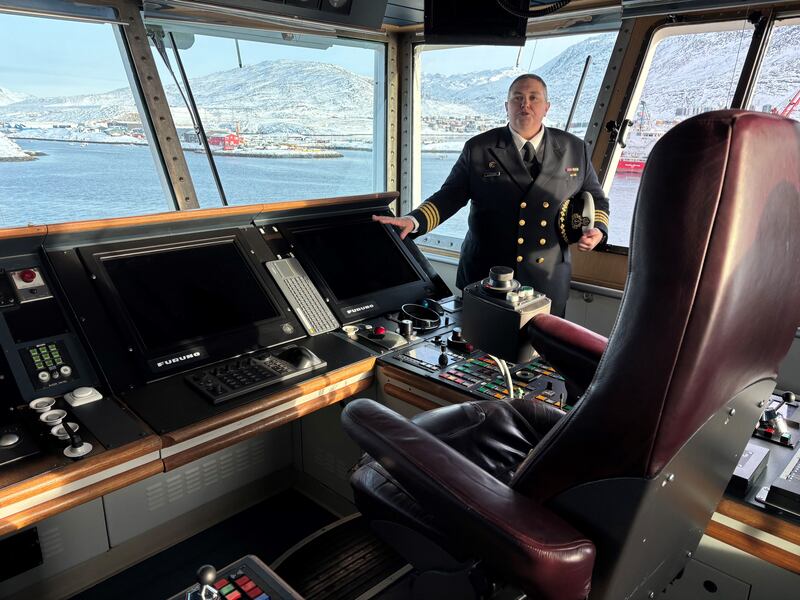
After Jean Goodwill arrived in Nuuk, Greenland on Feb. 4 for a scheduled crew change, CTV News took part in a tour of the icebreaker vessel, to learn more about the coast guard’s presence in the Arctic. The tour took reporters from top to bottom, including the bridge, or command centre, engines (four of them, two per shaft), decks, lifeboat (big enough to squish in up to 40 crew), dining room, lounges and small gym.
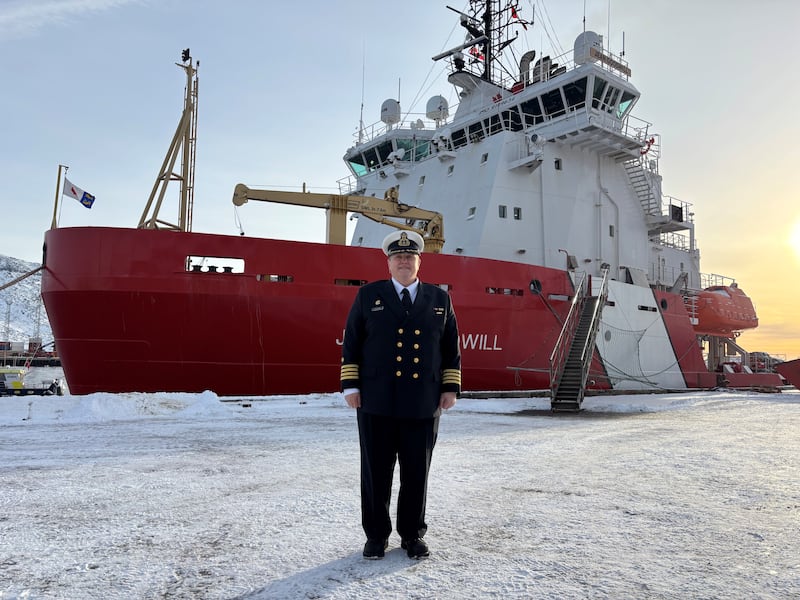
Greenland’s capital is a convenient place for a crew change; the port is large and usually ice-free. Since the opening of the Canadian consulate was just two days later, the 33-member crew stayed to be present for the ceremony. In addition to the Governor General and the media, the foreign affairs ministers for Canada, Denmark and Greenland also toured the ship.
“They are all extremely grateful and honoured that the Canadian Coast Guard and Canada in general is here and standing with them,” Lacombe said of her conversations with Greenlanders, during a time of anxiety and concern for the autonomous Danish territory, after U.S. President Donald Trump escalated threats to take over last month.
“Icebreaking is my passion, and I’m very dedicated to the coast guard, and it is an honour and a privilege to be able to partake into this mission,” she said.
And as it travels through the Davis Strait, icebreaking is the ship’s main job. In the winter, Lacombe explained, that helps open tracks for commercial vessels to move goods and keep Canadian shelves stocked.
The ship also conducts search and rescue patrols, especially in areas with active fishing traffic, as well as supports Fisheries and Oceans Canada programming.
Routine trips like this one are 28 days, though there are enough supplies – food, medicine, fuel – on board to last between two and three months.
The crew generally works in 12-hour shifts, noon to midnight and midnight to noon. In reality, the captain explained, once on the ship you’re always on call, and search and rescue or icebreaking duties often lead to a wake-up call when extra help is needed.
Coast guard helps deliver babies
Like a lot of things on the 92-metre-long vessel, the medical centre is small – but well stocked.
Nurse practitioner Heather Tracey said they have most things you’d find at a pharmacy, or an ambulance or nursing station in the north. Like all Canadian Coast Guard nurses, she is trained for remote northern communities.
She says they can suture, staple, alter heart rates stabilize and dissolve blood clots.
“So we do everything on here to get you stable, until we can get close to either helicopter you off, or put you in a little boat to take you ashore,” she said.
Tracey has even delivered babies in remote areas – and more than once.
“If we go to a SAR [search and rescue] call and somebody’s delivering a baby in the woods, then we would be expected to go and help,” Tracey said.
“I’m lucky enough that all of them have sort of come out on their own.”
When Tracey spoke with CTV News, there had not yet been community calls since landing in Nuuk a few days prior.
In general, she helps both crew members (she was assisting one when we visited who had slipped on the ice) and attends search and rescue calls in the community, on cruise ships or fishing vessels, as examples. The ship also has rescue specialists to help her, trained in advanced first aid and mobilization, and able to give out some medication.
A changing environment
Lacombe has worked in the Arctic for 25 years, and has witnessed shrinking ice coverage and glaciers.
“It has changed extremely. Climate change is a reality, and I’ve seen that.”
Less ice means more ships, which can sometimes lead to “incidents,” she said, if ships try and take shortcuts or try areas that were previously inaccessible.
The ship’s chief engineer, Chris Longley, said he doesn’t currently see threats from countries like Russia or China, but he does see “dangers” from ships looking for shortcuts to save time and fuel, that underestimate just how dangerous it is to sail through those newly opened areas.
“Treacherous waterways that are not particularly well mapped out in terms of hydrography,” as he describes it.
“I think the Canadian Coast Guard as an operating entity, can really help the Canadian government and help Canadians and northern communities protect themselves from what could happen with large ships now transiting in places which never were thought of as marine traffic routes in the past.”
Longley said given that, it’s “more critical” for the Canadian Coast Guard to take on a bigger presence.
“People, I think, have not really considered, and they have not really placed a lot of importance about how the world is going to react to no ice in the Northwest Passage,” he tells CTV News.
“How does the world react to large cargo ships and large vessels that are going through there without a lot of oversight?”
Longley wants to see the Canadian Coast Guard offer more oversight to avoid problems that “would really do damage in a lot of marine sensitive areas … we don’t want to leave the Canadian Arctic open to damage.”
In September, the coast guard transitioned from the purview of Fisheries and Oceans Canada to the Department of National Defence.
The government is looking to expand the coast guard’s capabilities under Bill C-12, which would change the Oceans Act to let the Coast Guard conduct security patrols and share intelligence for security purposes. That bill has moved quickly through the House of Commons, currently being studied by the Senate.
Langley said it’s exciting to see plans to ramp up.
But he won’t be there to see them become reality on board Jean Goodwill or another vessel. After 36 years, he’s hanging up his headphones for the last time and retiring at the end of this trip.
Longley started with the coast guard as a young teenager, on ships with no cell phones or computers, and marvels at all he’s seen over the years, in terms of both improved technologies and shrinking ice.
“This is icing on the cake, to be involved in such a memorable moment in Greenland where a Canadian consulate has opened up for the first time. I can end off my career with a really high note.”