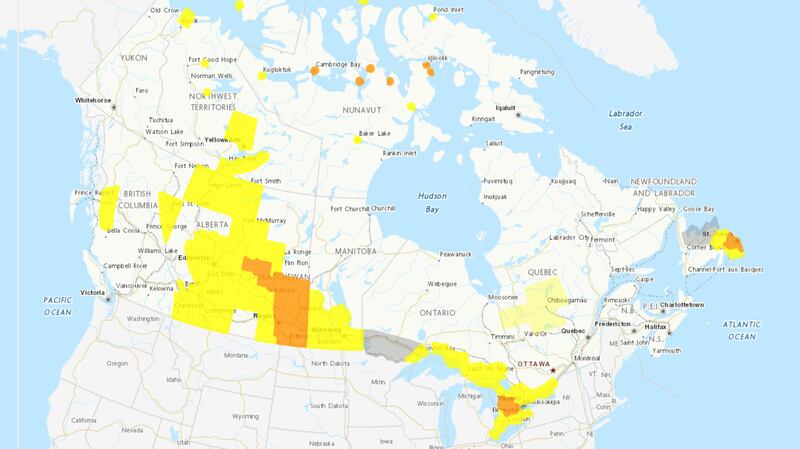
Environment Canada has issued a slew of weather warnings as large swaths of the country face messy conditions like winter storms, intense snowfall and freezing rain.
Winter storm slams Prairies
A winter storm with heavy snow and strong winds is expected to sweep across the Prairies from now until Thursday morning.
Snowfall and winter storm warnings are currently in place for large parts of Alberta, including Athabasca, Camrose, Calgary, Edmonton, Lethbridge, Medicine Hat and Red Deer. As much as 30 centimetres of snow is expected between Tuesday morning and evening in some areas while winds of up to 70 km/h could also cause poor visibility and blowing snow.
“Hazardous, blizzard-like winter conditions are expected today,” Environment Canada warned. “Visibility will likely be suddenly reduced to near zero at times. Road closures are possible. Consider postponing non-essential travel and outdoor activities until conditions improve.”
Heavy snowfall is also expected to blanket Saskatchewan starting Tuesday morning and afternoon as the storm travels eastward. As much as 35 centimetres of snow is in the forecast for areas like Regina and Prince Albert, while blowing snow and strong easterly winds of up to 80 km/h could reduce visibility. Conditions are expected to improve on Wednesday.
“These strong winds will spread eastward through the day and reach southwestern Manitoba late Tuesday afternoon,” Environment Canada cautioned. “Travel will likely be hazardous due to near-zero visibility.”
Across southern Manitoba, heavy snowfall is expected to begin Tuesday afternoon and evening before tapering off on Thursday morning. As much as 30 centimetres of snow could fall in some areas. Freezing rain is also forecast for southeastern Saskatchewan and southwestern Manitoba on Tuesday afternoon.
“The freezing rain will transition to snow on Tuesday evening,” Environment Canada said. “Roads and walkways will likely become icy and slippery. Local utility outages are possible.”
Snow, fog and ice in Ontario
The winter storm will continue tracking eastward where it’s expected to impact Ontario Tuesday night through Wednesday night.
Communities in northwestern Ontario could see as much as 20 centimetres of snow and experience reduced visibility with wind gusts of up to 60 km/h. Fog advisories are also in place for areas near the Great Lakes.
“At this point in time, the heaviest snow is expected to fall near the American border, south of the city of Thunder Bay,” Environment Canada said. “There remains some uncertainty with the track of the system, therefore, snowfall amounts and areas affected could change.”
Further south in areas like Brantford, Hamilton, Guelph, Kitchener, Stratford and Toronto, there could be several hours of freezing rain from Wednesday morning to evening, leading to up to 15 millimetres of ice accretion and possible utility outages.
“The most hazardous conditions are expected over areas of higher elevation,” Environment Canada said. “Roads and walkways will likely become icy and slippery. There may be a significant impact on rush hour traffic. There is risk of injury due to slips and falls.”
The winter storm is expected to bring a combination of snow, ice pellets and freezing rain to areas east of Toronto from Wednesday morning to the evening.
“There remains some uncertainty with the track of this system as such, snowfall amounts and areas affected could change,” Environment Canada said. “According to the latest analysis, it appears that regions east of Highway 400 may receive little to no freezing rain, with predominantly snow or ice pellets expected.”
Atlantic storm hits Newfoundland
While other parts of Atlantic Canada will be spared, a strong winter storm will slam into eastern and northern parts of Newfoundland today, leading to 25-50 centimetres of snow from Tuesday evening until Wednesday night and wind gusts of up to 80 km/h that will reduce visibility.
Impacted regions include areas in and around St. John’s, the Avalon Peninsula, Terra Nova and the Bonavista Peninsula.
“Locations inland and over higher terrain have the best chance of seeing the upper end of the forecast range, while the lower end of the range is more likely at lower elevations along the coast,” Environment Canada explained. “While the heaviest snow is expected to taper off Wednesday night, periods of snow, freezing drizzle or drizzle will continue into the weekend, resulting in additional snowfall accumulations.”
Other weather warnings and statements
Winter storm and snowfall warnings are also in place for eastern parts of B.C., including Elk Valley, Peace River, East Kootenay, and Yoho and Kootenay parks. Strong winds, frigid temperatures and heavy snow of up to 25 centimetres is expected.
“Snow will taper off this morning as the storm tracks eastward through the Prairies,” Environment Canada said. “Roads and walkways will likely be difficult to navigate. Travel will likely be challenging.”
The Northwest Territories and Nunavut, meanwhile, are expected to experience extreme cold, with wind chill values between -50 and -60 expected in many communities, including Yellowknife, Sachs Harbour, Cambridge Bay and Pond Inlet.

