The Government of Alberta announced a “record-breaking” investment in physician recruitment, training and compensation in the 2026-27 budget.
“We’re doing this for two reasons. First, we want to maintain Alberta’s reputation as a fantastic place for doctors to practice, and this funding will ensure the province’s physicians are well supported and competitively compensated,” said Premier Danielle Smith at the announcement in Edmonton Monday. “Second, we want to attract, recruit and retain physicians across the province with an appropriate mix between urban, rural and remote communities.”
The province said that the investment is 22 per cent more than in Budget 2025, amounting to about $1.4 billion.
The $7.7-billion investment includes $7.3 billion for physician services, $450 million for recruitment and education, and $15 million for other supports.
A quarter four report from the College of Physicians and Surgeons of Alberta (CPSA) said there were 13,008 physicians registered in the province at the end of 2025, reflecting an increase of 796 from the same period in 2024.
Smith said CPSA data indicates that we are gaining doctors in Alberta at a faster rate than population growth, calling it a “major win.”
“Our population grew by almost 600,000 people in just the last five years alone,” said the premier. “We’ve been increasing the number of doctors to keep up. At the end of last year, the number of physicians registered in the province was at a record high.”
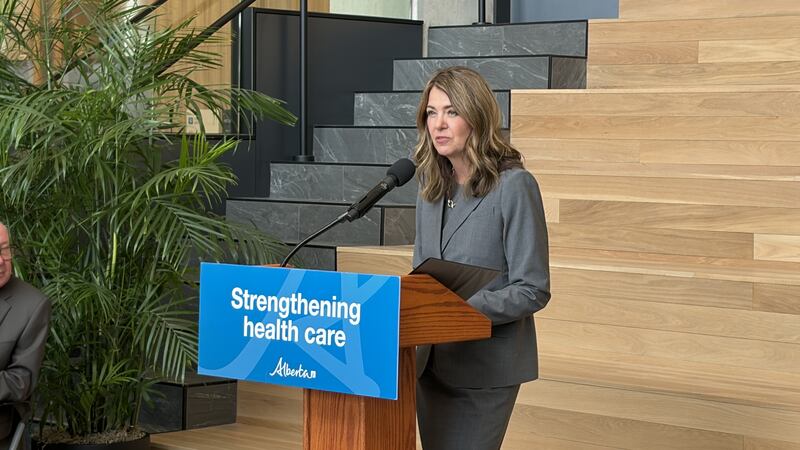
Primary and preventative health services minister Adriana LaGrange said the province has been working with the Alberta Medical Association (AMA) to develop a new primary care physician compensation model.
“Alberta’s primary care compensation model is designed to be very competitive financially, as well as a better support for comprehensive, patient focused care,” said LaGrange.
The province and the AMA will be at the bargaining table negotiating a new collective agreement in March.
“There have been disruptions in our ability to attract in previous years for a variety of reasons – COVID-19 being one and contract negotiations being another – but I feel like we’ve got a really good starting ground and common ground of understanding with the AMA,” said Smith. “This is a measure of good faith for them, that we’re preparing to invest, but we also want the service improvements, as do they.”
A recent report from the Angus Reid Institute found that Alberta has fewer family physicians per capita than it did 10 years ago, while every other province, besides Ontatio, has more doctors per patient than it did in 2015.
Sharif Haji, Alberta’s New Democrat Shadow Minister for Primary and Preventative Health Services, cited the report in a statement.
“The announcement today by the premier is unclear as to whether this new money will just cover a new contract with existing doctors or will see a real gain in doctor-to-patient numbers,” said Haji. “The reality is we have fewer doctors per capita in Alberta than we did when the United Conservative Party government came to power.”
The report found that 31 per cent of Alberta have found it difficult to access their current doctor, while the Canadian Institute for Health Information said 83.8 per cent of adults in the province reported having access to a regular health-care provider.
Emergency physician Raj Sherman said he was pleased to hear about the investment, but was skeptical.
“Many physicians, especially family physicians, have been taking a pay cut for the last three years and looking after more patients,” Sherman told CTV News Edmonton. “It doesn’t address the structural underlying fundamental problems of the system.”
He said family doctors have only seen a one-per-cent salary increase over the last three years.
“We always welcome more money into health care, but we want to make sure it’s targeted and put in the right areas,” said Sherman.
Monday’s announcement comes during the wind down of a flu season that saw lengthy emergency room wait times and over capacity hospitals.
RELATED STORIES:

