A young Ukrainian ophthalmologist who graduated into war says she never expected her first years of practice would involve reconstructing faces shattered by explosives.
Four years after Russia’s full-scale invasion, Dr. Pavla Ivaniuta says helping patients rebuild their lives has become both her duty and her motivation.
Ivaniuta, 26, is currently in Calgary upgrading her surgical training through a humanitarian fellowship adapted to meet the urgent needs of Ukrainian doctors working in a conflict zone.
She finished her training just as the war intensified and quickly found herself working on cases far more complex than most new graduates would expect.
“At the beginning, it was really difficult. I used to cry because it’s not just soldiers, it’s also children,” Ivaniuta said.
But over time, she says the work has reshaped her confidence as a surgeon.
“Now I feel that I can help. I can do this case, and I don’t need to be upset, because, due to my knowledges, due to my skills, I can help.”
The University of Calgary already ran a traditional fellowship for eye surgeons, but her mentor, Dr. Karim Punja, says it was reshaped into a condensed program because of the pressures Ukrainian physicians face.
“So the normal fellowship program is about two years standardized curriculum… a set curriculum,” Punja said, adding that Ivaniuta’s training is different.
“This is very needs based, humanitarian based.”
Punja said the goal was to compress years of specialized education into a shorter timeline so surgeons like Ivaniuta could return home quickly and share what they learned with colleagues treating trauma patients.
“She hasn’t had a chance to walk, let alone run, and she’s got a sprint at an Olympic level, having just come out of finishing school in residency,” he said.
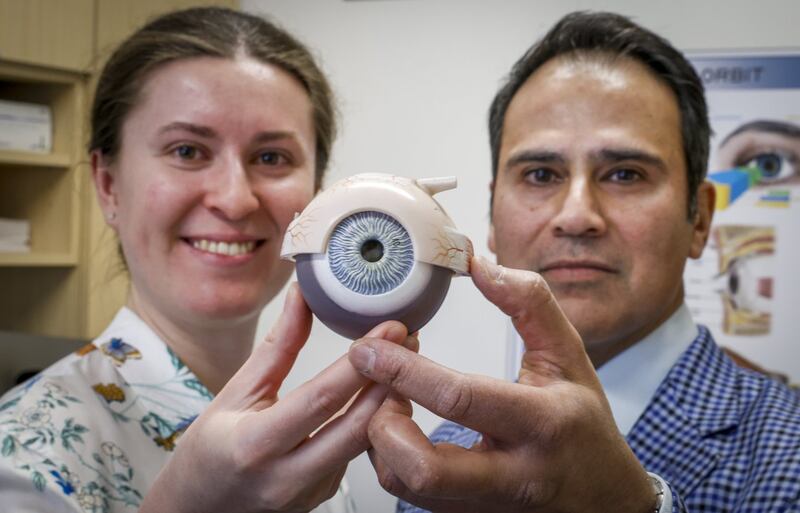
Many of her patients are young men or children recovering months after initial injuries, seeking reconstruction that allows them to function and reintegrate socially.
“Mostly, as I said, it’s children or it’s males, from 18 years old up to, I don’t know, 30, 40 years old, and they want to look good. They want to continue their life,” she said.
Ivaniuta said working in a country under constant attack can also mean adapting to unpredictable conditions inside the operating room.
“But of course, if it’s some like tiny private clinic, of course it’s it’s hard, and that’s why we are working all together, because we can support if there is any problem with light, some nurses, other stuff, can just bring their phone and just turn light on to help to finish the operation,” she said.
Punja said many of the surgical techniques Ivaniuta is learning in Calgary closely resemble the complex reconstruction performed on cancer patients in Canada, making the training directly applicable to war injuries.
“There’s so much overlap oncology or cancer reconstruction when there’s big tumors around the eye, in the orbit the socket,” said Punja.
“When we’re reconstructing those the anatomic principles, the precision, the planning, the nuance, it’s identical.”
“She can utilize them in Ukraine with her, with her complex patients. When she returns.”
Despite the relative safety of training in Calgary, Ivaniuta plans to return to Ukraine this spring.
“My main mission to be here, it’s to improve my knowledge is in reconstructive surgeries,” she said. “I really want to go back, because I have my family, have my friends, my job… it’s my life, my childhood, everything was... is there.”
Wednesday marks four years since the invasion began, but Ivaniuta says the anniversary feels less like a milestone and more like another day living through war.
“Honestly, it’s just one more day of war for me, because it’s not over,” she said. “Every time in my hometown in Kyiv, every night it’s a drone attacks, it’s bombed, a bomb attack by rockets.”
Punja plans to travel to Ukraine later this year to operate alongside her and better understand the conditions she faces.
“I don’t know… I’m worried. I won’t lie, but I feel it’s the right thing to do,” he said.
For Ivaniuta, the work remains deeply personal, shaped not only by her profession but by her connection to home.
“Yeah, of course… We are all hope,” she said, when asked if she believes the war will eventually end.

