An Ontario psychologist is warning that proposed changes to the province’s training requirements for the profession could create confusion for the public, increase risks for patients seeking mental health care, and raise questions about whether the shift could cause a ripple beyond provincial borders.
Dr. Lea Ann Ouimet, a practicing school psychologist with 15 years of experience, says she became concerned after reviewing reforms put forward by the College of Psychologists and Behaviour Analysts of Ontario (CPBAO).
She argues the public already struggles to understand the differences between mental-health professionals — including psychologists, psychotherapists, psychiatrists and social workers — and fears the proposed reforms could further blur those lines.
“If you don’t have enough of a depth of training, you can’t know what you don’t know. Misdiagnosing someone, the potential for harm there is huge,” she told CTV News.ca in a Zoom interview.
Ouimet said in practice, a misdiagnosis often leads to ineffective or inappropriate treatment, and even after years in the field, there are still times she goes back to books or research articles.
“Even now, after so many years, I’m not always sure.”
She noted psychiatrists are medical doctors who complete specialized training in mental health and operate within a medical model of care, meaning they can diagnose, prescribe medication and sometimes provide therapy.

Psychologists, while not physicians, are also authorized to conduct assessments and diagnose mental disorders before delivering treatment and therapy.
In contrast, psychotherapists and social workers focus on counselling and therapeutic support, but are not permitted to perform formal diagnoses.
Dr. Laura Nichols, president of the Ontario Psychological Association (OPA), sees it as a risk to “public safety.”
“Psychologists work with high-risk and complex cases, including trauma, suicidality, and serious mental illness. Supervised training is where clinicians learn judgment, ethics and how to manage complexity,” she said in an email to CTVNews.ca.
Nichols said insufficient preparation to assess, diagnose and treat these conditions can lead to misdiagnosis, inconsistent quality of care and reduced public trust.
“Would you want a family physician doing a cardiac surgery?” she said.
What Ontario currently requires – and what will change
Under Ontario’s existing framework, doctoral-trained applicants register as psychologists and must complete a pre-doctoral residency spanning roughly five to six years, followed by one year of post-doctor supervised practice. They must also pass the Examination for Professional Practice in Psychology (EPPP), a jurisprudence and ethics exam, and an oral exam administrated by the CPBAO.
Master’s-trained applicants register as psychological associates. Under current regulations, they must complete a total of five years of experience – typically four years of post-master’s work experience that is not formally evaluated by the College, followed by one final year of supervised practice reported to the regulator.
Like doctoral applicants, they must also pass the EPPP, jurisprudence and oral exams.
One major proposal would remove the minimum four-year, post-master’s work experience requirements and replace it with a one-year minimum, followed by a final year of supervised practice.
Ouimet said supervised practice is critical because it allows new clinicians to translate theory into real-world decision-making.
She also worries experienced master’s-level psychologists could be grouped together with future registrants who complete significantly less training - a distinction she says patients are unlikely to recognize.
Nichols estimates the change represents a roughly 75 per cent reduction in post-graduate experience requirements.
Another proposed change would allow all registrants who meet entry-to-practice competencies - whether trained at the master’s or doctoral level - to use the title “psychologists.”
Nichols said eliminating certain independent competency exams is also under consideration.
The CPBAO says reporting has misunderstood the proposed reforms. In an email to CTVNews.ca, registrar and CEO Dr. Tony DeBono said the College’s changes, presented in December and now before the ministry of health, are intended to modernize regulation while maintaining entry-to-practice competencies.
“These changes are about eliminating barriers, not lowering standards,” he said in a statement.
DeBono noted that interprovincial mobility rules already allow master’s-level psychologists with one year of supervised practice from other provinces to register in Ontario without additional experience requirements, while Ontario professionals face stricter standards when seeking registration elsewhere.
Nichols, however, said reducing training hours “changes the calibre and quantity of preparation,” and warned that access to care must not come at the expense of quality.
She added that access issues are largely tied to funding and system capacity, not educational requirements, and said shortages are more pronounced in the publicly funded system than in private practice.
Voices ignored, dismissed says psychologists
While the CPBAO says they held “extensive consultation with registrants and the public,” Ouimet said their voices were dismissed.
Nichols said approximately 10,000 Ontarians participated in the consultations, with roughly 90 per cent opposing the proposed changes. More than half of the participants were public members.
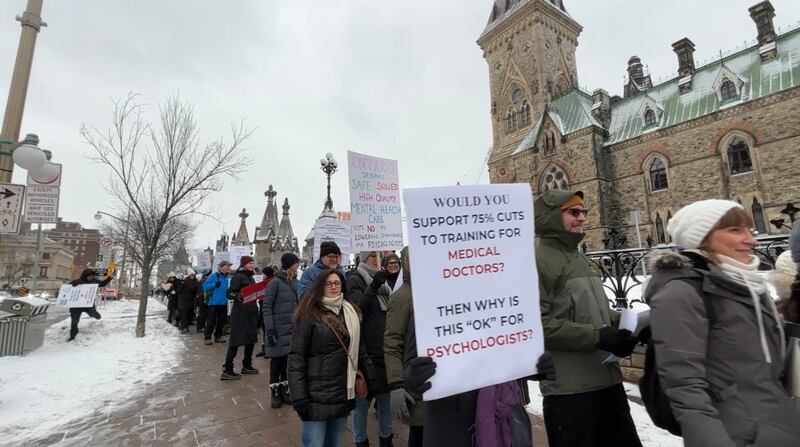
“Why can’t we bring people up to the standard instead of lowering the standard?” Ouimet said.
Nicholas said the OPA concern’s centre of transparency and patient protection.
“Patients deserve clarity when such a vast discrepancy in training exists,” she added.
How psychologist training differs across Canada
Psychologist training requirements vary across Canada, reflecting different regulatory approaches to education, supervision and public protection.
In B.C., only doctoral-level applicants may use the title psychologist. Registration requires a doctoral degree, about 1,600 hours of a pre-doctoral internship, a full year of post-doctoral supervised practice, the EPPP, a jurisprudence exam and an oral exam.
Alberta allows both master’s- and doctoral-trained psychologists to register independently. Applicants must complete one year of supervised practice, pass the EPPP, as well as the Law and Ethics for Alberta Psychologists (LEAP) exam, which replaced the oral exam in 2019, according to a College of Alberta Psychologists’ (CAP) spokesperson.
In Saskatchewan, training pathways depend on degree level. Doctoral graduates must complete a year of post-doctoral supervised practice, while master’s-trained applicants complete a year of supervised post-master’s practice before independent registration. Both streams require the EPPP and an oral exam.
Manitoba distinguishes between psychologists and psychological associates. Only doctor-trained registrants may practice independently as psychologists, while master’s-trained associates must complete four years of supervised practice before qualifying for independent practice.
In Quebec, psychologists must hold a doctoral degree to practice independently and complete more than 2,300 hours of supervised pre-doctoral training. The province does not use the EPPP or oral exam, but requires French-language proficiency and ethics coursework.
Several Atlantic provinces permit master’s-level psychologists to practice independently, though supervision requirements differ. Nova Scotia requires four years of post-master’s experience, while Newfoundland and Labrador requires two years. Both provinces use the EPPP, though Newfoundland and Labrador does not require an oral exam.
New Brunswick and Prince Edward Island require a doctoral degree to use the title “psychologist.”
In the North, both master’s- and doctoral-trained psychologists may practice independently in Yukon and the Northwest Territories, provided they complete extensive supervised experience and pass the EPPP. Yukon also requires a jurisdiction-specific ethics exam and Indigenous cultural training.
Ouimet said while many provinces have historically moved toward strengthening training standards, Ontario appears to be moving in the opposite direction.
“It’s going to be a disservice to the people of Ontario who are waiting for assessments or treatments,” she said.
Whether other provinces and territories could follow Ontario’s move, Nichols said it’s possible. “Other provinces may watch closely to see how this unfolds,” she said. “Many other provinces currently maintain doctoral-level entry for psychologists, so this would represent a significant departure.”

