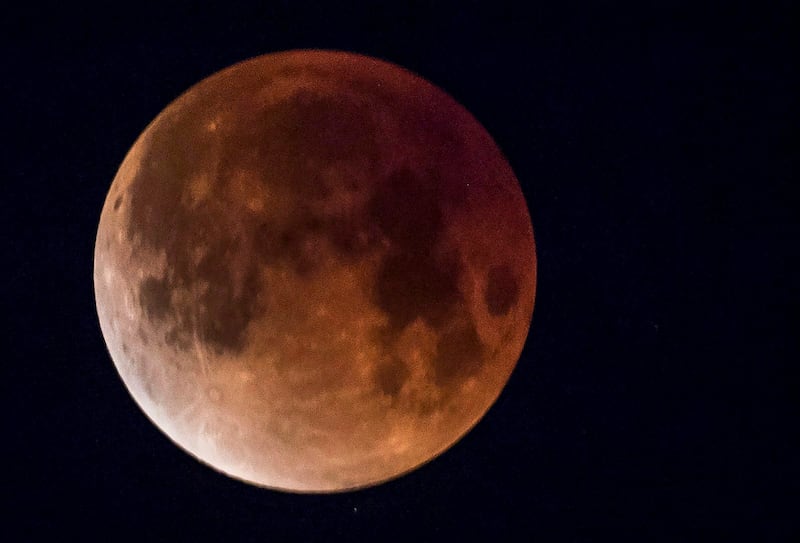
A total lunar eclipse, also known as the “Blood Moon,” is on its way on March 3 and people across North and South America, Asia and Oceania can witness it.
Here’s everything you need to know about what it is and where you can see it in Canada.
What is a ‘Blood Moon’?
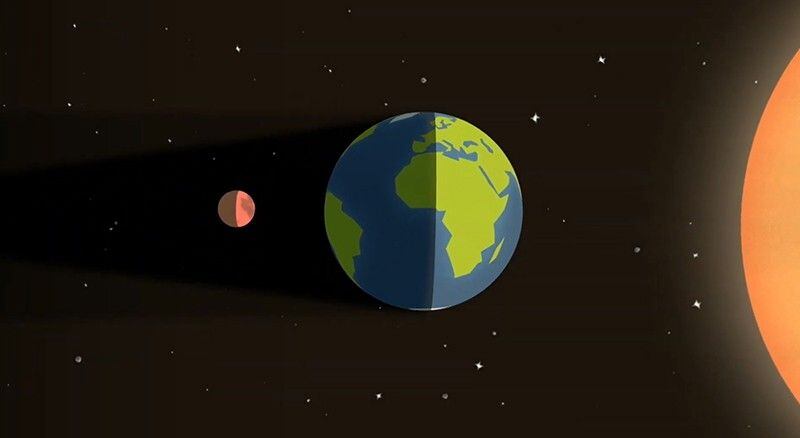
According to the Canadian Space Agency (CSA), a lunar eclipse occurs when the Earth comes between the moon and the sun. The moon then passes through the shadow cast by Earth.
Sunlight is refracted through the Earth’s atmosphere, which gives the moon a red hue.
This phenomenon can only occur during a full moon, the space agency adds, when the moon is opposite the Earth, rather than the sun.
“Unlike solar eclipses, lunar eclipses can be seen by practically an entire hemisphere, which means that a much larger number of people can see them for a longer period of time,” the space agency said.
A total lunar eclipse occurs when the moon “completely” crosses the “umbra,” or the innermost part of Earth’s shadow where sunlight does not reach.
“If the eclipse starts shortly after the moon rises, you will see the whole thing,” the CSA said. “If the eclipse starts just before the moon sets, you will only see the first part of it.”
Where can you see the lunar eclipse in Canada?
The entire eclipse will last around five and half hours, with the moon turning red for nearly an hour, according to The Weather Network meteorologist Scott Sutherland.
The event will occur in the hours between midnight and dawn of March 3, with observers in Eastern Canada able to see it closer to dawn.
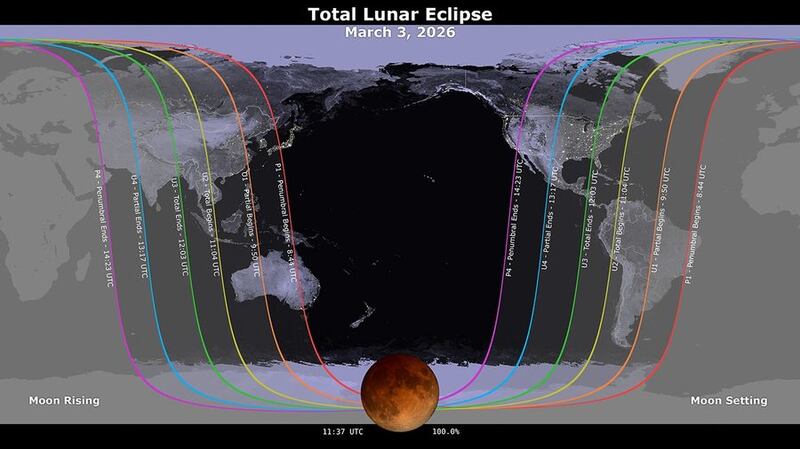
St. John’s, N.L., will see the eclipse beginning at 5:14 a.m. NST, with the partial eclipse starting at 6:20 a.m.
Halifax will witness the start of the eclipse closer to 4:44 a.m. AST, with the partial eclipse starting at 5:50 a.m.
People in Montreal and Toronto can see the eclipse starting 3:44 a.m. EST, with the partial eclipse beginning at 4:50 a.m. and the total eclipse starting closer to 6:04 a.m.
Winnipeg and Regina residents can witness the eclipse starting 2:44 a.m. CST, with the partial eclipse at 3:50 a.m. and the total eclipse starting closer to 5:04 a.m.
Those in Calgary can see the eclipse starting at 1:44 a.m. MST, with the partial eclipse starting at 2:50 a.m. and the total eclipse beginning closer to 4:04 a.m.
Residents in Vancouver can witness the eclipse beginning at 12:44 a.m. PST, with the partial eclipse starting at 1:50 a.m. and total eclipse beginning closer to 3:04 a.m.
How to watch a lunar eclipse?
The CSA says lunar eclipses are the most “easily observable astronomical phenomena” since no equipment is required to observe them.
People watching can use a telescope or binoculars, or even take photos of the eclipse with a mobile phone.
“Contrary to solar eclipses, it is safe to observe a lunar eclipse with the naked eye. No special eye protection is necessary,” the space agency adds.