Canadians are becoming more exposed to conspiracy theory content in their social media feeds, but only a certain number of accounts are responsible for promoting the vast majority of it, a new study suggests.
Researchers at the Media Ecosystem Observatory (MEO) analyzed more than 14 million posts between 2023 and 2025 across popular online platforms — TikTok, X (formerly known as Twitter), Instagram and Bluesky — and found there are only about 100 very active Canadian users who account for nearly 70 per cent of conspiratorial content.
“This demonstrates that conspiratorial claims are driven by a small, highly active and visible subset of social media users who exert a disproportionate influence on the information environment,” stated the report, which was released this week.
The MEO research centre is a partnership between McGill University and the University of Toronto that studies the health of Canada’s information ecosystem.
The study, “Conspiratorial Claims and Institutional Distrust in Canada’s Online Ecosystem,” looked at some of the most widespread anti-institutional conspiratorial claims, including ones about the federal government manipulating data about health threats and climate change to exert control over Canadians, a secretive group of elites known as the “Deep State” holding immense power and about major Canadian news organizations conspiring with senior government officials to manipulate public opinion.
While more Canadians reported being aware of these claims online, the study suggested only a fraction of them actually believe in them.
Still, the claims are something democracies can’t ignore, said co-author Mathieu Lavigne, the observatory’s analytics lead and academic associate at McGill’s Max Bell School of Public Policy.
“They can shift away attention from more constructive debates, and they can decrease trust in institutions and democratic processes,” he said.
“I would say that even if a small minority of Canadians believe in conspiracy theories, the impacts on society can be pretty important. So, one example is conspiracy theories about vaccines. We’ve seen an increase in the number of measles cases in the U.S., even though it’s a small minority of people who believe in vaccine conspiracy theories.”

The study’s authors note that criticism of public institutions is not inherently problematic.
In fact, it’s a sign of a healthy democracy.
The problem is that when online platforms incentivize engagement with likes and comments, they can amplify conspiratorial claims and “entrench them in the public debate,” they say.
“I think the fine line is between criticizing institutions in a constructive way and saying, without evidence, that institutions or elites are colluding to harm Canadians or control Canadians,” Lavigne said.
Who is spreading conspiracy theory content in Canada?
When asked, Lavigne wouldn’t name the accounts responsible for promoting most of the conspiratorial content online.
According to the study, social media influencers produce most of the conspiracy-related posts (87 per cent) and receive the most engagement, accounting for 89 per cent of views and 87 per cent of likes.
Other key players include alternative news outlets and politicians.
The observatory also surveyed a nationally representative sample of 1,459 Canadians between Oct. 20 and Nov. 7, 2025, to gauge their awareness, belief and engagement with eight conspiracy theories.
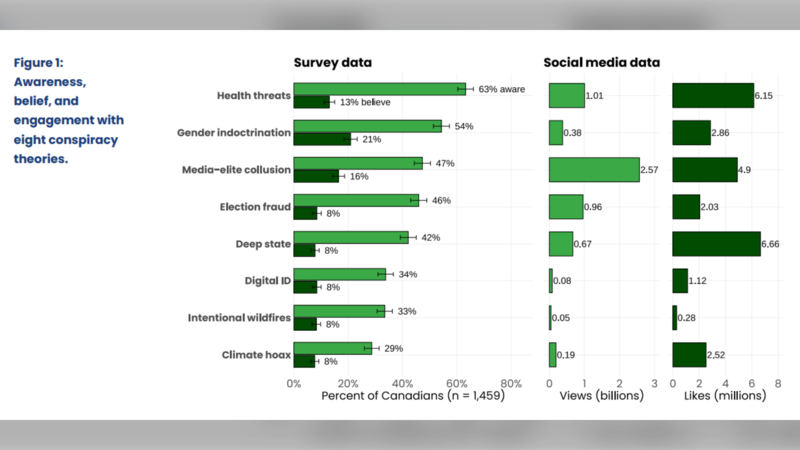
The claims that Canadians reported they were most aware of on social media were ones about public health threats (such as COVID-19) being exaggerated to expand government control (63 per cent), schools are indoctrinating kids with radical gender ideology (54 per cent) and the media-elite collusion (47 per cent).
Notably, of the eight claims that were studied, respondents said they most believed the ones about gender indoctrination (21 per cent), the media-elite collusion (16 per cent) and health threats (13 per cent).
Claims about other themes (election fraud, the Deep State, digital ID, intentional wildfires, and the climate hoax) all ranked lower at eight per cent each.
The claim that got the most engagement on social media was media-elite collusion, amassing more than 2.57 billion views — “more than twice as many as the next most viewed conspiracies, health threats and election fraud, each with roughly a billion views,” according to the report.
“Since 2018 in Canada, we’ve seen a decline in trust in the media, so I wasn’t really surprised by that finding because it’s also a narrative that has been used by some populist actors and alternative media to decrease trust in mainstream media organizations,” Lavigne said.
Which social media site spreads the most claims?
When it comes to platforms hosting anti-institutional conspiratorial claims, X by far has the most engagement.
The site, owned by the world’s richest person, Elon Musk, accounts for 70 per cent of total likes among the four platforms, which the researchers say reflects “both platform-level amplification and the characteristics of its users.”
In second place is TikTok, with 20 per cent of total likes, followed by Instagram (nine per cent) and Bluesky (0.6 per cent).
TikTok, however, led the way for most likes on the top 20 posts per conspiracy.
“This suggests that while the volume of conspiratorial content circulating on X is substantially larger than on other platforms, an individual TikTok video can have as much impact as an individual tweet,” the study noted.
The observatory’s report includes recommendations to prevent the spread of conspiracy theory content from undermining the public’s trust in institutions, including giving users more control of their social media feeds and launching awareness campaigns during predictable conspiracy “peak seasons,” such as election cycles and wildfire season.
“We need transparency and accountability for governments as well to prevent these types of narratives from emerging in the first place,” Lavigne said, “And more transparency from platforms about the type of content that their algorithms promote and the risks that these algorithms might have on society and democracy.”
The MEO’s survey has a margin of error of +/- 2.6 per cent, 19 times out of 20.

