


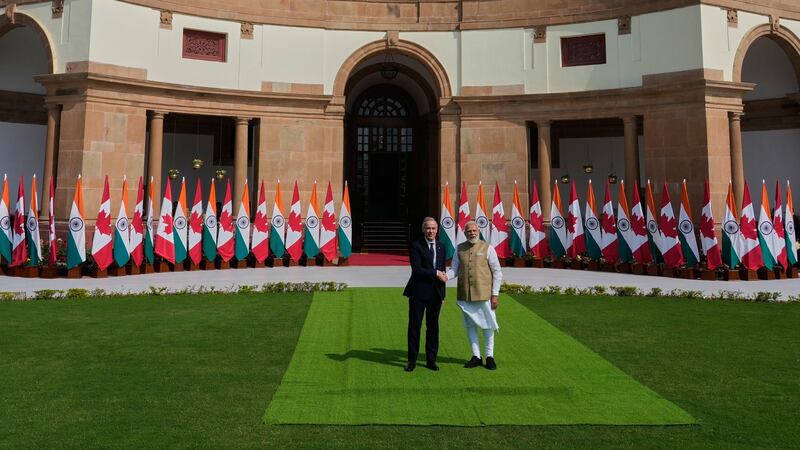
NEW DELHI -- In a major development to reset relations between Canada and India, the two countries’ leaders signed several memoranda of understanding including a $2.6-billion nuclear energy deal Monday, while Canada’s spy agency says India is stills one of the main perpetrators of foreign interference in Canada.
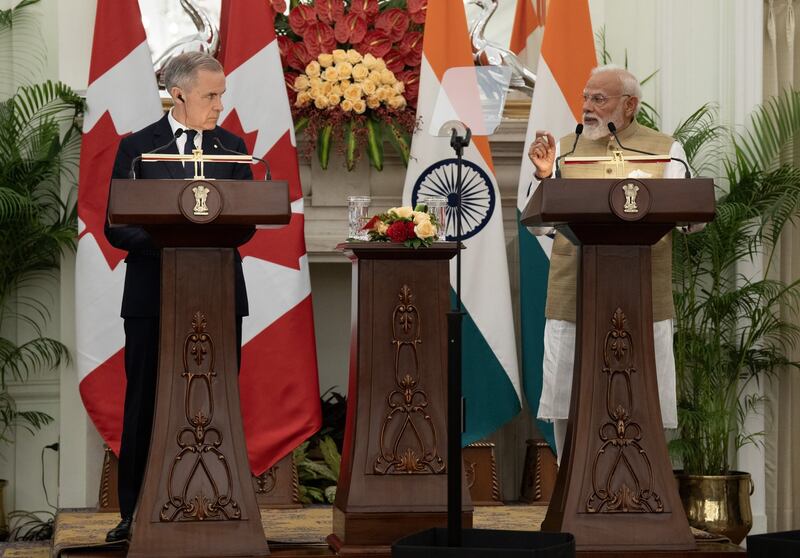
“We are one family,” Prime Minister Mark Carney said, standing beside Indian Prime Minister Narendra Modi, and extending an invitation for the latter to visit Canada.
Carney’s office said Modi accepted the invitation, but there is no timeline for a visit.
Later on Monday — and for the first time after being asked a number of times earlier in the trip — Foreign Affairs Minister Anita Anand pushed back on comments a Canadian government official made last week, suggesting India was no longer actively involved in foreign interference or transnational regression.
“The words of the senior official are not words that I personally would use,” Anand said. “I agree with his comments relating to the guardrails that we have in place.”
In the wake of the comments last Wednesday, there has been serious pushback from Canada’s Sikh community, intelligence community and some Liberal MPs, including secretary of state for combatting crime, Ruby Sahota.
Please see my statement: pic.twitter.com/bQEb6ub7xP
— Ruby Sahota (@rubysahotalib) February 28, 2026
A federal government press release includes one line about transnational repression. The release noted that during his meeting with Modi, Carney “underscored that Canada will continue to take measures to combat” transnational repression, but no further details were included.
There was no opportunity to press the prime minister about his discussions with Modi, or any other topic, as Carney’s office cancelled his first media availability of the trip. A spokesperson blamed the Modi meetings running long, and an inability to delay the next flight to Australia due to crew shift time rules.
In a new statement to CTV News from the Canadian Security and Intelligence Service (CSIS) on Monday, the organization said India is still one of the main perpetrators of foreign interference in Canada.
“As the Minister of Public Safety, Minister Gary Anandasangaree, said earlier this week, there is still more work to be done. For its part, CSIS continues to take all allegations of foreign interference and transnational repression seriously,” the statement reads.
“CSIS remains vigilant against foreign interference and espionage threats from all countries,” the statement added. “CSIS’s threat assessment of the main perpetrators of foreign interference and espionage against Canada has not changed.”
In a report last June, the agency accused India of being one of the main perpetrators of foreign interference and espionage in Canada.
‘Beginning of a new, prosperous relationship’
India and Canada, meanwhile, have formally launched talks for a broad Comprehensive Economic Partnership Agreement (CEPA), committing to finalizing the new trade deal by the end of the year.
Carney also announced the two leaders signed five memoranda of understanding while he was in New Delhi, including on energy and artificial intelligence, and 10 commercial deals worth more than $5.5 billion.
A much-anticipated uranium deal tops that list, which would see Saskatchewan-based Cameco supply nearly 22-million pounds of uranium to India between 2027 and 2035 for “nuclear energy generation.” The deal is valued at $2.6 billion.
In his remarks, through a translator, Modi referred to the Cameco deal as a “landmark” agreement.
“Cameco is proud to be a strategic partner with India to help meet its civil nuclear fuel needs and support its trade relationship with Canada,” said Cameco CEO Tim Gitzel in a news release.
“It’s going to be good for the electricity outbuild here in India, as well as good for the economy, and good for, in particular, northern Saskatchewan and Canada,” Saskatchewan Premier Scott Moe said after the remarks.
Some of the other commercial deals making up the $5.5 billion involve previously announced ventures, such as a McCain Foods expansion in India.
“All of these agreements are the beginning of a new, prosperous relationship that will offer generational opportunities to workers and businesses in both their countries,” said Carney.
One of the five MOUs was signed between India and the Government of Saskatchewan, announcing the India Canada Joint Pulse Protein Centre of Excellence.
On energy, Carney pointed to India’s expected doubling in projected demand population by 2040.
“Canada is well-positioned to contribute, as a reliable supplier of the world’s lowest-carbon, responsibly produced LNG (liquefied natural gas) from our West Coast,” he said in his remarks.
‘Business loves certainty’
According to the Prime Minister’s Office, there has been more engagement between Canada and India this year than any other in the past two decades.
“We in the business community are quite excited by what we’ve heard,” said the Business Council of Canada’s Goldy Hyder, noting specifically a new CEPA deal.
Hyder was seated upfront with the Canadian delegation at Hyderabad House in New Delhi for the joint remarks and signing ceremony.
“Business loves certainty, and particularly at a time like this where uncertainty is rampant, trade agreements give us some confidence that we can invest in each other’s countries,” he said.
Throughout Carney’s time in India and ahead of the trip, federal and provincial government officials and analysts have all pointed to the room for growth in the trade relationship, with Canada behind a number of other G7 nations seeking further deals with India.
While the government press release points to $110 billion in Canadian investment in India in 2024, trade numbers from Global Affairs Canada paint a different part of the picture, showing that same year India only accounted for 0.7 per cent of Canada’s total exports and 0.8 per cent of imports.
Carney repeated in his speech that Canada’s goal is to double two-way trade to hit $70 billion by 2030.
Carney also noted Canadian pension funds are among the largest foreign investors in India – claiming $2 trillion in capital – as he referred to a “longer time horizon.”
Modi put the existing investment from Canadian pension funds in his country at $100 billion.
“This demonstrates their deep trust in India’s growth story,” he said through a translator.
Carney wraps up his trip to India Monday afternoon in New Delhi, and heads to Australia for the second country in his 10-day trade tour.
With files from CTV News’ chief political correspondent Vassy Kapelos and CTV News’ Stephanie Ha

