Conservative Leader Pierre Poilievre says he wants to see a “modern” partnership secured between Canada, the United Kingdom, Australia and New Zealand to increase free trade and make life more affordable.
In the midst of his first international trip since becoming the leader of the official Opposition, Poilievre made the comments while delivering what’s known as the Margaret Thatcher Lecture, hosted by a centre-right think tank.
In a nearly 30-minute speech — which delved into the history of capitalism and the benefits of free trade — Poilievre pitched his vision for CANZUK, referring to a proposed alliance between Canada, the United Kingdom, Australia and New Zealand, popularized more than a decade ago.
“When the treaties and agreements that allow us to trade freely face upheaval, we need to double down and deepen our ties with our old and most-trusted friends,” Poilievre said. “Instead of shrinking markets behind tariffs, we should expand opportunities among friends.”
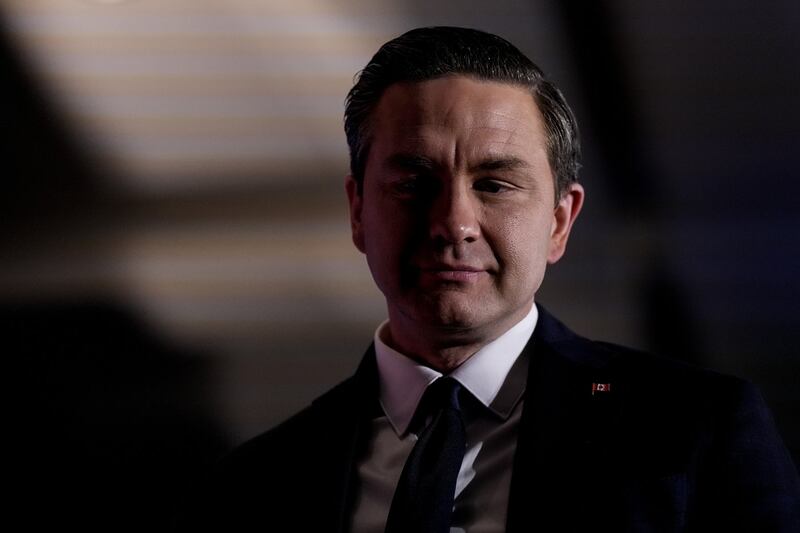
Poilievre said while free trade through the Comprehensive and Progressive Agreement for Trans-Pacific Partnership — signed in 2018 and including eight other countries — already exists, Canada, the United Kingdom, Australia and New Zealand “must go further.”
In practice, he said, such a deal would include automatic professional recognition, regulatory presumption of equivalence, a skilled mobility framework, defence procurement integration, and a critical minerals and energy compact.
It would also help the four countries shore up against shared threats, namely China and Russia, Poilievre said.
Poilievre in his address also pitched stronger nuclear energy co-operation, and suggested Canada and the U.K. should strike a liquified natural gas (LNG) supply arrangement, telling the crowd that energy security can be equated with national security.
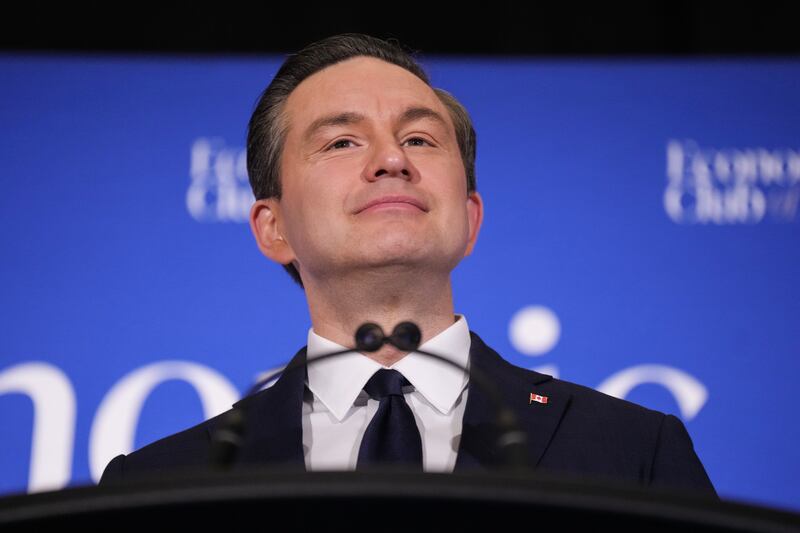
“We want to fuel the freedom of our allies by building up a strategic energy and mineral reserve that could be available in the event of war to those countries that have agreed to provide tariff free access to Canadians,” he said.
And, taking aim at inflationary government spending, including by former King Henry VIII — calling him “one of the worst, though not the first” — Poilievre throughout his speech emphasized the need for conservatives to advocate for the working class, as well as young people.
Noting his party broadened its electoral coalition in the last federal election by appealing to those demographics, Poilievre said conservatives “have always known that the greatness of a nation lies in its working people.”
“There is nobility in work and resilience of those who fight their own battles, get knocked down by life, pick themselves up, and quietly get on with their jobs,” he said. “And there is wisdom in these common men and women who build things, fix things, and move things and make things.”
Poilievre in his speech also emphasized the need to become “stronger at home” to increase leverage abroad, saying the way to do that is through “free trade with old friends, (and) strengthen the bonds that we have between us.”
The theme largely echoed that of a speech Poilievre gave at the Economic Club of Canada in Toronto last week.
Over the last two days in London, Poilievre has been meeting with U.K. members of parliament and the business community.
On Wednesday, he’s headed for Berlin, where he’ll spend the next several days meeting with officials and business leaders. His itinerary also has him delivering a keynote speech at the Konrad Adenauer Foundation, and visiting the Hamburg Harbour, Jade-Wesser Port and LNG facility.
With files from CTV News’ Rachel Aiello

