The mayors of Kingston, Ont. and South Frontenac, Ont. have issued a joint statement calling on the federal government to build the proposed Alto high-speed rail project along Highway 401 and add a stop in Kingston.
The project is still early stages of public consultation but has already faced pushback from many rural communities in eastern Ontario.
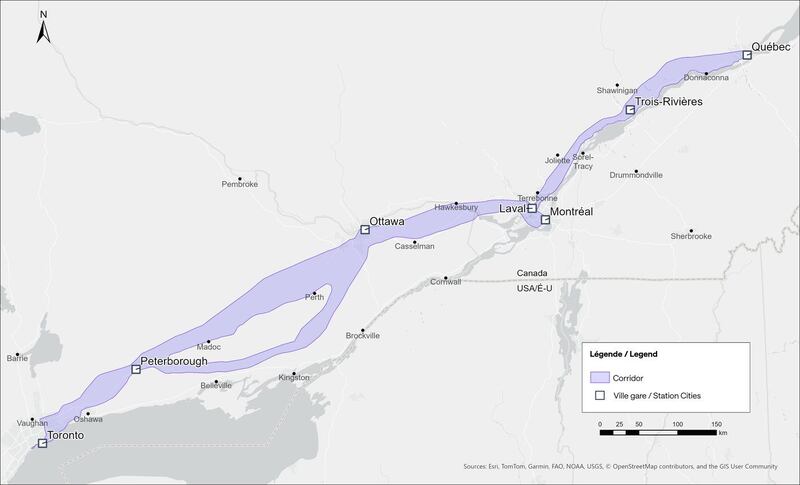
The proposed 1,000-kilometre high-speed rail line from Toronto to Quebec City will also have stops in Ottawa, Laval, Peterborough, Trois- Rivières and Montreal. It is expected to cost $60-90 billion and take years to build.
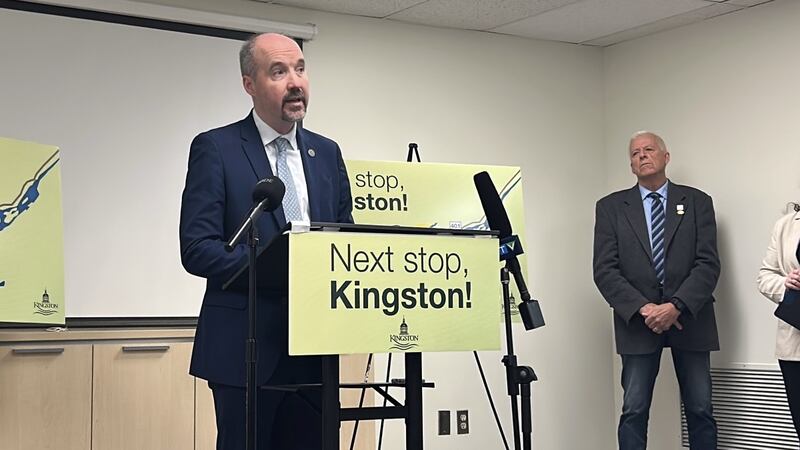
On Monday, Kingston Mayor Bryan Paterson and South Frontenac Mayor Ron Vandewal held a joint news conference with a simple message, “Build it along the 401 corridor and add a stop in Kingston.”
The project is currently looking at two possible routes. A southern corridor would pass through South Frontenac, a rural township north of Kingston, but does not stop in Kingston and is several kilometres north of the Highway 401 corridor.
“If the federal government is going ahead with this $60-90 billion project, it must be realistic and focused on minimizing impacts to property owners, agricultural lands, natural heritage systems, and rural communities. This is not just about infrastructure. It is about people, common sense, sustainability, and protecting what makes our region unique,” the joint statement from the mayors said.
“South Frontenac and the townships surrounding Kingston are home to families who have Th farmed for generations, small businesses that rely on tourism and recreation, and are a part of the health of our region. A new rail corridor cutting through untouched rural land and sensitive landscapes will permanently change that character and divide communities.”
The mayors say aligning the rail line along Highway 401 would “minimize (the) destruction and fragmentation of farmland, wetlands, and communities,” noting that South Frontenac is home to several nationally significant heritage features, such as the Frontenac Arch UNESCO Biosphere Reserve.
“Running high-speed rail through rural areas will disrupt communities whose livelihoods depend on farming, tourism and stewardship of the environment,” the joint statement says.
South Frontenac council unanimously supported a motion from Vandewal in February to oppose the southern route passing through the township.
Kingston city council has previously voted to support a motion from Paterson to demand a Kingston stop.
“A Kingston stop connects the region’s major institutions, businesses, health care organizations and residents to fast, reliable rail service between Toronto, Ottawa, and Montreal. This would drive economic growth, attract investment, strengthen our tourism sector, and improve mobility, benefits shared across Southeastern Ontario,” the joint statement said.
The joint statement on Monday was meant to provide a “united voice” for the southeastern Ontario region.
“Public feedback in this area has been strong and consistent. The southern route as presented is not supported and raises many concerns including the impact to the environment, creating land-locked agricultural parcels with no access, creating dead end roads and concerns over the land expropriation process,” the joint statement said.
The mayors say they support innovation and modern transportation but reiterated their proposal to align the route along Highway 401 and add a Kingston stop.
“Well-planned infrastructure balances national goals with local responsibility. Developing high-speed rail along the Highway 401 corridor and adding a Kingston stop achieves those goals: it advances Canada’s transportation future while protecting and respecting rural landscapes and maximizing national economic opportunity,” the mayors said.
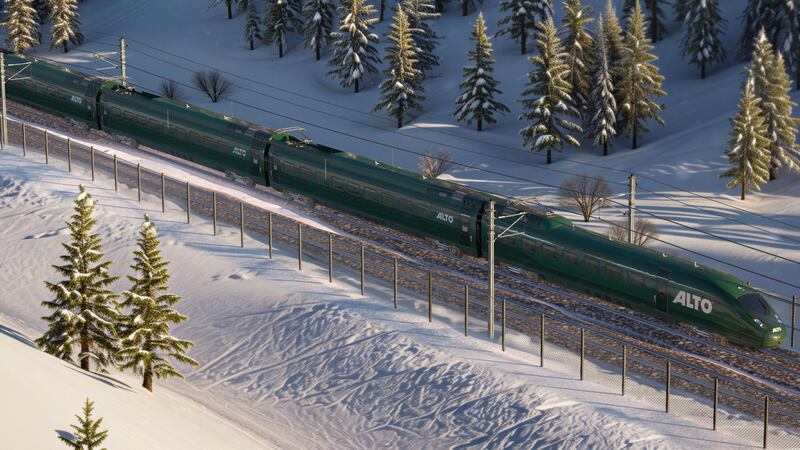
Alto says the project would create 50,000 jobs during construction and add roughly $24.5 billion annually to Canada’s GDP. The train would “cut travel times between cities in half” compared to current train trips and will offer more frequent departures between major cities like Toronto, Ottawa, Montreal and Quebec City. The train would travel at speeds of 300 km/h or more. The first segment would be built between Ottawa and Montreal.
In a statement to CTV News Ottawa, Alto said the final alignment, including stations, is subject to approval by the federal government.
“As a Crown corporation, Alto’s role is to develop the project based on the direction provided in our mandate letter. As with any major infrastructure project, the government may refine parameters over time,” a spokesperson said.
“With regards to the 401, I will invite you to look at the corridor map on our website. Having sais that, we WILL try as much as possible to follow existing corridors (highways, railways, energy). One thing to remember is that high-speed tracks need to be as straight as possible."
The office of the Minister of Transport says in an email that its final decisions on routing will reflect consultations it has with local communities.
“The federal government remains committed to ensuring that the consultation process led by Alto is credible and accessible, and that local parties are treated equitably and consistently throughout the process. Any final routing decisions will reflect consultations with landowners and local communities,” a spokesperson said.
Residents, business owners concerned
Gord Boulton fears the plan for high-speed rail will ruin his hunting and fishing business in South Frontenac. He also serves as the committee lead of the community group Save South Frontenac.
“It would end my business. It would be done there. It would cut my property in half and then with a train coming by every half hour. People come there to be in Mother Nature. They don’t come there to listen to a train,” Boulton told CTV News Ottawa.
“It’s the feeling of when someone’s family member is sick. And it’s not good feeling.”
Some rural residents agreed that moving the rail line along Highway 401 would alleviate fears of expropriation.
“It’s not that we don’t understand why the government wants to do this. What I don’t understand is why they would do it so callously to us,” said one Kingston resident.
Paterson says he’s confident in the efforts of the community.
“In a project that has created a lot of division and controversy, there’s a united front here that’s formed in this part of eastern Ontario that we think is very powerful,” he said.
There will be an open house in Gatineau on March 11, before Alto wraps up their first round of open houses on March 25 in Stirling, Ont.
Public consultation on the project at this stage ends on March 29. Results of the public consultation are expected to be released in the summer.
With files from CTV News Ottawa’s Kimberley Johnson

