The arrival of a tagged great white shark in the waters off southern British Columbia is giving scientists mixed signals about the health of western Canada’s ocean environment.
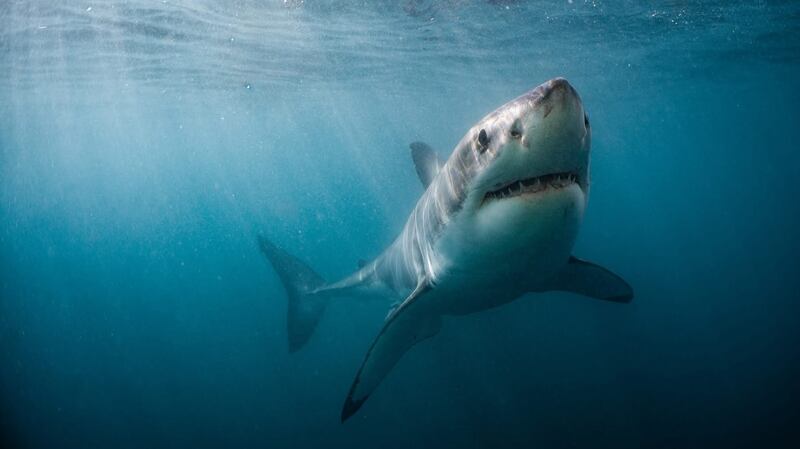
Michael Domeier, president and director of the Marine Conservation Science Institute, triggered alarm on social media Tuesday after sharing a post showing the present location of Kara, a roughly five-metre female white shark that was tagged with a tracking device in October.
“Kara has visited Canada!” Domeier wrote in the post, adding that the animal is the first white shark the Seattle-based institute has ever tracked into B.C. waters.
“I expect her to move far offshore soon, but she likes to prove me wrong,” he added.
While sightings of great white sharks are rare in B.C., that could be changing as ocean temperatures rise and food sources like seals and sea lions become increasingly abundant.
Andrew Trites, director of the University of B.C.’s marine mammal research unit, says species protections are also benefiting shark populations around the world.
Kara is likely hunting elephant seals or northern fur seals as they make their seasonal migration back to Alaska, Trites says.
“In the Salish Sea, we have the world’s highest density of harbour seals,” he added. “Those are great food, and we know that our transient killer whales—they know about it. The secret’s been let out.”
In 2024, a great white shark was found dead on the coast of Haida Gwaii in northern B.C.
At the time, Fisheries and Oceans Canada said the four-metre shark had been feeding on a seal, and was likely a sign the species was venturing farther north as oceans warm due to climate change.
“There are reports historically of great whites being here, but it may be something we see more and more frequently now,” Trites said.
“It may be that some day we’ll hear somebody sitting across on BC Ferries look out and say, ‘What is that? It’s a great white!’ Who would have thought?”
The UBC researcher says that because shark behaviour—including their migration patterns—is driven by the availability of food, there are likely far more great white sharks visiting the B.C. coast than we realize.
“When a shark is hatched, it’s all on its own. There’s no family support. There’s no mom and dad to bring it up and teach it the way of the world,” Trites said.
“And it’s thanks to these sorts of (tracking) technologies that we become more sensitive to the needs of these different species and even recognizing that British Columbia is also home to great whites—maybe not a great number at this point, but more and more will be coming undoubtedly, as the planet continues to warm.”
RELATED STORIES:

