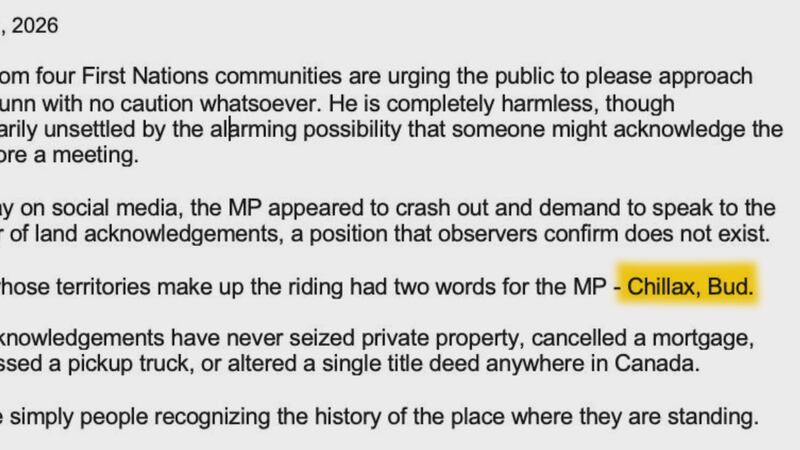
By now you’ve seen the cheeky statement signed by four B.C. chiefs urging a Vancouver Island MP to “chillax” after he appeared to “crash out” over land claims.
The sarcasm and slang have helped propel the story across the country with a two-fold goal: mildly provoking member of Parliament Aaron Gunn for taking issue with land acknowledgements, while drawing attention to the First Nations leaders’ insistence that recognizing the land’s history hasn’t changed any private property rights.
“I think he is playing on the fears that are out there and I think he actually knows better, so an unserious statement, we thought, would be better met with an unserious response,” explained Dillon Johnson, an executive councillor with the Tla’amin Nation in Gunn’s riding.
He told CTV News they were inspired, in part, by California Gov. Gavin Newsom’s mockery of America’s president on social media, which has engaged a younger, less politically engaged demographic with national issues.
“I would say the intent of our statement wasn’t to further inflame or divide,” Johnson said. “It was really an intent to engage a wider audience and then and kind of zoom in on the real message, which is nobody’s coming for your private property and so forth.”
Satire an effective strategy
Much like the U.S. and Commonwealth countries, Canada has a rich history of political satire, and that’s why the sassy rejoinder to Gunn’s social media post spread in a matter of hours.
“It is a novel strategy and it’s a fascinating example of how simply being a little more restrained in a response and injecting humor and then chiding and mockery and all these things is also humanizing,” said Stewart Prest, a political scientist at the University of British Columbia.
He pointed out that laughing about something can encourage people to talk about it as well, even if it’s a thorny issue.
“That’s a crucial first step to understanding and resolving some of the challenges, and also accepting that sometimes we’re just going to disagree, but we don’t have to be disagreeable as we do so,” Prest said.
Gunn responds
Gunn, a documentary filmmaker turned politician, is very familiar with online virality, enjoying considerable attention for a documentary titled “Vancouver is Dying” while also coming under fire for comments about residential schools.
“I appreciate the attempt at humor, but the truth is that this is a very serious concern for many people in British Columbia,” he said, in a virtual interview from his office in Ottawa.
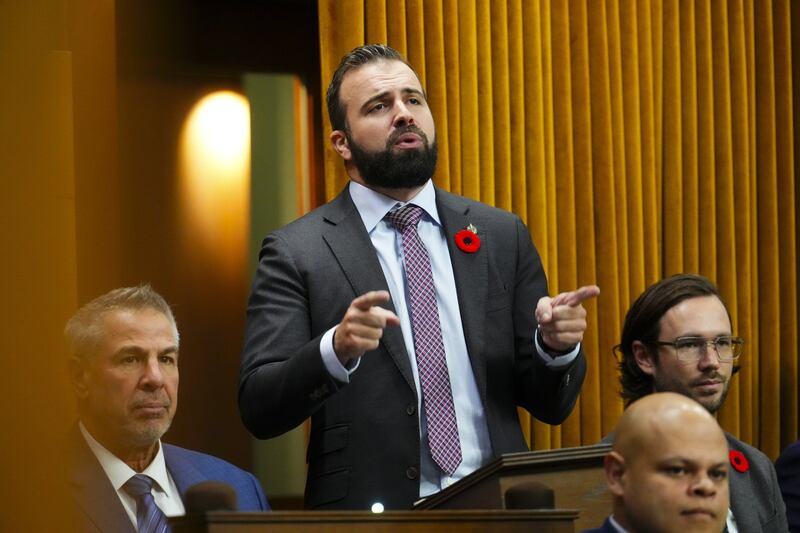
He takes issue with the use of the word “unceded” in land acknowledgements, believing that when federal officials do so, “they are undermining their own legal defence of private property, and instead furthering a narrative — a real radical narrative — that we all live on stolen land.”
His social media post in response to the “crash out” statement accused the chiefs of playing identity politics. CTV News suggested he was doing the same with his initial statement.
“I don’t think so at all. I mean, I think you’d be hard pressed to argue that over the past, five, six, seven years, things haven’t got more divisive in this province, in this country,” Gunn said. “I think you have to get back to treating people as Canadians irrespective of their race, of their identity, whether they’re Indigenous or non-Indigenous, treating a Canadian like a Canadian — and I think that’s actually the least divisive thing.”
RELATED STORIES:
- B.C. chiefs tell MP Aaron Gunn to ‘chillax’ about land acknowledgments
- Most members of B.C.’s legislature vote against bill to stop land acknowledgements
- Petitioners ask B.C. Supreme Court to force UBC to stop Indigenous land acknowledgements
- Some B.C. appraisers adding land-claims clause after Aboriginal title court case
- Fact File: What the Musqueam agreements mean for private property owners in B.C.

