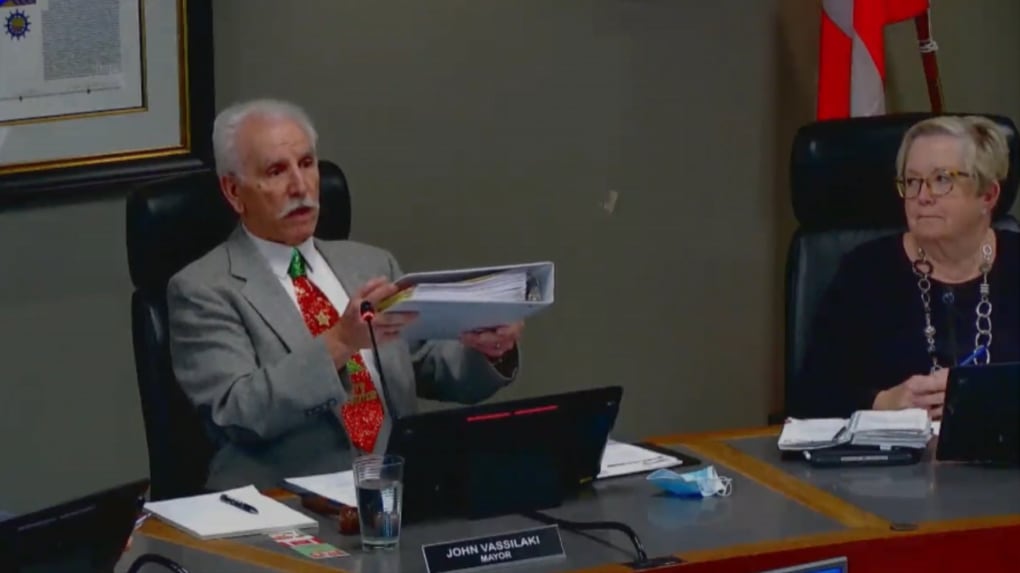
Former Penticton mayor John Vassilaki has been ordered to pay back his family’s liquor store business for the more than $814,000 he misappropriated from it over the course of more than a decade.
Vassilaki, who served as mayor of the B.C. Interior city from 2018 to 2022, was fired from the company he co-owns with his brother Nick Vassilakakis (who spells his name differently) in October 2023.
Vassilaki’s son Fred and Nick’s sons Florio and George also own stakes in the organization, known as Vassilaki & Sons Investments Ltd. (VSI), which has operated Last Call Liquor Mart in Penticton since 2004.
In response to his firing, Vassilaki sued VSI for wrongful dismissal, while the company—now directed by Nick and Florio—countersued, arguing that it had just cause for terminating the former mayor and claiming damages for the money he misappropriated.
In a decision issued in B.C. Supreme Court in Kelowna last week, Justice Kenneth W. Ball dismissed Vassilaki’s claim and allowed the counterclaim, ordering him to pay back the family company for “excessive and unearned” amounts he had the company pay to himself and his wife and kids.
The misappropriation
Ball’s decision lists a wide array of payments from VSI to Vassilaki and his family members that he authorized while he was the company’s president and director from 2004 to 2023.
The list comes from an agreed statement of facts and multiple “notices to admit” that Vassilaki admitted prior to the trial.
According to the decision, he admitted to causing VSI to pay his wife Barbara both an hourly wage and a monthly salary beginning in 2007, with regular increases to both and only occasional reductions or stoppages of one or the other.
In 2008, he hired his daughter Tania as a sales associate for the liquor store, and between 2011 and 2013, he increased her hourly wage from $10 to $31.43. He also had the company begin paying her a second hourly wage of $14 in 2013, and paid both amounts for several months.
“The plaintiff further admitted that he was responsible for ensuring that VSI’s hourly employees were only paid for the hours that they worked, while conceding that he knowingly caused VSI to pay his, Barbara’s, Fred’s, and Tania’s wages while they were on vacation, having also received vacation pay-in-lieu in each pay period,” the decision reads.
“In furtherance of these schemes, he would permit his family members to prepare and submit inaccurate payroll records.”
The decision indicates Vassilaki caused VSI to pay him—at one point—a monthly salary and two hourly wages.
He also had the company pay him a salary of $3,500 a month from July 2018 through April 2021, despite not working for the company during the period.
He won the mayoral election in October 2018 and received an $80,000 annual salary as mayor, plus $36,000 for his role as a regional director of the Regional District of Okanagan-Similkameen.
“Between September 2009 and July 2020, the plaintiff used VSI’s funds to pay his personal expenses, such as home insurance, vacation expenses, and postage stamps that he purchased at auctions,” the decision reads.
“Notwithstanding these expenses were utterly unrelated to the business of VSI, the plaintiff, who was the senior employee of VSI and responsible to protect the business assets of VSI, did not seek board approval to use VSI’s funds in this manner. Nick was not made aware of these payments before August 2020.”
According to the decision, Nick issued Vassilaki a “written warning” at that time, but the then-mayor’s misconduct “continued unabated for several more years.”
‘John didn’t do a lot of work’
Two employees of Last Call Liquor Mart who are not related to the Vassilaki family submitted affidavits in support of VSI’s case against its former president.
Both told the court that Vassilaki “did not like to answer the phone” and lacked computer skills, so he did not take or process orders or do other tasks that required a computer.
“John didn’t do a lot of work when he was at the liquor store,” the court decision reads, quoting directly from one of the affidavits.
The decision goes on to paraphrase the employees’ assertion that Vassilaki spent most of his time at the store “watching television in his office.”
The actual management of the store, according to the employees, fell to Vassilaki’s son Fred, who was paid an hourly wage and reported working 104 hours every semi-monthly pay period.
One of the employees noted in their affidavit that this total would require Fred to work multiple day and night shifts each week, something she asserted “simply did not happen.”
The court decision cites similar concerns from the employees about Barbara and Tania’s workloads at the liquor store.
Both employees said Tania did not work 40 hours per pay period, despite claiming such compensation, with one of them telling the court “she had not seen Tania work an entire shift.”
Barbara, too, would “often come and go as she pleased,” according to one of the employees, who claimed that when Barbara was at work, she often spent her time watching TV with Vassilaki in the office.
VSI didn’t ‘condone’ misconduct
While Vassilaki alleged in his notice of civil claim that he was terminated without cause, Ball’s decision notes that Vassilaki admitted on the second day of the trial that VSI had cause to fire him.
The rest of the trial focused instead on Vassilaki’s argument that VSI—through its failure to fire him for six months after Nick and Florio first suspected him of wrongdoing—condoned his misconduct.
“An employer who is made aware of misconduct that could constitute just cause must elect whether to terminate the employment relationship or condone the misconduct by allowing the employment relationship to persist, notwithstanding the misconduct,” Ball’s decision explains.
“The employer’s election must be made within a reasonable time of learning of the misconduct. Misconduct that the employer has condoned no longer constitutes just cause unless new facts, such as further misconduct, come to light.”
In this case, Vassilaki submitted “no evidence” to support his assertion that VSI had condoned his misconduct, according to the decision. Rather, he asked the court to infer condonation from the six-month period that elapsed before the company’s directors decided to fire him.
VSI argued that it was not waiting during that period, but rather investigating. The company hired a law firm that specializes in internal corporate investigations to look into payments VSI had made to Vassilaki and his side of the family.
They received the investigator’s report in late July 2023 and decided, upon receiving it, to fire Vassilaki. However, they opted to wait to do so until they had hired a person to replace him and Fred as the liquor store’s manager.
Ball concluded that the investigation was “clearly a necessary and reasonable action for VSI to take,” particularly because—by the time it occurred—Vassilaki was already suing the company in a different case, alleging shareholder oppression. He lost that case.
“The three months that VSI took to find a replacement store manager were not unreasonable in the circumstances, and any delay that might have existed was at the very least contributed to by the plaintiff’s own litigation as well as factors beyond VSI’s control,” Ball’s decision reads.
“Again, the plaintiff bears the onus of proving condonation; he advanced no evidence in support of this claim but only asked this Court to draw an inference based on the facts. I cannot agree that the facts of this matter evince an intention on the part of VSI to either delay termination or condone the plaintiff’s misconduct.”
The judge ruled that VSI had not condoned the misconduct and that it had just cause for terminating Vassilaki’s employment.
He awarded VSI $814,681.99 in damages for its counterclaim, noting that Vassilaki had not contested or called evidence to dispute the amount of damages he should owe.
The bulk of the total, some $631,269, constituted repayment of excessive wages paid to Vassilaki, Fred, Barbara and Tania over the years.
A further $108,500 was for wages Vassilaki collected from VSI between 2018 and 2021, when he was mayor and not working for the company.
The remaining amounts were for improper transfers to Barbara and payments made to Fred and Tania while they were vacationing in Mexico, plus loans Vassilaki drew from VSI but had not repaid and money Vassilaki caused VSI to pay to his personal lawyer for representation in the oppression proceeding.
RELATED STORIES:

