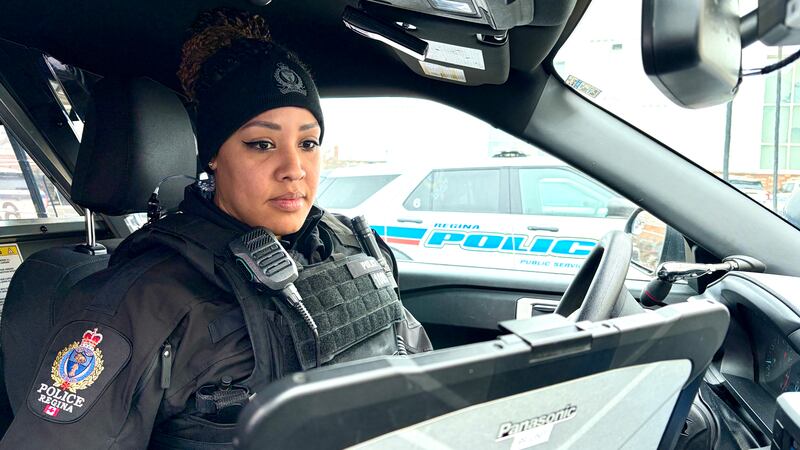
Const. Desiree Ates has been on the job with the Regina Police Service (RPS) for just a few months, graduating from the Saskatchewan Police College last December.
However, she’s already made Queen City history as the first Black female officer to wear the RPS badge.
Ates said when she was first told she was making history, it was quite the surprise.
She had joked about being the first female Black officer with her colleagues, without knowing that it was about to become her reality.
“I think representation is super, super important, and if you can see yourself and somebody else who’s already in the uniform, whether that’s just in the career itself or in the uniform or in some other aspect or element, great. I love that,” she explained.
Ates comes from a diverse background. Her father is African American, and her mother Indigenous, both cultures that Ates says have had a tremendous influence on her life.
That diversity is something that Regina Police Service Chief Lorilee Davies says she wants to see more on the force.
“There’s isn’t a way to do this job effectively, and with trust and accountability if you don’t represent your community,” she said.
“So, as our community becomes more diverse, we have to be intentional about being present in the community, building those relationships, because it’s when you have relationships that people feel confident to say, my son, my daughter, my sister, my mother could go and do that job, and I would trust RPS to treat them with respect and with compassion and all the things that a good employer should do.”
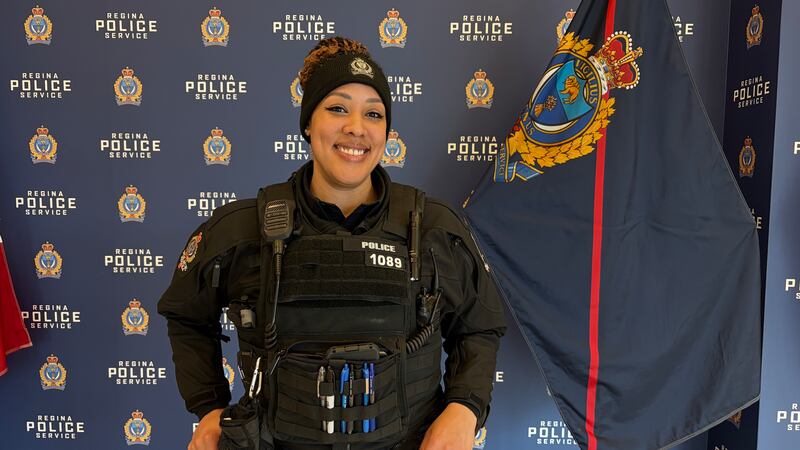
Davies said she and Ates have had some good conversations.
The two can relate, as Davies was recently named the first female chief in RPS history.
And while Ates may be a constable now, she has big goals in her policing career.
“She said, ‘I’m actually going to be the first female Black chief.’ And I’m like, ‘Yes, you go, fantastic.’ I love that she has that career aspiration, which is amazing.”
Ates is a self-described nomad, saying she has travelled far and wide in her personal and professional life.
That included a stop in Denmark, where she played professional volleyball. And according to her, that lived experience has helped her in policing to be a better communicator.
“You never know what someone’s going through. Even though they can look happy on the outside, they may have just gone through the most traumatic thing in their life,” she said.
“And so just being an ear for someone to listen to is huge. And I think that’s been a commonality amongst all of the different communities that I’ve lived.”

When asked if it was a shock that it took this long for the Queen City to see its first Black female officer of the law, Ates had mixed feelings.
“I would say yes and no, because I think policing is a career that not everyone wants to get into. It’s a very niche career, and you have to be a certain type of person to get into policing, and not everyone enjoys that,” she said.
“And in Canada, I would say our Black population is pretty small.”
As for what the future holds for Ates’ policing career, she has expressed an interest in many different avenues, including SWAT, K-9, forensics, being a spotter on the police airplane and being a school resource officer.