A little more than an hour outside of Ottawa, the small town of Perth, Ont. is dotted on roadways and in windows with signs that say “Save our College.”
The town is hoping there will be a resolution after Algonquin College announced the closure of its Perth campus last year, among other cuts, citing a multi-million dollar deficit and the federal cap on international students as factors. This month, the school approved cuts to 30 more programs.
“Of course, it’s an economic advantage to the community, because you have students here buying groceries, renting rooms and so on. But it’s that the type of college with the heritage masonry and the heritage carpentry has been here for so long. It’s so well known, it fits in well with the heritage of Perth,” Mayor Judy Brown told CTV News.
While heritage carpentry and joinery student Robin Gifford can finish his program before the school closes in August, he calls the ordeal “just too bad,” especially for first-year students.
Gifford has strong words for how post-secondary institutions have handled the international student program.
“The schools found a way to abuse international students for money, and they took advantage of it. And if your institution can’t run profitably without exploiting international students, that’s not our fault. That’s your fault,” he told CTV News from the parking lot of the Perth campus after class this week.
Algonquin College did not respond to several media requests made via email, text, phone call and even in person at the Perth campus.
This week, Canada’s Auditor General raised concerns about how the federal government handled its program to cap international student permits.
In addition to finding that the government only had the ability to investigate 4,057 of the 153,324 potentially red-flag student cases raised by post-secondary institutions, Auditor General Karen Hogan, found that the cap worked to drop the number of international students far more than expected.
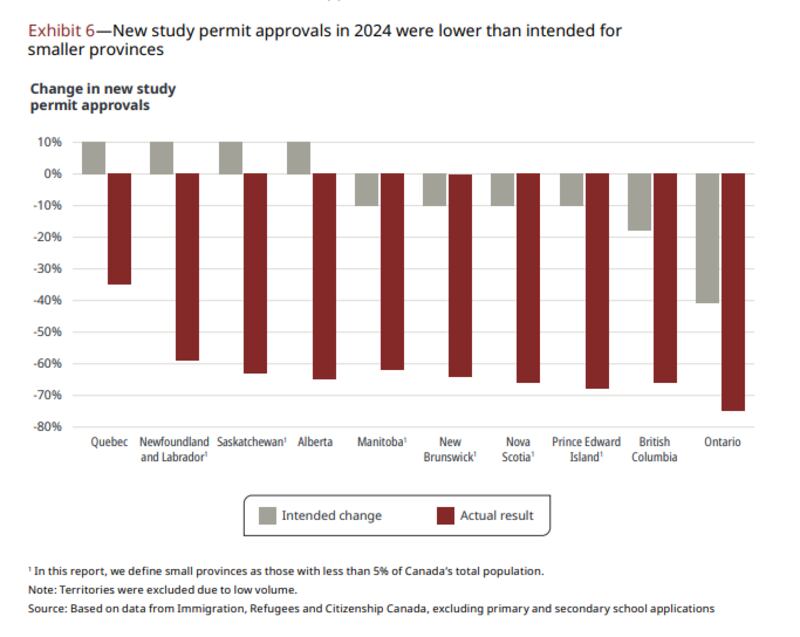
In 2024, the immigration department approved less than half the expected number of new study permits. As the table above indicates, the report also found smaller provinces were disproportionately impacted.
“What was surprising was that the immigration department couldn’t tell us why these declines happen,” Hogan said.
Canada’s reputation has ‘taken a hit’
The University of Saskatchewan tells CTV News it also does not know why the number of international students has dropped so sharply – 18 per cent across the entire student body from fall of 2024 compared to fall 2025, with much bigger impacts at the undergraduate level.
“We have seen a rather dramatic impact from those policy changes,” interim Vice-Provost Marjorie Delbaere tells CTV News.
She says the school hasn’t stopped any of its international recruitment efforts. She hopes immigration officials will meet with them to explain why their numbers dropped, and what they can do to be more successful.
“It’s something we’re trying to understand better,” Delbaere said.
According to government projections, overall the province of Saskatchewan was expected to see a 10 per cent increase in permit approvals, while it actually saw a 63 per cent decrease.
Next door, Alberta expected to see a 10 per cent increase, but saw a 65 per cent drop off.
For Lethbridge Polytechnic, an 80 per cent decline in international applications and 40 per cent decline in international enrollment “really impacted our budget,” said Registrar and Dean of Student Experience Marko Hilgersom.
Last spring, the school announced layoffs and program cuts to make up for an $8 million shortfall.
The loss of the students has also affected the feel of the school, according to Hilgersom.
“There’s a little less energy. I always like the energy. I like the voices. I like the laughter,” Hilgersom said.
In part, he says the policy changes and uncertainty have deterred potential international students from applying in the first place.
“Many are just reconsidering Canada as a place to go to school and work. … It’s hard to overcome that hit to the brand reputation.”
However, the head of Universities Canada says it’s not impossible.
Gabriel Miller says while Canada’s reputation has taken a hit due to the federal changes, “places like India want to get back on track.”
“What we need to do is make sure that the system’s stable now for a couple of years. Let’s not do anything else that sends a message to students around the world that they’re not sure how the rules work in Canada.”
On Monday, in response to the auditor general’s report, Immigration Minister Lena Metlege Diab said her government accepts the findings and recommendations to strengthen investigations of red-flagged students, and “will act to improve,” without offering any specific targets.
“Our focus will remain clear, to protect genuine students, to support our communities and to strengthen the integrity and restore public confidence in our system,” said Diab.
With files from CTV News’ Rachel Hanes

