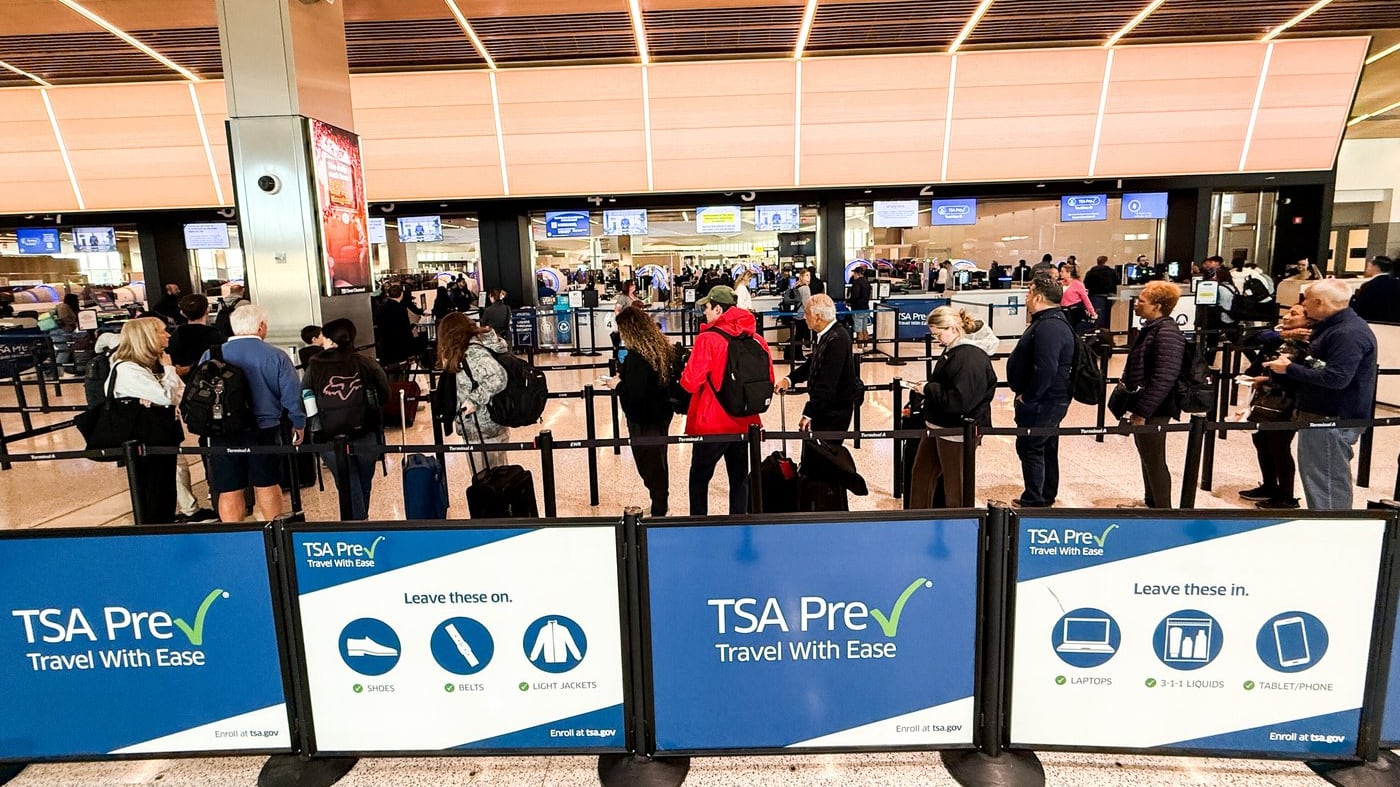
As security lines at major U.S. airports ease up after a month of long and unpredictable delays, government agencies and airport authorities are urging travellers to rethink how they prepare for flights.
U.S. Transportation Security Administration (TSA) agents started getting back pay after more than a month without income when routine U.S. Department of Homeland Security (DHS) funding was halted in mid-February.
As of Monday, long wait times at airports have begun to ease, but normal levels won’t be expected until a few weeks from now, according to one travel expert.
“It’s going to take some time for TSA agents to get paid and get back to a normal schedule,” said Alexis Parks, manager at Travel Best Bets.
At airports like Hartsfield-Jackson International Airport in Atlanta, Ga., wait times have stretched into hours amid TSA staff shortages that have significantly impacted screening capacity. U.S. Immigration and Customs Enforcement (ICE) officers have also been deployed at some U.S. airports.
Other major hubs, including George Bush Intercontinental Airport in Houston, Texas, have also experienced extended delays, including four-hour security lines, though conditions can shift quickly throughout the day.
While wait-time apps can offer estimates, official guidance from TSA and other agencies makes clear that preparation is most reliable way to avoid missing a flight.
Arrive early
The TSA recommends travellers get to the airport earlier in order to give themselves enough time to move through the various checkpoints when departing for a flight. The TSA says travellers should arrive at least two hours before a domestic flight and three hours ahead of an international departure.
Parks said a common mistake travellers make is being unprepared for connecting times between flights.
“Airlines will have an hour or even 45 minutes of connecting time. My general rule is three hours minimum because you just never know. Make sure your connecting points are giving enough time,” Parks said.
The security agency said travellers are encouraged to contact their airline as times may vary depending on the airport and travel date.
“In general, please allow time for parking-shuttle transportation, airline check-in, obtaining a boarding pass and going through the security screening process, which includes screening of your carry-on bag,” it said.
Parks said those that are coming off cruise ships or getting to a cruise ship, are groups of travellers that are showing concern and should be mindful of timing.
If a flight is missed due to a long security line, Parks said customers should check their airlines policies and rebooking options before they travel. She also mentioned that’s often beyond airlines’ control.
Pack strategically
Beyond arrival time, the TSA emphasizes that how you pack can directly impact how long you spend in line.
TSA says compliance with the 3-1-1 liquids rule – which restrict liquids, gels, and aerosols to 3.4 ounces (100 mililitres) or less per container on travellers’ carry-on luggage. All items must be put into one, quart-sized, clear, plastic, resealable bag with one bag allowed per passenger.
Travellers are also expected to remove large electronics for separate inspection, unless they are in designated expedited lanes, and to avoid bringing prohibited items that could trigger delays.
Parks said travellers should keep in mind TSA’s prohibited items, which can be found on their website.
Identification requirements
According to TSA, all passengers aged 18 or older must present valid government-issued ID to pass through a checkpoint - and for Canadians, that typically means a valid passport.
Travellers should ensure their passport is valid for the duration of their stay and keep it easily accessible.
Other acceptable IDs for Canadian travellers include a Canadian provincial driver’s licence or Indian and Northern Affairs Canada card.
For those looking to reduce time spent in line, officials point to traveller programs as one of the few ways to make the process more predictable. TSA PreCheck allows approved passengers to access dedicated screening lanes and avoid removing certain items such as shoes and light outwear. While these lines are not immune to congestion, they are generally faster than standard screening.
Where to check wait times
Against the backdrop of nationwide delays, travellers and increasingly turning to digital tools to estimate how early they should arrive. Airlines say the best advice for passengers right now is to check TSA wait times their scheduled departures.
The most widely used option is the official myTSA app, developed by the Transportation Security Administration. The app combines crowd-sourced reports with historical data to give users a sense of how busy an airport typically is at certain times of day.
The myTSA app’s dashboard currently reads: “due to the lapse in federal funding, this website will not be actively managed.”
Parks also suggested an app called “Mobile Passport Control,” which helps to speed up the U.S. entry process.
For more immediate information, travellers can also check the official website of airports that often publish live wait times broken down by terminal or checkpoint.
International travellers face an additional layer of uncertainty when clearing customs. The U.S. Customs and Boarder Protection (CBP) publishes its own airport wait time tracker, which estimates how long passengers can expect to wait when entering into the country. Like TSA data, those estimates are based on historical data at the busiest international airports.

