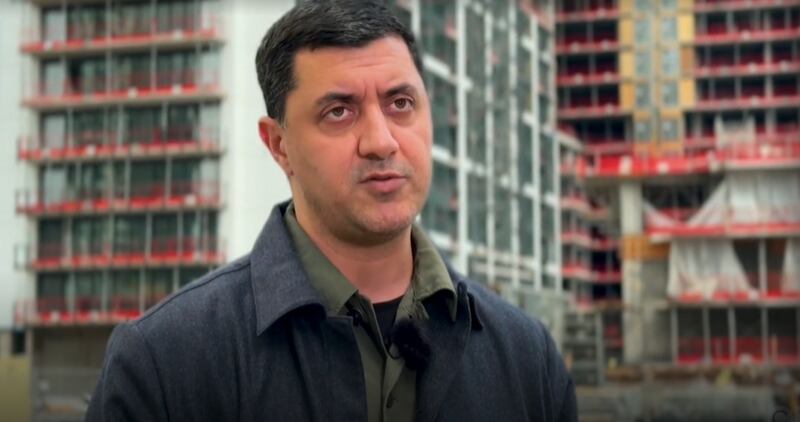
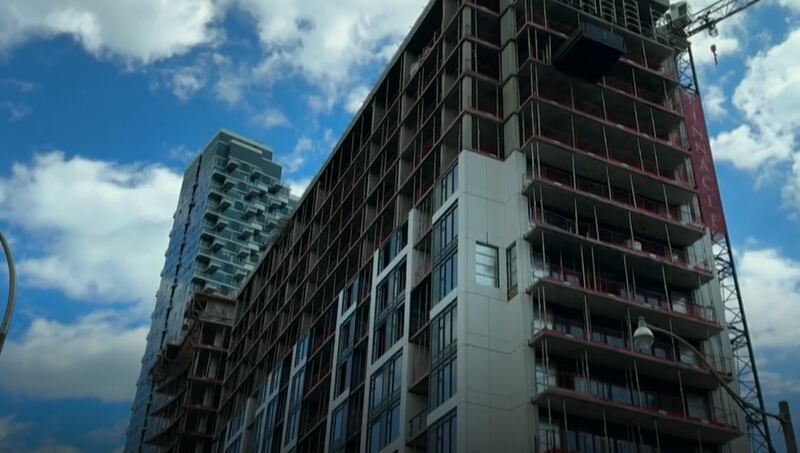
Ami Maknoon is hit with a wave of mixed emotions as he stares at the half-completed condo building along Toronto’s Lake Shore Boulevard. One of those units was not only meant to be home to his growing family, but an investment for his two daughters when he put a down payment on one-bedroom back in 2018.
But now, after years of delays and the property value plummeting, he doubts he’ll be able to find the additional $120,000 he’s expected to pay once the deal is set to close.
“The hope was to keep this as something that I can probably, later on, give it to my children, help them with their future,” said Maknoon to CTV News, Friday.
Maknoon said when he put down a 20 per cent deposit for a pre-construction condo, its value was roughly $650,000. That left the 80 per cent expected mortgage at $520,000.
But after COVID-19 led to construction delays, now the new appraised value of the home is closer to $500,000. The bank will now only lend him 80 per cent of that new, lower value, which is $400,000.
But the developer still expects buyers to pay the original agreed-upon price of which 80 per cent is left remaining to pay.
That’s a shortfall of $120,000, and money that buyers like Maknoon don’t have.
“It’s really scary, because right now we are not in a position to close,” he said. “I didn’t see it coming in my worst nightmare that my life savings would be gone like that.”
“I’m going to lose my entire downpayment and it’s not just me. It’s thousands of other people.”
Growing problem Canada-wide
Toronto-based mortgage broker and author of “Burn Your Mortgage,” Sean Cooper calls what’s happening “a perfect storm.”
“With the Canadian economy slowing down, as well as the population not growing anymore… that has definitely created challenges for condo investors, especially landlords as well," said Cooper in a Zoom interview with CTV News Friday. “There’s definitely been periods of slowdown in the market.”
“I would say this would probably affect hundreds, if not thousands of Canadians.”
Data shows apartment prices in Toronto have dropped back down to pandemic levels, after spiking in 2022. Condo values for those who bought at peak nearly four years ago have dropped to around 25 per cent.
“I’ve been a real estate lawyer for almost 50 years, and I’ve never seen anything quite like this,” said Vancouver-based real estate lawyer, Perry Ehrlich to CTV News via Zoom on Friday.
“Usually real estate is great, and if you hold it, it only gets better and better. But what’s monumental is the fact that people have put down huge deposits and think they can get bank financing… and they can’t.”
“It’s very unfortunate,” said another real estate lawyer, Alexandra Raszewska in a Zoom interview with CTV News Friday. “We’re getting a lot of calls, I’d say one or two a day where people are struggling. Closings are coming up this year, and they can’t cover the gap.”
“That is very dangerous nowadays, as people are unfortunately learning (buying condos) is no longer a mechanism to make a profit. People are truly losing a lot of money and they’re losing their deposits,” said Raszewska.
Few solutions available: experts
Real estate lawyers and mortgage brokers say there are very limited options available: find the additional money to close the property, negotiate with the developer, reassign it to a new buyer, default on the contract and risk litigation or file for bankruptcy.
“They’re going to have to come up with the money, either by borrowing or getting loans from relatives, or coming up with the money somewhere cashing an RRSP,” said Toronto-based real estate lawyer Bob Aaron to CTV News.
“Or in the worst-case scenario – I’ve had to refer some of my clients to trustees in bankruptcy because with the reconstruction contract, they are in a negative position as to their net worth and they’re going to have to go bankrupt."
Some pre-construction buyers have taken matters into their own hands, posting their properties on online platforms to try and find someone to take over their contract, but Raszewska suggests trying to talk to the developer first to find a solution.
“There, unfortunately, is very little room to renegotiate with these builders,” said Raszewska. “But there are a few things you can discuss with your lawyer, and a few things that you can ask the builder for, whether that be a price reduction, a vendor take back mortgage… maybe you can look to swap your agreement to a smaller unit that you can potentially afford better.”
Raszewska adds defaulting on the contract isn’t illegal, and perhaps the best option for some buyers is to walk away.
Calls for government to step in
Walking away from his contract and potentially risking litigation from the developer is the option Maknoon is considering.
“If I want to close, I have to pay the balance out of my pocket and I don’t have access to that money right now, so I have to forget about the down payment that I’ve paid and just deal with it. It’s a disaster,” he said. “The government is doing nothing.”
Pre-construction buyers have continued calls for the federal and provincial governments to step in to help them.
A recent public-private partnership had one real estate company, High Art Capital, team up with a Crown agency, Building Ontario Fund (BOF), to launch a $1.3-billion-dollar fund to purchase the growing number of unsold Greater Toronto Area condos and convert them into long-term affordable rental housing.
The hope for some buyers and developers is that they could add their properties to the rental market, instead of selling them.
“By converting unsold condo inventory into rental units, Building Ontario Fund is creating affordable housing for the GTA’s workforce, helping to stabilize the housing market and attract private capital; and accelerating the conversion of stalled condominium inventory into long–term rental housing," said BOF CEO, Michael Fedchyshyn in a statement to CTV News.
“This initiative is designed to turn already-built homes into long-term rental homes now,” said Ryan Roebuck with High Art Capital. “This is not a bailout, not a grant program, and not a taxpayer handout. Units will be acquired through an open and competitive market call with clear criteria around location, quality, unit mix and price.”
“It’s a good idea,” Aaron said. “It remains to be seen whether it will actually work out to fulfill the demand and the supply issues.”
CTV News reached out to the federal housing minister’s office regarding calls to aid pre-construction buyers who are facing losses but did not receive a response in time for publication.

