


As the Artemis II mission proceeds on its path Monday to breaking the record for a lunar flyby, certain questions about the journey have caught the eye of some observers.
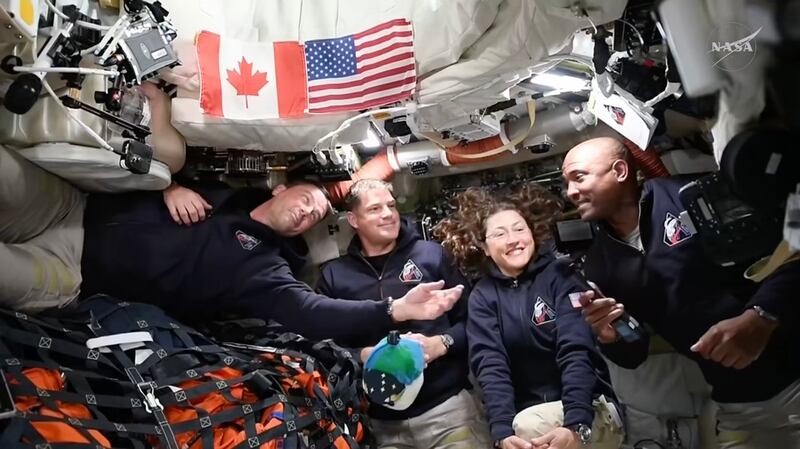
CTV News’ science and technology expert Dan Riskin, in an interview with CTV’s Your Morning on Monday, described the living conditions on the spacecraft as a small cabin with a “volume about the size of a minivan.”
The bathroom on the Orion capsule reportedly broke on Wednesday after a malfunction following lift-off but has since been mended.
- READ MORE: Artemis on track to break record set by Apollo 13 during lunar flyby
- READ MORE: Artemis II toilet acts up again as astronauts speed toward the moon to break Apollo 13’s record
So, how did the crew of Artemis II navigate that situation?
Debbie Korth, NASA’s Orion program deputy manager, said the crew members had reported a smell coming from the bathroom, adding that space toilets are “always a challenge.”
The space agency’s mission control instructed the space travellers to start using the backup urine collection bags until the bathroom was repaired.
“The way it works is the number two stuff gets captured and brought back to Earth, but the number one stuff just gets thrown out into space,” he explained. “But apparently that hasn’t been going totally according to plan.”
According to Riskin, the spacecraft was initially not ejecting the excreta back out.
“There was a problem,” Riskin said. “They haven’t given full details on what was going on, but when they had that toilet problem shortly after launch, it was dealing with number one that was causing the problems, not dealing with number two.”
Riskin described a “pungent odour” that has made the spacecraft its home following these mishaps, especially since the astronauts aboard also can’t take a shower.
“One of the things that those astronauts are doing right now is just paying close attention to what the smells are like, what the sounds are like … just letting people know, so that for future missions they can plan for it,” he said.
However, there is another factor contributing to the olfactory nuisance: flatulence.
Riskin, after a quick chuckle, explained that the gases passed by human bodies are flammable and can quickly become a major problem in space.
“You’ve got methane, you’ve got hydrogen,” he said. “Before people went to space, there was a lot of effort put into figuring out what you could feed them so they wouldn’t fart as much, and people were super worried about it.”
According to Riskin, earlier conversations from Apollo 16, when the crew didn’t know their microphones were on, described how brutal it was to be in the capsule together because of the passing of gas.
“There is an air scrubber, but how bad it smells, how much that’s happening … we’re going to find out,” he said. “That’s part of what they’re testing about the Artemis II spacecraft: How much does it stink like farts?”
With files from The Associated Press

