


On Monday, the crew of Artemis II travelled further into space than any humans had ever ventured before, and they’ve been in contact with Earth for the duration of the mission so far, but that is set to change.
For about 40 minutes on Monday evening as it travels behind the moon, the Orion spacecraft will lose contact with National Aeronautics and Space Administration (NASA) mission control.
NASA has relied on its Deep Space Network to communicate with the astronauts, utilizing giant antennas placed in California, Spain and Australia. But as Orion rounds the far side of the moon, radio communications will be completely blocked.
Similar communications blackouts have occurred each time a spacecraft has passed behind the moon’s far side, which was the case for nine of NASA’s Apollo missions between 1968 and 1972.
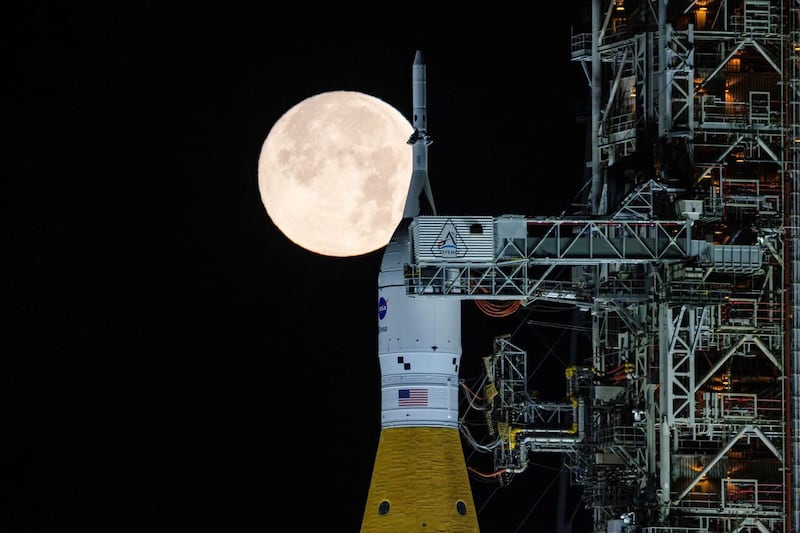
For the approximately 40 minutes that the Artemis II crew – which includes Canadian Jeremy Hansen – is alone in space, they will see something no other humans have before.
“Those astronauts are going to see the backside of the moon with their eyeballs, and the sun will be hitting the backside of the moon, which it did not do for the Apollo astronauts,” CTV News science and tech expert Dan Riskin told CTV News Channel on Saturday.
“They’ll be seeing a sun-lit surface that no human’s eyeballs have ever seen before.”
One of Artemis II’s flight directors, Judd Frieling, told The Associated Press the communications blackouts were always a tense time for ground controllers during the Apollo missions.
Derek Buzasi, professor of astronomy and astrophysics at the University of Chicago, told the AFP news service that “we all held our breaths a little bit,” when previous Apollo missions rounded the moon and communications were briefly cut off.
“It’ll be exciting, you know, in a slightly scary way, when they go behind the moon,” he said.
But, Frieling noted, during that time, “physics takes over and physics will absolutely get us back to the front side of the moon.”
The blackout is expected to begin at around 6:45 p.m. ET, with mission control re-acquiring communications with Orion at around 7:25 p.m.
If something goes wrong during the blackout, or at any point in the mission, Riskin said the crew is prepared for “every contingency that could possibly happen,” noting that if there was a serious failure like a leak, the crew have spacesuits and other equipment that would protect them.
Although the communications blackout may be nerve-wracking, Riskin said mission control is more likely to be looking ahead to Orion’s re-entry into Earth’s atmosphere, which presents more serious safety risks for the crew.
“Then it’s really a question of how that re-entry burn goes … because there were some surprises with Artemis I and they think they’ve figured those out and they’ve organized things a little differently for this spacecraft,” he said.
“But I think we risk missing this beautiful moment if we think too much down the road.”

