WINNIPEG — Lisa Taron was left to rely on her 91-year-old mother financially after scammers, claiming to be from her bank, left her without any money.
On Feb. 12, the 62-year-old Taron said she received a call from someone who claimed to work for TD Bank, saying they flagged a potentially fraudulent charge in Montreal.
“I’m not in Montreal, and I said that wasn’t me,” she said.
Taron said the caller placed her on hold several times, playing what sounded like TD’s official hold music, and appeared to have detailed information about her account.
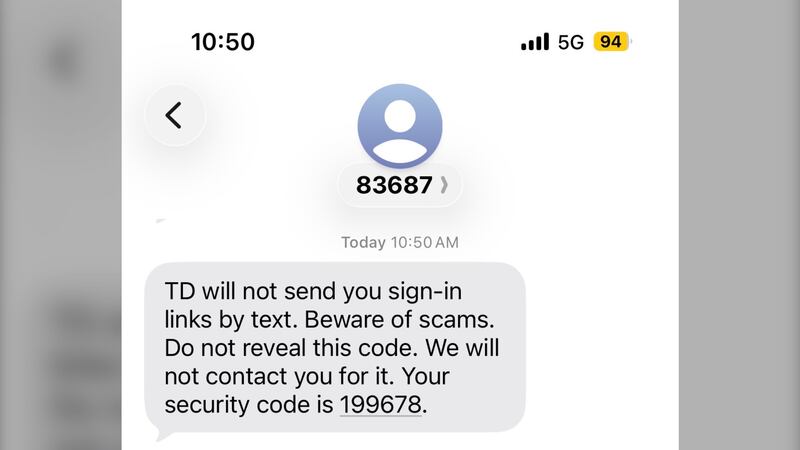
Taron said she was asked to confirm a text message and was then told about a second charge regarding an international Air Canada fare.
“I panicked. I said, that wasn’t me. I was put on hold and they never came back,” she said.
Taron immediately contacted her bank, in which they informed her that her account was breached. She was told a new debit card would be issued to her.
But when she checked her account the next day, she couldn’t believe what she saw.
About $2,500 had been drained from her account through repeated $93 withdrawals.
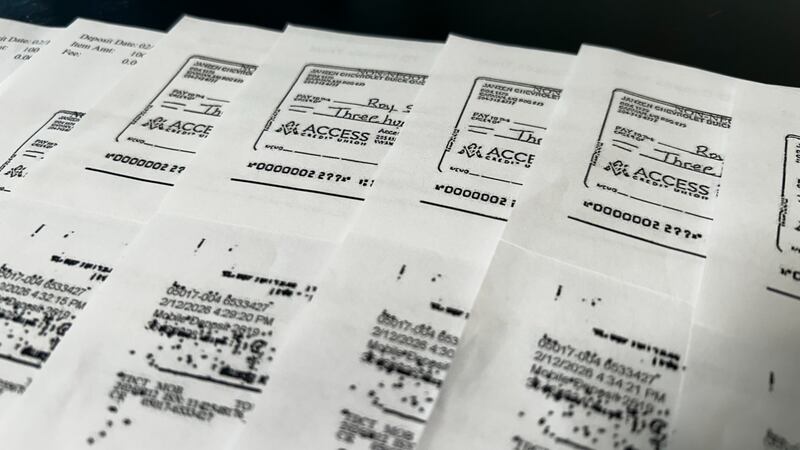
In addition, scammers withdrew another $2,100 by exploiting the bank’s mobile app, depositing the same $100 cheque, made out to someone named Roy Scott, into her account 21 times.
In total, Taron lost $4,650 and was left with a negative balance.
“I was baffled because never at any point did I give my account number and pin number,” she said. “Those are two crucial elements you need to access a bank account.”
She’s now questioning how the scammers were able to appear so convincing.
“If someone out there knows my name, my phone number, has information about my account, has the same TD on hold music, the same TD on call display, how is it that they are able to do that?” she said.
‘Distressing’ to be fraud victim: TD spokesperson
Mick Ramos, a senior manager for TD Bank Group, told CTV News they aren’t able to speak to details of the case due to privacy concerns, but says each case is assessed individually.
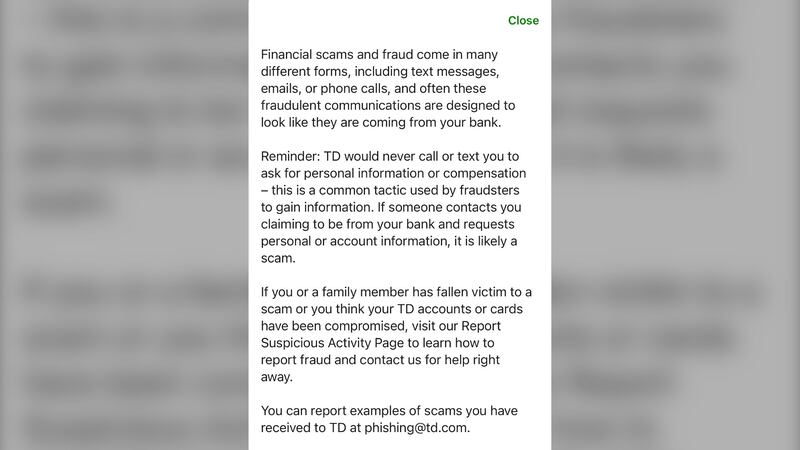
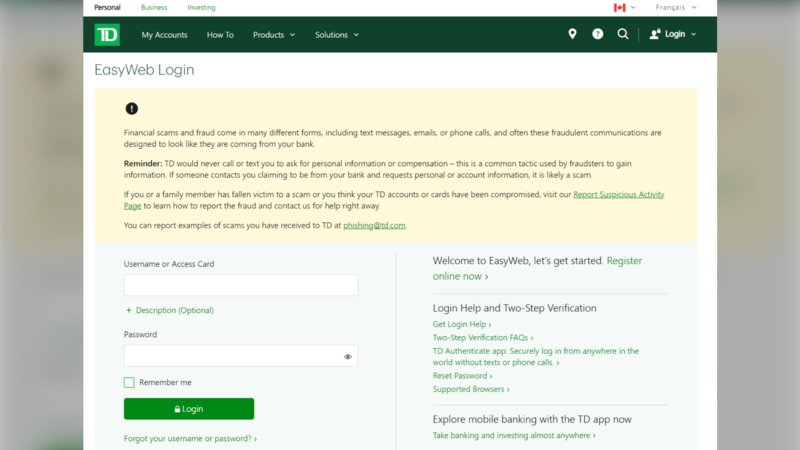
“Please remember: if you receive a suspicious call or text from someone claiming to be your bank, verify it by calling the number on the back of your card. Caller ID can be faked,” he said.
“Your bank will never contact you to ask for a one-time passcode sent to your mobile device or email address. Don’t share this code with anyone.”
Taron said her requests for reimbursement were denied twice, which has frustrated her.
Living in subsidized housing, she was left with no savings and forced to depend on her elderly mother for rent, food and medication.
“It is brutal when you have no money in your account and you’re fighting a bank. It is brutal,” she said. “The systems are getting very slick, extremely slick, and now with AI they might even get slicker, but we are all going to be vulnerable to this.”
Taron said if she didn’t have her mom, “I would have had to set up a GoFundMe because I have nothing to sell.”
Taron hopes her story serves as a warning to others.
Fraud a fast-growing crime in Canada
Data released in March by the Canadian Anti-Fraud Centre (CAFC) shows fraud is rapidly increasing across the country.
Canadians lost more than $704 million to fraud in 2025, which is up from $638 million in 2024.
Fraud losses since 2022 have surpassed $2.4 billion.
“We’re seeing that fraudsters now have more personal information when they’re calling victims to make it more believable,” said Jeff Horncastle, who is the client and communications officer with the CAFC. “Technology is being weaponized.”
“We’re getting a lot of reports of fraudsters having some of the victim’s personal information before they make the outgoing phone call,” he added. “We have to remember that even if the person calling us has personal information, it may not be legitimate and always take the time you need to verify.”
David Gerhard says scams, like the one Taron experienced, are becoming all too common.
“The powerful tools of artificial intelligence allow scammers to build narratives that seem to be more convincing to be able to use the communication channels,” said Gerhard, who serves as the department head of computer science at the University of Manitoba. “That makes it easier to have these fraudulent activities take place.”
‘An epidemic’
Tech analyst Carmi Levy says scams are becoming more sophisticated than ever before, fooling not just seniors, but young people too.
“For years, it was always easy to tell that it was a scam because their English wasn’t so great; maybe the graphics were a little bit off; it was obvious that it was amateur hour,” he said. “Now scammers have access to tools that allow them very high-fidelity assets, so they can legitimately pretend to be from a bank, convince us that they’re from a bank, convince us that they are someone who they clearly are not.”
Levy said there are signs Canadians should be looking out for to identify scams online or over the phone.
“Most banks, most government agencies, most insurance companies will not spontaneously message you for something there, and so that should be your first clue,” he said.
“Look up the names of those who they say they are. Do they have a LinkedIn profile? Can you find them on Google? Are they legitimate? If they don’t exist, that’s another tell.”
Levy’s advice is blunt.
“Stop believing people when the phone rings,” he said.
If you have been a victim of fraud, report it right away to either your financial institution, the police, or the CAFC.

