A woman who hit and killed a nine-year-old girl at a Saskatoon crosswalk will not be going back to trial.
In a unanimous decision released Friday, Saskatchewan’s appeal court upheld a stay of proceedings in the case of Taylor Kennedy, whose trial was ended in December 2024 when a judge determined the woman’s rights were breached because she was not tried within a reasonable time.
The Charter of Rights and Freedoms guarantees every person charged with an offence the right “to be tried within a reasonable time,” which the Supreme Court of Canada has interpreted to mean a trial should conclude no later than 18 months after the day charges are laid — referred to as the “Jordan limit.”
Kennedy was charged with impaired driving exceeding the prescribed blood-drug concentration of THC, causing the death of nine-year-old Baeleigh Maurice. She was the first person in Saskatchewan charged with causing a death while driving under the influence of THC.
Maurice was going to school on Sept. 9, 2021, pushing her scooter at a crosswalk on 33rd Street West, when she was hit by Kennedy’s truck.

At the crash scene — before an officer read her rights — Kennedy told police she vaped marijuana and micro-dosed magic mushrooms the day prior.
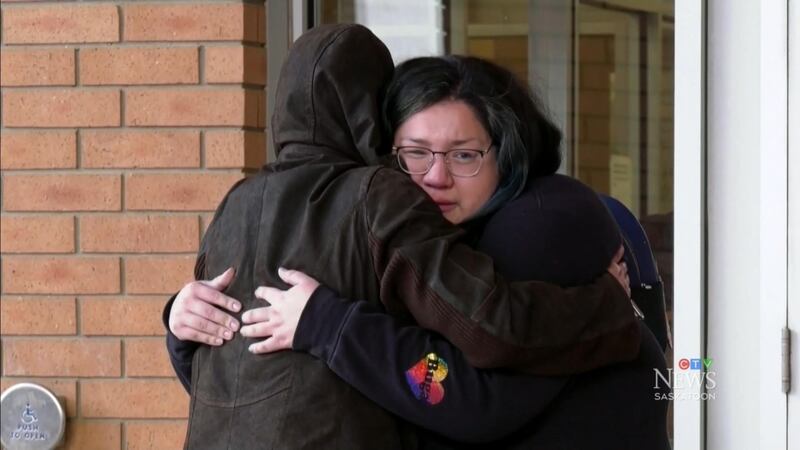
When Judge Jane Wootten announced the stay of proceedings in December 2024, just shy of 30 months after the charges were laid, the gallery erupted in anger.
“You’re forever going down as the white judge who upheld white supremacy,” someone in the gallery yelled.
“Racist! F****** racist!” another person shouted.
The Crown quickly appealed and made its case before the panel of three judges in November 2025, arguing that even though Kennedy’s right to be tried within a reasonable time was violated, Justice Wootten erred by not finding there were additional reasons to extend the time limit due to the COVID-19 pandemic.
In its decision, the appeal court agreed Wootten should have extended the time limit.
“However, even adjusting for this and one other matter, Ms. Kennedy was still not tried within a reasonable time. For this reason, the Crown’s appeal must be dismissed.”
How did they calculate the delay?
In calculating how many of the 899 days between the charge and the end of trial actually counted toward the 18-month Jordan limit, Wootten first subtracted any delays that were the responsiblity of the defence — finding 109 days of defence delay.
Wootten also substracted the 49 days she took to render a significant decision in the middle of proceedings.
Even with these adjustments, the total time to trial remained well in excess of what would be reasonable under the Jordan framework.
But in its appeal, the Crown argued that further subtractions should have been made from the total, including 120 because of the COVID-19 pandemic, 60 days for an “exceptional circumstance arising from the service of a defence Charter application,” and 45 additional days it said was caused by defence counsel.
With those additional days subtracted from the total, the Crown contended Kennedy was tried within a reasonable time.
Kennedy’s defence was that the Crown took a “lackadaisical” approach to the case, and ought to bear most of the weight of the delay.
“She takes the position that, if anything, the judge was overly generous in the calculation of defence delay.”
After a detailed parsing of the Crown’s math, the appeal court could only remove another 134 days from the total — 120 to account for the pandemic, and another 14 for days in which the Crown was available but defence counsel was not.
Even accounting for that adjustment, the time to conclude her trial still “significantly exceeded what is allowable under the Charter,” the court ruled.
“As has been noted, the Crown agrees that, if Ms. Kennedy’s right to be tried within a reasonable time was breached, the charge against her was properly stayed. Accordingly, the Crown’s appeal must be dismissed.”
Will the Crown appeal to the Supreme Court?
It remains to be seen if the Crown will pursue its final avenue of appeal with the Supreme Court of Canada.
A spokesperson for the Public Prosecutions office told CTV News it’s currently reviewing the decisions to determine whether a further appeal would be appropriate.
Stay by delay: How common are these in cases in Saskatchewan?
The Public Prosecutions office maintains it has enough staff to resolve most cases in a timely fashion, and that “the vast majority of cases in Saskatchewan are resolved within the time limit.”
“In the small number of cases where that has not happened, it has been a result of unique circumstances,” a spokesperson told CTV News.
Relative to other provinces, Saskatchewan has a relatively low rate of cases that exceed the Jordan limit, based on Statistics Canada’s Integrated Criminal Court Survey.
Year-over-year, Saskatchewan is among the lowest in the country at 2.7 per cent, with a nationwide average of 9.4.
It may be statistically aberrant, but that’s cold comfort for the victims of crime and their families.
“Public Prosecutions understands that these are tragic circumstances and that this case has been incredibly difficult for the family. Every effort is made as part of a prosecution to maintain communication with victims’ families and ensure they are connected with resources from Victim Services.”
It also pointed to a newly-implemented Case Readiness Unit, created to help address high caseloads and prioritize complex criminal files.
RELATED:
With files from Laura Woodward and Matt Young

