WINNIPEG – Lisa Taron was left to rely on her 91-year-old mother for financial support after scammers, posing as representatives from her bank, gained access to her account and drained her savings.
In February, approximately $2,500 was withdrawn from her TD Bank account through repeated withdrawals of $93.
In addition, the fraudsters withdrew another $2,100 by exploiting the bank’s mobile app and depositing the same $100 cheque into her account 21 times.
However, the name on those fraudulent cheques was not Taron’s, instead it belonged to a person named Roy Scott.

CTV News was able to get in contact with Scott, who lives in Carman, Man., about 75 kilometres southwest of Winnipeg.
Even though his name appears on the cheques that drained Taron’s account, Scott is urging he is not the scammer, rather a victim.
He says he lost thousands of dollars after fraudsters accessed his account at TD Bank in October.
“They went into my e-Transfer accounts, my line of credits, my credit cards, my deposits, and they took an image of my cheque, and if you’ll notice on that cheque, even though the numerical number is $100, it’s still made out to $322 on the cheque,” he said.
“My daughter’s account was cleaned out, in the neighbourhood of $2,000, and her disability checks go into that account.”
Scott says he believes the situation began after he completed work for a company in Carman Man. and deposited a legitimate cheque at the bank.
Days later, his account was compromised. He says fraudsters copied the cheque and began altering its numerical value.
Scott says he spoke with the RCMP, who told him that three accounts had been opened under his name in Ontario.
He reported the incident to both the RCMP and TD Bank. Months later he received a deposit from the bank, but says he is still trying to determine what losses the amount he received actually covers.
“There was money taken off my visa cards, there was money taken out of my savings account, there was money taken out of my line of credit,” he said.
Scott believes he is still owed money.
“As far as I am concerned, I still am,” he said.
Fraud reports taken seriously: TD spokesperson
Mick Ramos, a senior manager for TD Bank Group, told CTV News on Friday, that they cannot comment on any details of the case due to privacy matters, but confirmed that they have reached out and have been in contact with Scott.
“Each circumstance is different and assessed individually,” he said in an emailed statement. “If you’ve been a victim of fraud, report it right away to your financial institution, the police, credit bureaus and the Canadian Anti-Fraud Centre.
Like Scott, Taron, who spoke to CTV News earlier this week, said she is still fighting TD to get the over $4,000 she lost from scammers.
“I am still getting brushed off from TD,” she said. “This has really affected me. It’s been so exhausting. I don’t sleep and it’s been hard to concentrate on anything.”
“My heart absolutely breaks for those who are experiencing similar hardship due to gross negligence of TD Bank.”
Taron says she plans to sue TD in court “for more than they allowed to be stolen from me.”
Fraud growing in Canada
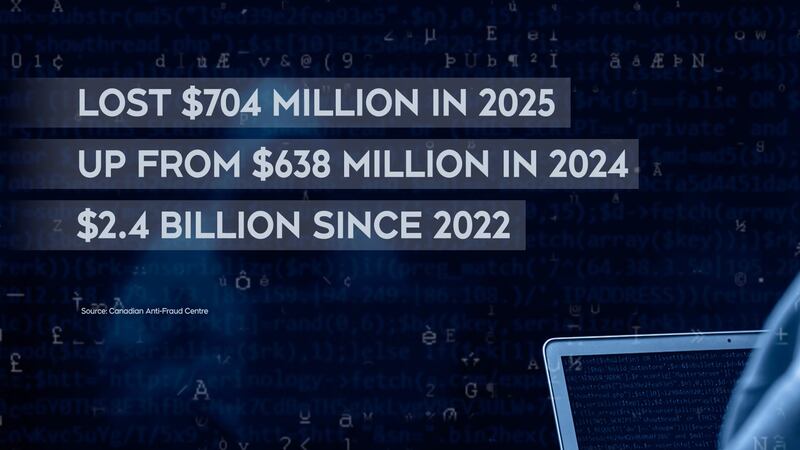
Data released in March from the Canadian Anti-Fraud Centre (CAFC) shows fraud is increasing across the country.
$704 million was lost to fraud in 2025, up from $638 million in 2024.
Since 2022, fraud losses have surpassed $2.4 billion.
Jeff Horncastle with the CAFC told CTV News earlier this week, that fraud is changing on a daily basis.
“We’re getting a lot of reports that fraudsters have some of the victims’ personal information before they make the outgoing phone call, or before they send the email,” Horncastle said, the client and communications officer with the CAFC.
“We have to remember that even if the person calling us has personal information, it may not be legitimate and always take the time you need to verify and report as much as you can.”
Tech analyst Carmi Levy, says scams and incidents of fraud is an “epidemic” in Canada, saying it’s getting worse by the day.
“The numbers keep going up,” he told CTV News earlier this week. “The victims aren’t just seniors, they’re all ages and unfortunately, they’re becoming more sophisticated.”
Levy said there are some tell-tale signs Canadians should be looking out for.
“Most banks, most government agencies, most insurance companies, will not spontaneously message you for something and so that should be your first clue,” he said.
“It’s okay to hang up the phone; It’s okay to challenge when someone calls you; It’s okay to break that chain of messaging and then use your own research to call your bank directly.”
“In the past, it was easier to tell the difference between legitimate and not legitimate. You could lean in and look for inadequate grammar or language, or you know, bad copy in a script.” he said. “Whereas now, thanks to artificial intelligence, even when we lean in, we can’t tell. It looks legitimate and it looks professional.”
Concerns of continued impact
As for Scott, he is worried about what will happen going forward.
“I am concerned because as long as they can keep photocopying that cheque, they can keep using it,” he said. “I don’t know how you can stop these people anymore.”
“I can only help and I don’t see it being stopped at the end of it, because I mean, these are professional people,” he said.

