Prime Minister Mark Carney is on the precipice of a majority government, a milestone the Liberals haven’t reached in years.
There are three federal by-elections taking place on Monday, and the Liberals only need to win one to reach the 172-seat threshold required to control the majority of seats in this 45th Parliament.
So, how did Carney get here? What are the ridings that are up for grabs? And what does the party plan to do with more power? The difference a year makes
Nearly one year ago, Carney was dancing to Canadian band Down With Webster, celebrating the Liberals’ federal election win. Clinching 169 seats, it was a major comeback for an embattled party but still landed the Liberals three seats shy of a majority mandate.
“I’m looking forward to working together to deliver for Canadians,” Carney said on election night.
After months of having to work across party lines, and amid senior Liberals Chrystia Freeland and Bill Blair vacating their seats, the math started to improve for Carney’s majority.One by one, the prime minister attracted five opposition MPs to cross the floor. First it was Nova Scotia Conservative MP Chris d’Entremont in November.
Come the Liberal Christmas party in December, Ontario Conservative MP Michael Ma followed suit. By February, Alberta Conservative MP Matt Jeneroux was ready to make the leap rather than resigning. Then, it was the New Democrats’ turn to lose a member, seeing Nunavut MP Lori Idlout leave her then-caucus of seven MPs to become a Liberal. Lastly, Ontario Conservative MP Marilyn Gladu joined Carney’s ranks.
The ideological range and rapidity of the defections was a rare feat that brought his party to 171 seats and making it so Carney’s coveted majority could be claimed at the ballot box.
‘Canadians voted for a minority’
Though, Conservatives don’t see it that way.
“They’re denying the democracy that was reflected in the last election, which was a fiercely contested election, a narrowly decided outcome,” said Conservative MP Shuvaloy Majumdar in an interview on CTV’s Question Period. “Canadians voted for a minority Parliament, and in doing so, they had an expectation that the government [and]the opposition would work together on their priorities.”
Majumdar accused Carney – and the cabinet members that have been involved in the conversations to convince MPs to cross the floor – of “playing conniving games of an authoritarian looking to consolidate power in the House of Commons.”
Switching party affiliations between elections is a legitimate option members of Parliament have in our political system.
Conservative Leader Pierre Poilievre has in the past voted against a proposal to force byelections in cases of floor-crossings, a measure he’s endorsed since the defections from his ranks occurred.
CTV News’ pollster Nik Nanos said the current 13-point advantage the Liberals have over the Conservatives is “a bigger advantage than they had in the last federal election.”
Three seats for the taking
Now, with three vacant seats up for grabs on Monday, just one would bring the Liberals over the majority threshold. Any additional pickups would further stabilize the party’s control over Parliament.
Two of the ridings in question are in Liberal strongholds University-Rosedale, Ont. and Scarborough Southwest, Ont. and the third is in what pollsters consider a Bloc Quebecois-Liberal tossup, Terrebonne, Que.
“I’m watching for voter turnout,” Nanos said. “In Terrebonne, it’s going to be a block-by-block, neighborhood-by-neighborhood fight.”
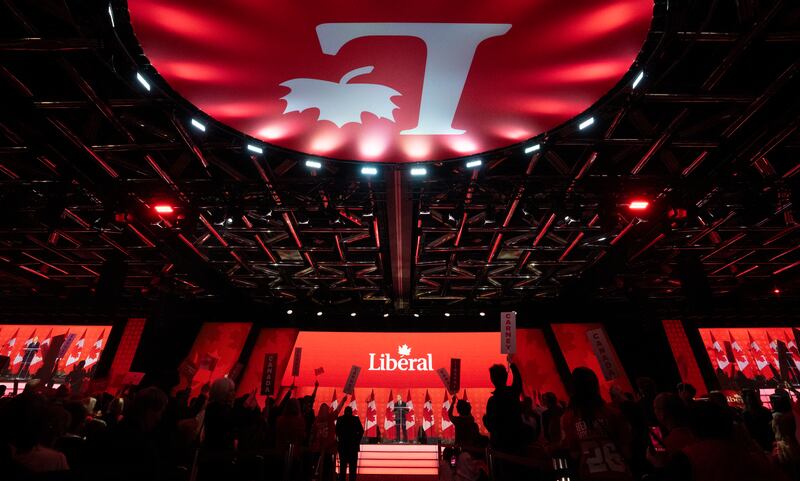
Some Liberal insiders at the party’s national convention in Montreal have suggested Carney wants to seal his majority “at the ballot box” and not through additional floor-crossers, which the former communications director to prime minister Paul Martin says is “just plain sensible.”
“It just comes with that added degree of legitimacy,” said Scott Reid. “And it’s buttressed by other things. I mean, if the prime minister should win all three ridings, then that also is echoed in the popular support that he enjoys right now.”
What will Carney do with more power?
Speaking to CTV News’ Mike Le Couteur at the convention on Friday, Liberal Party President Sachit Mehra said the prime minister tightening his grip on power will give the government momentum but doesn’t change their plans.
“I think Canada finds itself in a moment, in a global moment, and Canadians want to feel that their government is unified and working hard,” he said. “We’re going to keep working for Canadians. We’re going to keep working towards making Canada a better place.”
Carney has also said he doesn’t plan to prorogue Parliament if he clinches a majority, saying his MPs will be focused on using any new parliamentary leverage to pass more Liberal policy.
“We are absolutely focused on working with Parliament, getting legislation through Parliament, adjusting legislation where it needs to be, where it’s better informed by the discussions in Parliament,” Carney told reporters in late March.

