It took decades for forensic technology to advance so experts could identify the body of missing Ontario woman Pamela Harvey.
For 46 years, the 23-year-old’s remains waited at Laboratoire de Sciences Judiciaires et de Médecine Légale (LSJML) in Montreal, Que.
Dr. Corinne D’Anjou, chief forensic odontologist at the LSJML, is the one who first discovered a link between a set of remains in the lab and Harvey, who went missing from Sudbury, Ont., on Christmas Day in 1978.
In March 1979, the body of an unidentified woman was discovered in Saint-Eustache, Que., but forensics were not advanced enough to make an identification.
The remains were sent to the LSJML.
“Back in the 1970s, we didn’t even know that DNA would be something at one point,” explains D’Anjou. “Techniques that were used back then were not in mind of maybe, someday, something will happen [to advance techniques in forensics].”
D’Anjou is part of the lab’s forensic identification unit, created in 2023 in collaboration with the Corner’s office, the Sûreté du Québec (SQ), Montreal police (SPVM) and many other police forces.
The goal: identify as many Jane and John Does as possible.
“We have, now, 29 cases that have been identified, which is quite a bit,” D’Anjou said. “We have...seven other cases that are pending more expertise and can be identified pretty soon as well.”
She adds that, in preparing for her interview with CTV News, she may have made an additional possible match.
“I was organizing for you, and I was like, oh wait a second,” she said. “I was just punching holes [in a binder], and it’s oftentimes how it happens. I do some links, but the police officers do a lot of links as well.”
There are still 304 potential matches waiting to be made by the LSJML.
Bazar de la Charité
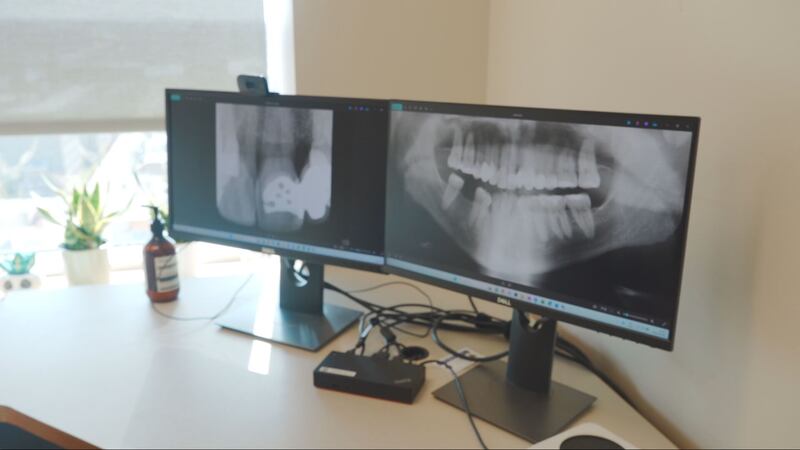
Forensic odontology, D’Anjou explains, is not a new science.
It dates back to the Bazar de la Charité fire in Paris, Fra., in 1897.
The blaze claimed the lives of 126 people, including many notable aristocratic women.
“Most people were identified with a piece of clothing,” D’Anjou said. “At one point, one was too burned to be identified with anything. So, they looked at the mouth, and they saw that there were a lot of fillings.”
She says officials compared it to dental records, and the victim was identified as Sophie Charlotte of Bavaria, Duchess of Alençon, by her dentist.
“We look at the teeth...and we do what we call an odontograph, where what we do is we draw all the fillings that person has, and it’s extremely similar to what was done in the late 1800s,” she said.
First forensics lab in North America
The LSJML was the first forensics lab ever created in North America.
It was founded in 1914 and falls under the jurisdiction of the Quebec Ministry of Public Security.
It brings together a host of scientific expertise, including toxicology, DNA, pathology, anthropology and more.
D’Anjou admits that, realistically, the lab will most likely never identify every single set of remains that comes into the LSJML.
All the same, she says she’ll never stop trying to bring closure to families waiting for their loved ones to come home - even if it takes decades.
“There are cases that will remain with us much longer,” she said. “At the same time, the purpose of doing this is giving answers to the families, as much as it can be upsetting sometimes or it can be a sad situation, the deceased deserve all of our attention.”

