Watch special live coverage,CTV News Special: Federal Byelections 2026 hosted by Omar Sachedina and Vassy Kapelos, starting at 7 p.m. ET, streaming on CTVNews.ca, the CTV News App,CP24.com, the CP24 App, BNNBloomberg.ca, the BNN Bloomberg App, Crave, and broadcast on CTV News Channel, CP24 and BNN Bloomberg.
Voters in three distinct federal ridings — Terrebonne, Scarborough Southwest, and University—Rosedale — are heading to the polls Monday for byelections that showcase Canada’s diverse political landscape.
From a razor-thin margin in the suburban Quebec riding of Terrebonne in last April’s federal election, to the deeply entrenched Liberal strongholds in Toronto, the demographic and voting patterns in each riding tell a unique story.
While two of the races appear to be foregone conclusions, a closer look at the voters by data analytics firm Environics Analysis reveals the anxieties and priorities that could shape the results, from cost-of-living pressures on families to the influence of star candidates and the critical importance of voter turnout.
Terrebonne
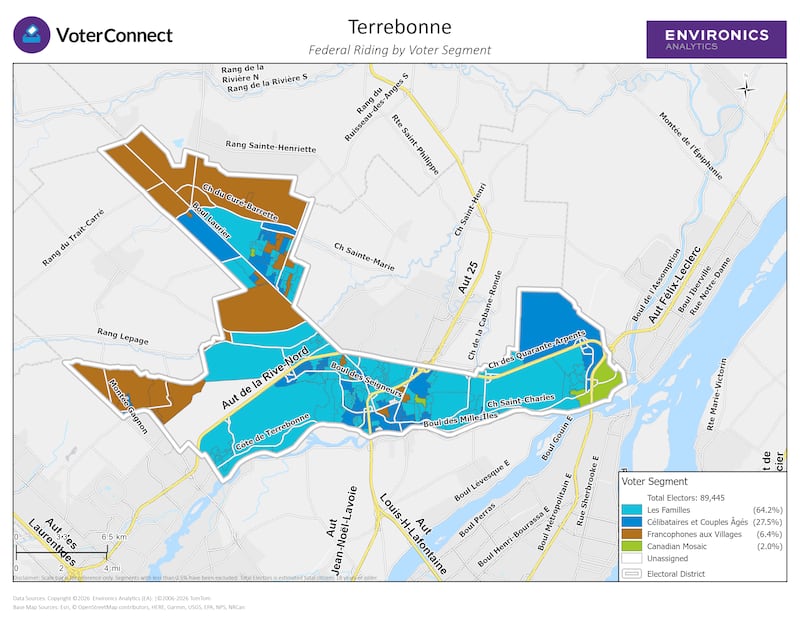
Terrebonne is a north shore riding of suburban Montreal, north of Laval. Residents are most likely to be middle-aged families with school-aged children who live comfortable commuter lifestyles.
Average household income at $125,000 is above average for Quebec. About 14% of residents are immigrants here, with 19% identifying as a visible minority. While the suburban family orientation of the riding is dominant, other lifestyles are present: about one in four household maintainers are seniors (65+) and 30% of residents live in apartments.
From a voting perspective, Terrebonne has been a Bloc Québecois (BQ) stronghold since 2015. But in last year’s federal election, the Liberals and Conservatives gained share, pushing the Liberals to win by one vote, with both the BQ and Liberals achieving 38.7% of the vote, while the Conservatives got 18.2%.
Last year, there was clearly a shift in voting patterns when a former BQ member of parliament who ran as an independent in 2021 was not in the race. There were also the trade and cost-of-living issues driving a change in voting patterns to consolidate away from smaller parties. The result was this extremely close race. Issues with some mail-in ballots resulted in a by-election being called.
The dynamics that will shape the results
The BQ outperformed in this riding compared to peer ridings in Suburban Montreal. When we break the Terrebonne results down into the Environics Analytics VoterConnect voter segments, the pattern is clear. If the segments present in Terrebonne voted more similarly to their patterns observed in peer ridings around the Montreal suburbs, the Liberals would have won this riding. Two voter segments stand out:
Les Familles (66% of voters in 2025) favoured the Liberals by 40.3% to 37.5% for the BQ. In suburban Montreal overall, the split for similar voters was 42.4% to 36.6% which is a wider margin for the Liberals. Turnout was also relatively weak for this segment at 69.7% in Terrebonne compared to 74.1% in suburban Montreal. The challenge for the Liberals to win this riding is to get as many of these voters to cast a ballot as possible since they tend to favour the Liberals. They could support this by speaking to this segment’s concerns about interest rates and cost of living given their higher-than-average debt levels and expenditures on food, transportation, housing and childcare.
Célibataires et Couples Âgés (27% of voters) favoured the BQ by 41.7% to the Liberals at 35.8%. The result in Terrebonne for this segment of voters was better than in suburban Montreal overall: BQ 39.7% vs. Liberals 38.3%. Turnout among this segment in Terrebonne was slightly weaker than the regional average. The BQ needs to get these voters out as much as possible and keep speaking to their concerns, as the older and more modest income residents are going to worry about healthcare access and inflation eroding the value of their retirement savings.
Scarborough Southwest
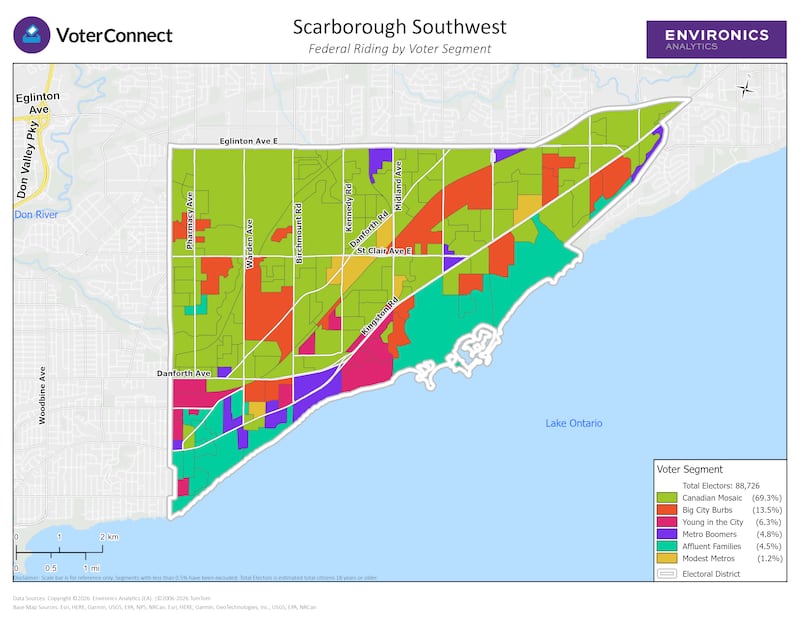
Scarborough Southwest is a riding where half the population is immigrants and 64% identify as visible minorities with South Asian, Black and Filipino the most common groups.
Families with children of varying ages are common, and household maintainers tend to be in the 35-64 age range. Residents are well educated, but incomes are on the lower side at $114,000 per household which is below the national average.
Residents in this riding are split quite evenly between houses and apartments, owners and renters. The largest Environics Analytics VoterConnect segment here is Canadian Mosaic who cast 67.1% of votes in the last election.
Voters strongly favoured the Liberals, with Bill Blair, a cabinet minister, holding the seat. They took 61.5% of the votes, compared to the Conservatives’ 30.6%. The Liberals outperformed in this riding at the Conservatives’ expense when we compare each voter segment’s performance in this riding to how they voted in the group of Toronto City (’416′ area) ridings overall.
Of particular note, among the all-important Canadian Mosaic segment, the Liberals got a 61.7% share here, compared to 56.6% in Toronto City overall.
With the Liberals having a very large lead, the gap will be difficult to overcome, but appealing to Canadian Mosaic’s concerns with crime and safety, support for cultural diversity, and cost-of-living challenges — especially relating to housing — could be effective in swaying their votes.
University—Rosedale
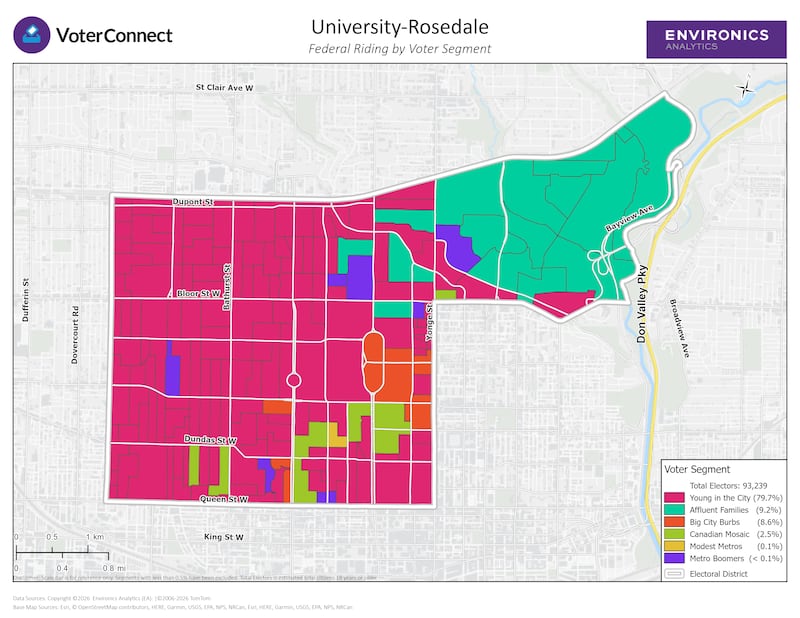
University—Rosedale is a downtown Toronto riding where young, childless professionals -- typically under 45 -- live in apartments and condos. Accordingly, 85% of residents live in the VoterConnect segment called Young in the City. Another 9% fall into an older segment called Affluent Families.
Overall, residents are well educated and have average household incomes of $186,000, which is 52% above the national average. The riding’s population has grown rapidly over the past five years. Immigrants make up 40% of the population and about 19% of residents identify themselves as Chinese visible minority, according to the Statistics Canada definition.
University—Rosedale residents feel relatively secure regarding their financial future and tend to support cultural diversity and environmental protection. The Liberals performed very well here, winning with 64.0% of the overall vote, with the Conservatives a distant 23.5%.
Our estimates show the Liberals outperformed based on typical voting patterns in Toronto City (the ’416′ area).
Chrystia Freeland, a longtime cabinet minister, held the seat since 2015. Ministers often boost party performance in ridings. The dominant voter segment, Young in the City, voted for the Liberals, 61.8% versus 26.3% for the Conservatives in Toronto City overall, meaning the Liberals outperformed in this riding by about 2.6% at the expense of the Conservatives.
With new candidates for the Liberals and Conservatives in this by-election, we will see Monday night whether the Liberals can retain such a large share of the vote.
- Toronto voters are going to the polls in two federal byelections today. Here’s why they matter
- Voters heading back to the polls in Terrebonne: here’s what you need to know
Definitions of VoterConnect segments mentioned in the above analyses
Les Familles
Representing 23% of the electorate in Quebec, Les Familles are upper-middle-class families in Quebec’s suburbs. Despite their decent incomes, Les Familles have an above-average debt-to-asset ratio so affordability and interest rates could figure in their day-to-day concerns, though their Social Values indicate they are less worried about their future finances (Financial Concern Regarding the Future) and enjoy living for today (Intuition & Impulse). When this segment is online, they like to stream music and TV content. They had the highest voter turnout of all segments in Quebec for the 2025 federal election (74.2%). Les Familles favoured the Bloc Québécois, with the Liberals finishing second.
Célibataires et Couples Âgés
These traditional, older singles and couples live in and around Quebec’s cities, mostly outside of the Montreal region. They live in a mix of apartments and houses, and, for those not working, their modest incomes depend on pensions and retirement savings. With the cost of living relatively low in their communities, they can still participate in cultural activities and take the odd trip, though their Social Values indicate that pragmatism and simplicity will be important considerations in decision-making (Utilitarian Consumerism and Aversion to Complexity). This segment uses traditional broadcast media quite heavily. They make up 21% of the electorate in Quebec and favoured the Liberals 2025 federal election. Turnout was a relatively low 64.3%.
Canadian Mosaic
Canadian Mosaic represents between 8% and 14% of voters in all provinces outside Atlantic Canada and Saskatchewan where this segment’s presence is very small. These are middle to lower-middle income postal codes in cities that often have large numbers of newcomers. Cost of housing is high for these Canadians with rent taking proportionately a one-third larger share out of the household budget than average for Canadian tenants. With disposable incomes 13% below the national average, affordability issues will be on their minds. Canadian Mosaic voters are avid consumers of digital media in particular and use a variety of social media channels and websites to get through their day. This segment was solidly Liberal in Manitoba, Ontario and Quebec, solidly Conservative in Alberta, and competitive between the Liberals and Conservatives in BC, with the Liberals winning out. With low voter turnout at 63.9% in the 2025 federal election, getting this group engaged could help some parties make gains.
Young in the City
This segment is characterized by young Canadians starting their careers with good educations, while trying to enjoy what downtown neighbourhoods have to offer. They believe in diversity and equality, scoring strongly on the Social Values Rejection of Authority, Flexible Families and Multiculturalism. Not surprisingly, this segment is heavily online using a range of social media channels and websites for many different purposes. But they do still tune in selectively to TV for their favourite shows and browse newspapers, especially real estate sections. The Liberals won Young in the City in the 2025 federal election in every province. This was the Conservatives’ worst-performing voter segment in nearly every province. Young in the City represents 8% of the electorate nationally and in the 2025 federal election had voter turnout at 67.1% which is about average.
Affluent Families
The wealthiest segment of voters in the country, Affluent Families typically have teenaged or college-aged children or are empty-nest couples. They have a low debt-to-asset ratio and live in well-heeled urban and suburban neighbourhoods where the average home value is about $1,200,000, or 79% above the national average at year-end 2024. They are avid newspaper readers and are more likely than average to be using LinkedIn. Affluent Families range from 12% to 15% of voters in Ontario, Alberta and BC, and 5% to 8% of voters in smaller English Canadian provinces. They had high voter turnout (73.5% in the 2025 federal election) and tended to vote Conservative in Alberta and Saskatchewan, while the Liberals won the popular vote with this segment elsewhere.
Environics Analytics (EA) specializes in creating high-quality, privacy-compliant estimates about the Canadian population at small geographic areas. We use a range of data sources and modelling techniques to estimate tens of thousands of variables relating to demographics, expenditures, wealth, leisure, health, psychographics, media use and human movement.

