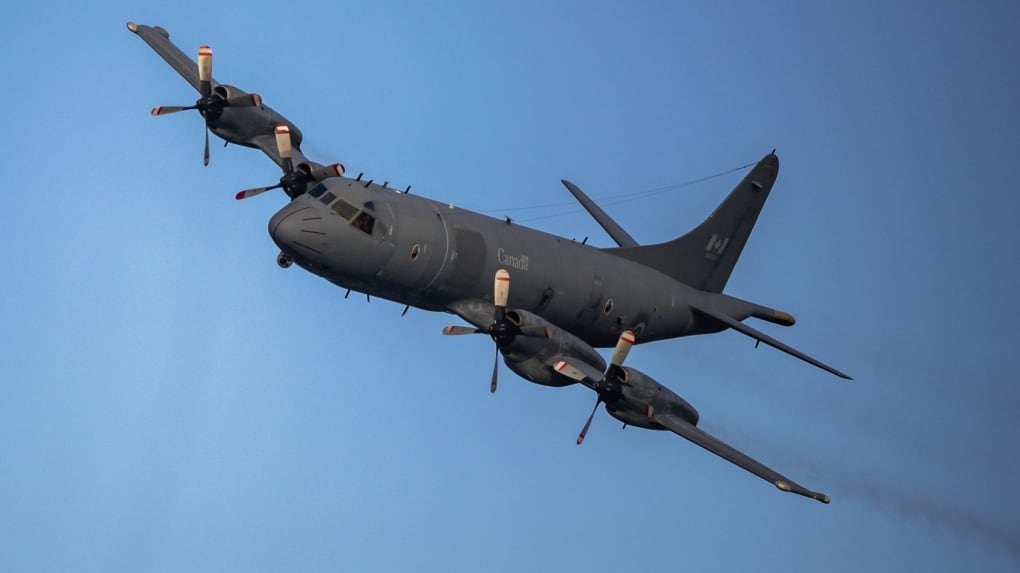
The Canadian military flew seven surveillance missions over waters near China in the past month to enforce North Korean sanctions, but the Department of National Defence is no longer confirming whether Chinese aircraft intercepted those flights, as it has in years past.
The missions were flown from Japan as part of Operation Neon, the Canadian military’s longstanding effort to document and disrupt vessels suspected of evading United Nations sanctions on the import of fuel and other commodities into North Korea.
The Canadian CP-140 Aurora patrol plane arrived at Kadena Air Base in Okinawa in late March and began flying long-range patrols over the East China Sea, as it has annually since 2018.
Unlike in previous years, however, the military is not saying whether any of those flights were intercepted by the Chinese People’s Liberation Army Air Force.
RELATED STORIES:
- Canadian military plane subjected to ‘unsafe’ Chinese intercepts, DND says
- Canadian military plane intercepted by Chinese jets ‘numerous’ times in recent weeks
‘Diplomatic sensitivities’
Multiple spokespeople for the Department of National Defence and Canadian Joint Operations Command (CJOC) declined to discuss encounters with Chinese aircraft—once acknowledged as a routine part of the mission.
“We do not normally comment on the specific number or detailed nature of interactions with military aircraft or vessels from other nations,” said Lt. Patrick Delisle, spokesperson for CJOC expeditionary operations, in an emailed statement.
“For operation security and diplomatic sensitivities, we will not share the number of intercepts for this iteration,” added fellow CJOC spokesperson Maj. Anne Côté in an interview.
Steffan Watkins, an Ottawa-based researcher who uses open-source intelligence to track ships and aircraft, says it’s likely that the Canadian plane was intercepted by Chinese military jets on every recent flight.
“That’s based on previous statements, interceptions during media ridealongs, previous leaks, and that it’s simply reasonable to think the Chinese would intercept foreign military aviation near their borders,” Watkins said. “This isn’t that different from NORAD intercepts of Russian training exercises off the coast of Alaska.”
‘Most intercepts’ safe and professional
National Defence spokesperson Kened Sadiku acknowledged it is historically common for Aurora crews deployed on Operation Neon to “interact with military assets from countries in the region.”
“Our personnel are trained to respond appropriately,” Sadiku said in an emailed statement, without addressing China specifically. “Most intercepts are conducted in a safe and professional manner.”
The Canadian Forces declined to share imagery from the recent patrols—as it has done in previous years—citing the same concerns about security and diplomatic sensitivity. In fact, the military declined to respond to any questions about the operation last week, even as foreign media reported details of the Canadian flights released by their own defence ministries.
The Japanese Ministry of Defence announced the arrival of the Canadian patrol aircraft on March 23 through an official statement and on social media. “It will be the 15th time Canada’s aircraft engaged in these activities since 2018,” the ministry wrote, highlighting the aircraft’s ship-monitoring mission.
The Canadian military has since declined to confirm whether the Aurora crew observed any suspicious vessels or transfers of illicit cargo during the recent patrols.
“We don’t disclose numbers either of ship-to-ship transfers or vessels of interest for operational security reasons,” Côté said. “We don’t share the number that we have observed—or not observed.”
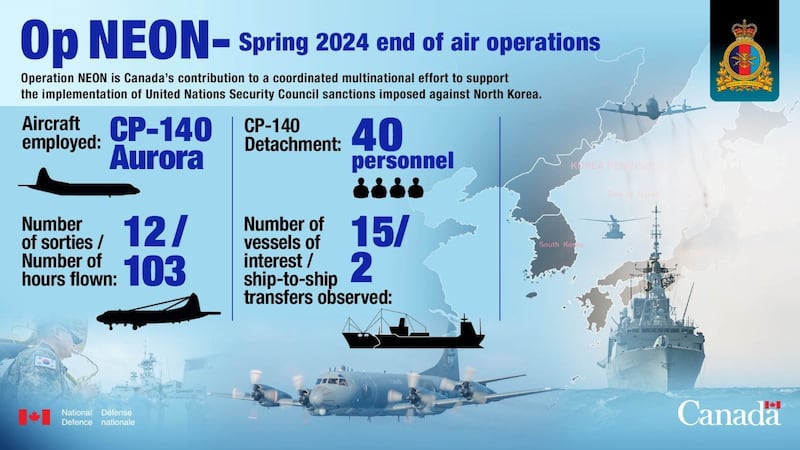
Yet as recently as 2024, National Defence published infographics highlighting data from that spring’s mission, including 15 vessels of interest observed and two documented ship-to-ship transfers.
‘Free and open Indo-Pacific’
Watkins says it is noteworthy that other Canadian allies in the region — specifically Japan, Australia and New Zealand — are actively publicizing their participation in the North Korea sanctions mission and “do not let any diplomatic sensitivities dissuade them from telling their public what is being done in their name.”
Last month, Australia raised concerns following what it described as an “unsafe and unprofessional” encounter with a Chinese helicopter.
An Australian military helicopter was flying over international waters in the Yellow Sea when it was intercepted by a Chinese aircraft, the Australian defence ministry said in a March 6 statement.
The Chinese helicopter approached to “an unsafe distance” before increasing its speed and rolling towards the Australian aircraft, requiring the crew to take ”evasive action,” the statement said.
China’s defence ministry said in a statement the Australian account amounted to “distortions of facts,” and that Australia was attempting to conduct reconnaissance on China under the pretext of enforcing the North Korean sanctions.
The Canadian government says the sanctions, adopted as part of a series of UN Security Council resolutions, aim to pressure North Korea to abandon its weapons of mass destruction programs by isolating the country economically.
“Not only does this demonstrate our interest in a free and open Indo-Pacific region,” Delisle said. “It also demonstrates our commitment to our allies and partners in maintaining an international system based on international law.”
READ MORE:

