


OTTAWA — Foreign Affairs Minister Anita Anand is rejecting claims that her government is prioritizing trade over humanitarian aid and human rights.
The federal government under Prime Minister Mark Carney has been criticized for cutting foreign aid, signing economic deals with autocracies and avoiding openly criticizing American actions against multilateral institutions.
But Anand told the Ottawa Civic Space Summit on Thursday that Canada’s values are “deeply integrated” into its economic and defence interests.
“I want to gently push back against the idea that civic space is somehow different from our objectives relating to economic growth and defence and security,” Anand said.
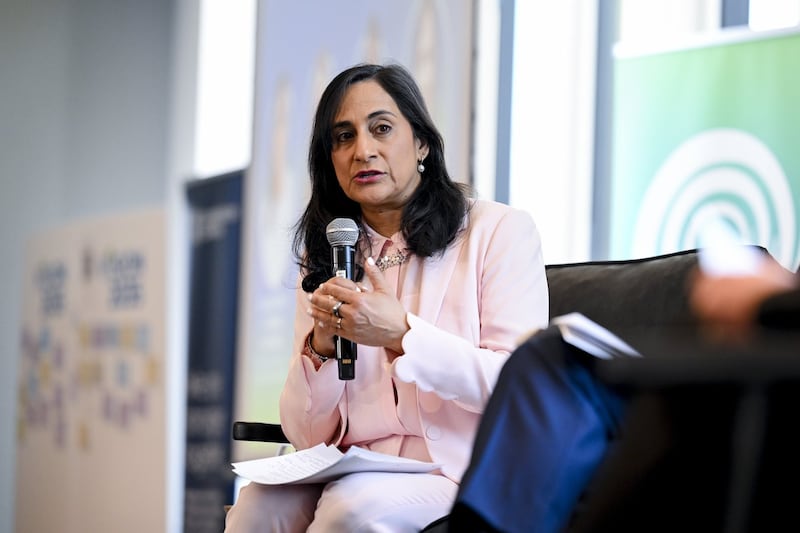
“In order for a country to be strong, in order for institutions to thrive, citizens themselves must feel safe and protected and they must have the economic means to survive.”
Anand gave the example of Canada’s push to restore shipping through the Strait of Hormuz disrupted by the U.S.-Israeli war on Iran.
She said the push to restore freedom of navigation is about both easing the costs Canadians face and ensuring poorer countries can access the fertilizer they need to feed their populations.
“Global supply chains for key survival mechanisms are absolutely also cut off,” she said. “It’s not just the fact that fertilizer isn’t able to flow. It’s that the food supply chain, the nutritional supply chain, is under threat.”
The conference focuses on the work of human rights defenders globally and how Canadian organizations can support them and Indigenous Peoples in Canada in the face of rising autocracy worldwide.
It is sponsored by the organization Resilient Societies and Co-operation Canada, which represents dozens of Canadian non-profits working in international assistance.
The conference comes as human rights activists and former Liberal ministers such as Lloyd Axworthy castigate the Carney government for signing economic deals with Beijing and Gulf nations while avoiding direct criticism of their human rights records.
The critics have noted allies such as France have been more vocal about actions Washington has taken that contradict multilateralism and international law, such as sanctioning International Criminal Court judges, blockading Cuba’s access to oil and capturing the Venezuelan president by force.
The conference also heard Thursday from a Global Affairs Canada official overseeing a newly branded “economic growth” division in the department’s international development branch.
Sacha Levasseur said the shift echoes changes made by the former Canadian International Development Agency before it was merged into GAC.
After the 2008 economic crisis, the organization shifted its focus from environmental sustainability to promoting more private investment and employment in developing countries.
Then the Trudeau government shifted the focus again, this time toward inclusive economic growth and a feminist foreign policy that supports the most vulnerable.
“We’ve been asked quite recently to revamp our approach to economic growth, when we do international assistance,” Levasseur said.
“The way things are shaping up, we’re kind of back to 2010, where we were looking at that from more of a private sector lens, and in the way we’re talking … that financial lingo and de-risking.”
De-risking refers to Global Affairs Canada backing projects in which companies and philanthropists are more likely to invest, resulting in a reduced need for federal spending.
Critics have argued the private sector can help with projects that boost living standards in developing countries, but can’t provide core services like water and education to the world’s poorest.
Paulina Ibarra is the head of the Multitudes Foundation in Chile, which advocates for transparency and accountability. She said Canadian funding for civic society spurs economic growth by cutting down on corruption and ending policies that block women and minorities from economic success.
“Canada’s feminist international assistance policy and the democratic resilience and human rights program, from our perspective, are not just aid programs. They are Canada’s, I would say, greatest economic security asset,” she told the conference.
“They allow us to build a technical capacity to fight back. By protecting the women, environmental and human rights defenders who act as watchdogs, Canada is protecting the integrity of an entire sector.”
Earlier during her remarks, Anand said Canada’s diplomacy is not conducted through social media.
“In order to be effective diplomats, we should not be utilizing social media as the primary tool of diplomacy. Diplomacy is nuanced. Diplomacy is complex,” she said. “We have to be strategic about how we push the necessary messages.”
Anand did not reference a 2018 Global Affairs Canada tweet calling for the release of women’s rights activists that sparked a years-long diplomatic spat with Saudi Arabia.
This report by The Canadian Press was first published April 23, 2026.
Dylan Robertson, The Canadian Press

