Hundreds of people were stranded on a northern Alberta highway overnight due to a snowstorm.
Multiple crashes were reported on Highway 63, the main highway through the region, and Highway 881 on Thursday after the storm landed. Both are provincial highways in and out of Fort McMurray.
As of Friday afternoon, travel was not recommended for about 100 kilometres of Highway 63 between Crow Lake Provincial Park and Fort McMurray International Airport, according to 511 Alberta. Travel was also not recommended on Highway 881 from Margie to Highway 63.
Mounties did not know how many people were stuck overnight, nor when traffic would return to normal. A flyover conducted by a third-party company on Friday counted approximately 300 vehicles stopped in two different pockets of congestion.
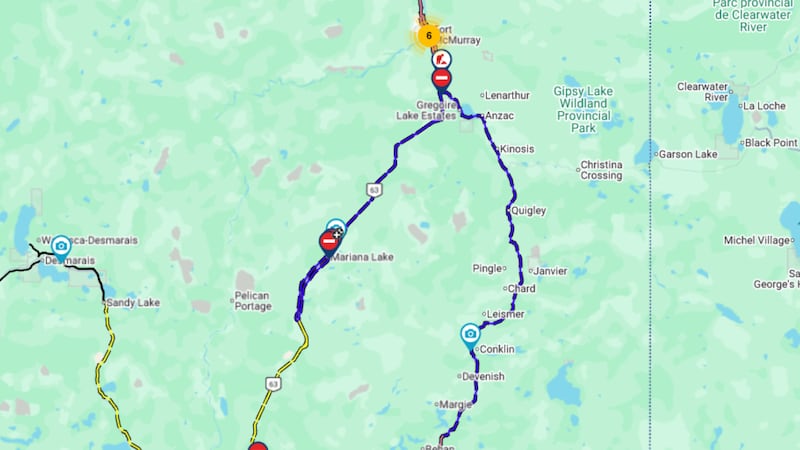
One of pockets of congestion was caused by a semi blocking northbound traffic on Highway 63 near Sand Tiger Lodge.
“We’re not sure if this accident is five kilometres, 10 kilometres, 15 (kilometres) in front of us. And I have no idea how far the traffic is backed up, but it’s as far as we can see,” Judith Iwaszkiw told CTV News Edmonton Friday morning after spending the night in her vehicle.
“We’re definitely better off than some people. I know people have run out of fuel, and there are some parents with small children who are lacking food and water and fuel,” Iwaszkiw said.
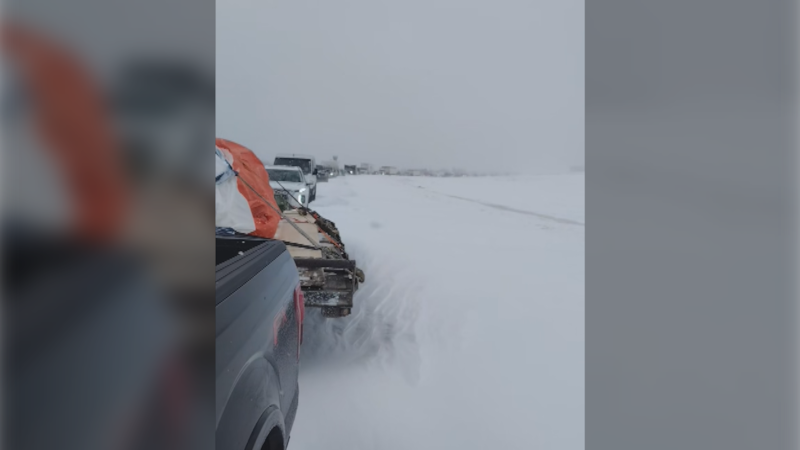
Meanwhile, snow drifts that were two or three feet tall were continuing to grow.
Emcon Services, which Alberta contracts for highway maintenance in the region, “has crews on the ground working to quickly clear the snowfall,” according to a government spokesperson.
“Additional resources have been deployed from Lac La Biche and Athabasca to support these efforts and help create safe access for emergency responders and tow operators. RCMP are currently coordinating escorts for tow trucks to move northbound and remove the vehicles blocking the highway. Emergency services have also been on site providing supplies and fuel to stranded motorists,” the transportation and economic corridors ministry said in an email.
“The priority is to safely clear the roads as quickly as possible. The highway will reopen once it is safe to do so.”
Regional Municipality of Wood Buffalo Mayor Sandy Bowman told CTV News Edmonton that it had deployed its own fleet of tow trucks south after assessing the situation.
He said conditions like these should have been sorted quicker in heavy winter months like January - but April snowstorms are less predictable and perhaps have fewer resources.
“We’ll take a look at what happened and where the failures were, and take a look at what the province could maybe do better with the contractor to ensure this doesn’t happen again. It’s still winter. Fort McMurray still has two feet of snow on the ground,” Bowman said.
“What I do know is that our residents have been stuck there now for, some up to 12 hours now, so we want to do everything we can. If that means taking our municipal resources and heading down the highway, we’re going to do that.”
The province said any delays to clearing the highway “were not due to a lack of preparedness, but rather the severity of the storm, poor visibility, ongoing snowfall, and the need to ensure it was safe for crews and tow operators to access the scene.”
The government is reviewing highway maintenance contractors’ response to this storm, as it does after all major storms, a spokesperson said.
Friday evening, the Regional Municipality of Wood Buffalo said it was working to get residents still stuck on Highway 63 back to major neighbourhoods in Fort McMurray.
It’s not known if anyone was injured in any of the crashes.
The highway was closed overnight as tow trucks and heavy wreckers continued to dig vehicles out of snow drifts.
‘It shouldn’t be like this’
A group of community members braved the conditions early Friday morning to do what they could to help.
Justin Young and Brian Power told CTV News Edmonton they were able to pull out 28 vehicles and delivered fuel, water and pizza — donated by Jomaa’s Pizza — to multiple others.
“Community,” Young said when asked what motivated him. “They do it for us. We’ll do it for them.”
Power added, “If we could have got more, we would have, but we can’t. The tractor-trailers are doubled up in lanes.”
They also saw many vehicles in the ditch. The temperature late-Friday morning was about -6 C.
It was a stark reminder of the importance of being prepared for emergencies.
“We are coming up on the 10-year anniversary of Fort McMurray wildfires, and I think as a community, we were so underprepared during that emergency situation, and this is almost reminiscent of that because people were not prepared to travel in this type of weather,” Young said.
“Having a spare pair of gloves, a spare toque, having a blanket, having a full tank of fuel, some snacks and some water, an emergency roadside kit with necessities is so, so important — during winter travel especially.”
The situation also had Iwaszkiw thinking of the 2016 fire that prompted Fort McMurray’s desperate evacuation.
“We have these elaborate systems put in place for emergency management and we’ve had so many catastrophes in Fort McMurray, and it seems like this region is just notorious for always waiting until the last minute and then trying to fix a problem after it’s tripled and quadrupled in urgency and size,” she told CTV News Edmonton.
“It shouldn’t be like this. You’ve got a large percentage of Canada’s (gross domestic product) coming out of the city. There’s no reason that we should be lacking the resources and the help that we need right now.”
RELATED STORIES:

