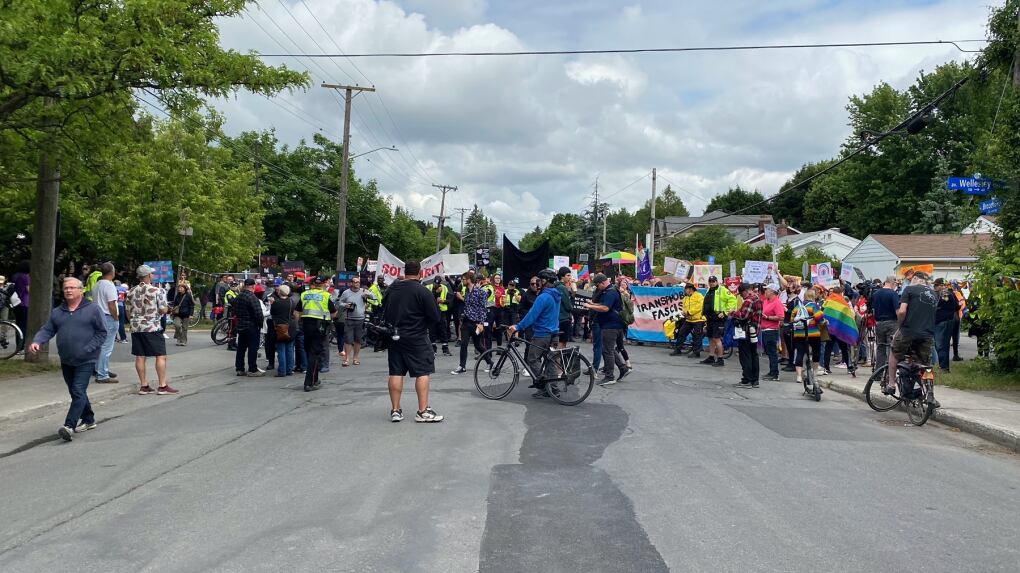
A lawyer for the Canadian Civil Liberties Association (CCLA) is voicing opposition to Ottawa’s recently approved bubble zone bylaw.
On Wednesday, councillors voted 20 to four in favour of the “Safe Access to Social Infrastructure Bylaw,” which will prohibit protests within 50 metres of places of worship, schools, hospitals and residential care facilities.
Anaïs Bussières McNicoll, lawyer and director of the Fundamental Freedoms program at the CCLA, says the bylaw is overly restrictive and would prohibit people from using spaces within the bubble zones to express any opinions.
“Even one person or two people gathering together to read a program about peace would be in violation of that bylaw,” Bussières McNicoll told Newstalk 580’s CFRA Weekends.
“So, we’re really talking about overbroad prohibitions that are a direct attack on expression that is non-violent and non-threatening and on protests that are completely peaceful.”
According to the bylaw, any act of protest or demonstration within established safety zones would be prohibited. The bylaw prohibits other conduct within the safety zones, including blocking or discouraging others from accessing facilities.
During Wednesday’s council meeting, Mayor Mark Sutcliffe said the bylaw strikes the right balance, protecting both community safety and the right to protest.
“What we are dealing with here is the very difficult decision of where to draw the line between those two, in some cases and some occasions, competing priorities,” he said.
“That is what we do. We draw lines. Our noise bylaw draws lines. All the bylaws we have draw lines between one person’s right to do something and somebody else’s right to not have to experience whatever that person is doing.”
Bussières McNicoll says provisions within the criminal code already work to uphold community safety, even during protests, making the bylaw is unnecessary.
“Mischief, intimidation, criminal harassment, uttering threats, participating in a riot — those are all provisions that exist, that apply everywhere in Canada, including in the context of protests, that allow the police to do their job,” she said. “Whenever there is a risk to public safety, they can intervene.”
Bubble zone bylaws have been passed in other Canadian cities, including Brampton, Calgary, Oakville, Toronto and Vaughan. The CCLA is currently challenging the bylaw adopted by Vaughan, and Calgary’s bylaw has also faced legal challenges.
For Bussières McNicoll, the adoption of theses bylaws represents a worrying trend of hostility towards peaceful protest.
“I feel like we must collectively question this growing narrative that the protest is necessary, problematic and must be shut down because it is disruptive,” Bussières McNicoll said.
“A protest can be disruptive and yet still be peaceful, and a reasonable level of disruption is part of the constitutional protection awarded to freedom of peaceful assembly and freedom of expression.”

