


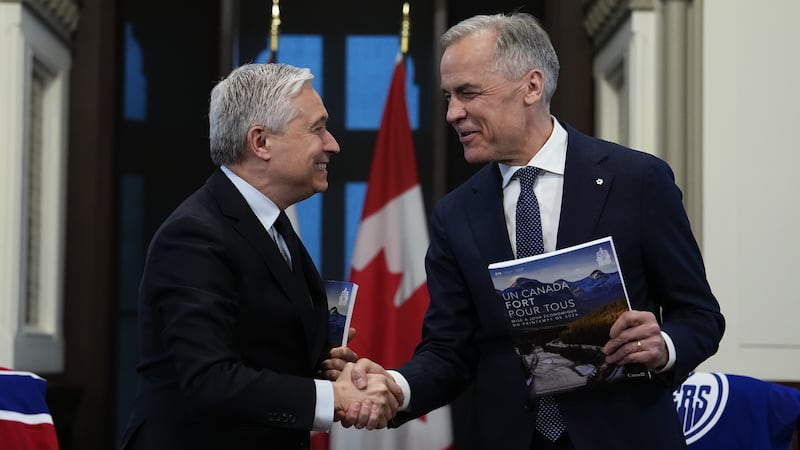
OTTAWA — In its first-ever spring economic update, Prime Minister Mark Carney’s newly minted majority government is promising to spend billions on a strategy to train more skilled workers to help deliver on its plans to build big.
The revised fiscal outlook also shows that while the federal deficit is $11.4 billion lower in the last fiscal year than what was projected in the 2025 federal budget, the deficit is tracking to only decline nominally in the years ahead.
For example, in the current 2026-27 fiscal year, the deficit is projected to be $65.3 billion, down just slightly from the $65.4 billion estimated in the 2025 federal budget.
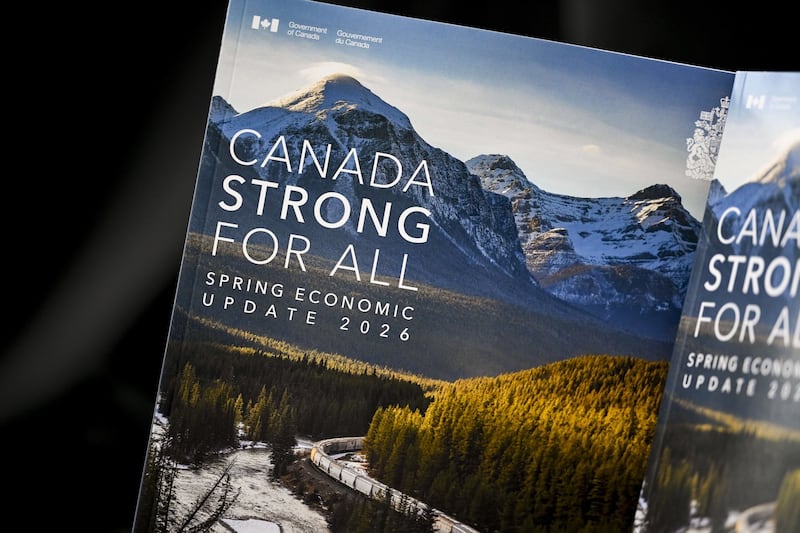
The document — clocking in at 167 pages cover to cover and titled “Canada Strong For All” — is illustrative of how the government is gearing up to execute on Carney’s ambitious agenda, while steering the country through geopolitical headwinds and uncertainty.
Though after promising to emphasize how their economic plan will benefit all Canadians, the government’s spring statement offers few new line items geared towards consumers’ pocketbooks.
In total, there is $37.5 billion in net new spending in the spring economic update. That number grows to $54.5 billion when including measures announced since the last federal budget.
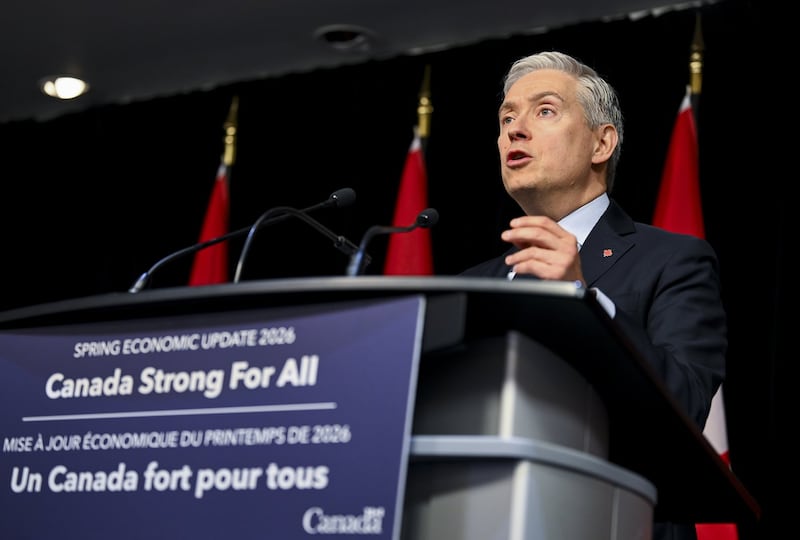
“Canada is resilient ... Canadians are resourceful people,” Finance Minister Francois-Philippe Champagne said in the House of Commons after tabling the spring economic statement.
“Together we can chart a path forward through the fog of uncertainty because Canada has what the world wants and increasingly needs.”
More money for workers and athletes
The biggest new commitment contained in the government’s economic update is a new nationwide recruitment and training effort that would see between 80,000 to 100,000 new skilled trade workers hired by 2030-31.
The government says this would create “new opportunities for Canadians” and attract the workers needed “to build more homes and major projects at speed and at scale.”
For this “Team Canada Strong” plan, the Liberals are allocating $5.9 billion over five years, combining initiatives such as wage subsidies, apprenticeship training grants, labour mobility tax credits, training bonuses, and employer incentives.
As Carney alluded to on Monday, the marquee macroeconomic pledge within the spring economic statement is the creation of a national sovereign wealth fund that will give Canadians a stake in major projects. Relatedly, the Liberals plan to make the Employee Ownership Trust Tax Exemption permanent “to empower workers to participate directly in building Canada strong.”
The update also includes a new commitment to invest in sport in Canada “from playground to podium.” Earmarking $755 million for this initiative, the government says its aim is to expand access to sport, better utilize existing and new infrastructure, and better support Canadian athletes.
On the defence front, the billions in major new spending anticipated in the years ahead are not yet being accounted for as costs have yet to be pinned down on future procurement.
But the Liberals are spending $103.8 million to establish the Defence Investment Agency as a standalone entity. Another $2 billion is being committed to continue Canada’s support for Ukraine through Operation UNIFIER.
The document also details costs and commitments connected to a series of pre-announced initiatives including the Major Projects Office, the automotive and nature strategies, as well as extending alcohol excise duty relief for Canadian breweries, distilleries and wineries.
Pension rate relief, little else for pocketbooks
In terms of affordability measures for everyday Canadians, this spring economic statement — which the Liberals have stressed is not a mini-budget — offers little that’s new.
The Liberals have chosen, however, to highlight a few pre-announced commitments such as the enhanced groceries benefit going to 12 million Canadians as of June 5, the temporary excise tax holiday saving Canadians up to 10 cents/L on gasoline, and capping non-sufficient fund fees at $10.
There is one new move that could offer a small degree of savings for workers. The government has announced that effective Jan. 1 of next year, it intends to reduce the Canada Pension Plan contribution rate from 9.9 per cent to 9.5 per cent.
The Liberals estimate this will translate into annual savings of approximately $133 for an employee earning $70,000 a year, with comparable savings for their employer.
On housing, the only measure that may directly benefit homeowners or prospective homebuyers is a commitment to extend the grace period for repaying Home Buyers’ Plan withdrawals from their Registered Retirement Savings Plan (RRSP) from two years to five years, for participants making a first withdrawal between Jan. 1, 2026 and Dec. 31, 2028.
Short-lived deficit decline
Taking all of this into account, economists CTV News spoke with were quick to note that while federal coffers have been buoyed by higher oil prices and other economic factors, the Liberals are opting to largely channel increased revenues and savings into new spending, rather than paying down the deficit more concertedly.
The 2025 federal budget presented last fall — framed as an “investment budget” — went big on capital spending and projected the deficit to be $78.3 billion in 2025-26. Now, the deficit for this fiscal year is projected to be $66.9 billion.
Over the five-year horizon, the deficit is not forecast to decrease to a comparable degree. In 2026-27, the deficit is projected to be $65.3 billion, in 2027-28, the deficit is tracking to decline slightly to $63.1 billion, continuing on a downward trajectory in the two years following, but still far from balance, sitting at $53.2 billion by 2030-31.
“Beyond 2025-26 the deficit track is essentially the same as what we have seen in the budget,” said Mostafa Askari, chief economist with the Institute of Fiscal Studies and Democracy. “The first thing I noticed was that the debt-to-GDP ratio is much lower than what they had at the time of the budget.”
Fred O’Riordan, national leader of tax policy at EY Canada, seized on the fact that debt-servicing charges are tracking to increase to $81 billion by 2030.
“That’s pretty significant when you consider that that $81 billion is revenue that has to be spent to service the debt, as opposed to revenue that’s available to deliver services and so on to Canadians,” O’Riordan said.
Ahead of the update, Carney was confident the document would demonstrate the government’s “good” fiscal management.
“We also remain firmly on track to balance day-to-day operating spending with revenues by 2028–29,” Champagne told MPs.
“We are maintaining a strong fiscal position,” he said. “We are on track to meet our fiscal anchors.”
No update on public service job cuts
Carney’s first budget also promised to rein in operational costs to the tune of $60 billion over five years. A major plank of that plan committed to shedding 28,000 public service jobs by 2028-29.
Tuesday’s fiscal refresh provided no meaningful update on the expenditure review effort. Though, the government does note it’s committing to reduce spending on external management and other consulting services by 20 per cent over the next three years.
This crackdown and pivot to rely on existing public service expertise is estimated to save $450 million in 2027-28, and $900 million annually from 2028-29 onwards.
The document does state that “results of other reviews” — such as the public service reduction efforts — “will be reported in Budget 2026.”
To get a sense of the lack of focus on public service cuts in this document — despite it being a preoccupying concern for many federal workers — the phrase “public service” only appears seven times in the entire spring economic statement.
In contrast, “oil” is mentioned 130 times, the word “defence” gets used 85 times, the word “gas” appears 77 times, and the descriptor “resilient” is referenced 28 times.
The Canada-United States-Mexico Agreement (CUSMA), a pact that could cause considerable economic shockwaves if dramatically renegotiated, comes up just six times.

Opposition resist, yet poised to pass
Sources told CTV News ahead of the embargoed reading of the spring economic statement that Champagne met with opposition parties in the lead up to Tuesday.
Though, while previous Liberal governments have had to make pre-budget consultations more of an earnest effort, given the need to secure opposition votes to pass any proposal, their current majority posture has eliminated that need.
As a result, all motions and legislation approving the spending within the spring economic statement, are expected to pass with ease, once debate concludes. This is the first time the federal Liberals have been in this position in several years.
And that’s perhaps a good thing for them, given the immediate reaction coming from the opposition parties has not been favourable.
“This Liberal prime minister has now doubled the deficit that Justin Trudeau left behind, from $31 billion to $65 billion. Everyone thought it would be impossible to outspend the reckless Justin Trudeau. But then this new Liberal prime minister came along and said ‘hold my champagne,” Conservative Leader Pierre Poilievre said, following Minister Champagne in the Commons.
Bloc Quebecois Leader Yves-Francois Blanchet called the refreshed financial outlook “something of a show,” because the deficit was reduced this year due to some planned spending not going out the door.
Avi Lewis, the new federal NDP leader, called the spring statement a missed opportunity. “The Liberal government had a big opportunity today to actually address the everyday emergency of the crisis of the cost of living for Canadians with concrete measures, new programs that would actually make people’s everyday lives better. It didn’t do that,” he said, speaking from the West Block foyer. Though, Lewis did embrace the move to invest in the skilled trades, while noting “the devil is really going to be in the implementation.”

