Researchers at the University of Manitoba are working on a new kind of imaging technology that could help detect breast cancer earlier.
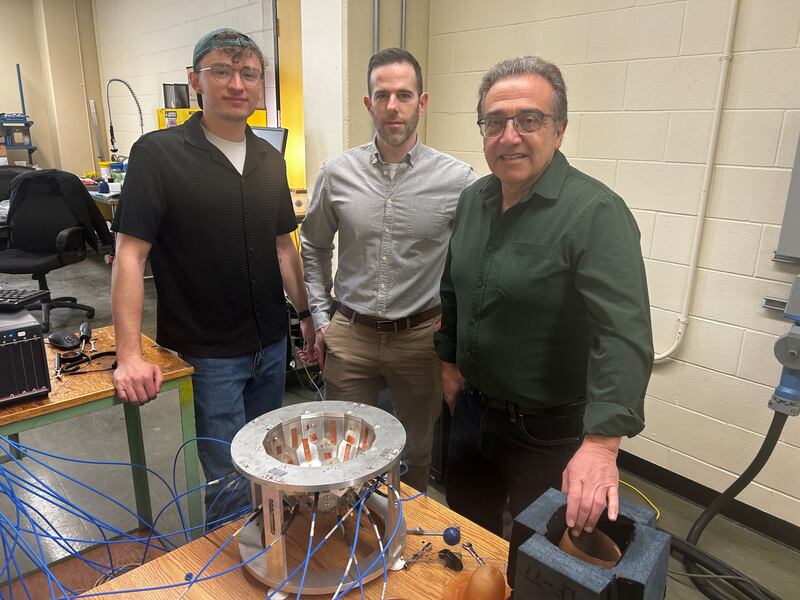
Joe LoVetri and his team are developing, what they call, dual-mode technology. They are the first in the world to couple ultrasound and microwave imaging at the same time.
The goal is to get a clearer picture of what’s happening inside the breast tissue.
“We’re the first ones to couple ultrasonic waves with microwaves,” said LoVetri, who is an electrical and computer engineering professor at the University of Manitoba.
“We think we’ve made a bit of a breakthrough in coupling those two to get more information of the tissue inside the breast.”
The technology relies on wave imaging, which uses energy waves, like ultrasound and microwaves, to look inside the body.
These waves are sent into the tissue and measured as they bounce back. Since different types of tissue affect the waves in different ways, researchers can use that data to build a detailed 3D image.
By combining these types of waves, LoVetri hopes to better distinguish between different kinds of tissue, making it easier to spot abnormalities.
“We’re hoping that we can get more, what’s called, specificity of the tissue to identify the tissue in the reconstructed image,” he said. “Typically in a mammogram, as any woman who’s gone to get a mammogram knows, you wait for the radiologist to look at the 3D scan or the 2D scan, and the radiologist has to interpret what’s in that image.”
Mammograms remain the primary tool for breast cancer screening.
LoVetri says this new technology isn’t meant to replace mammograms, but to work alongside them, and he hopes it could help doctors gather more information faster.
“Normally when a woman gets cancer treatments, they don’t usually monitor during the treatment,” he said. “They only image at the beginning and at the end. This would be ideal technology to monitor during the treatment, to see if the treatment is working or not.”
According to the Canadian Cancer Society, breast cancer is still the most common cancer among Canadian women, with about one-in-eight expected to be diagnosed in their lifetime.
LoVetri hopes their research can allow early detection to lower the number of women being diagnosed with breast cancer.
“You can’t deny the importance of breast cancer. I think everybody in Canada knows of someone who has had breast cancer,” he said.
What comes next?
LoVetri is now preparing to move the prototype to the next stage.
The University of Manitoba has partnered with Taumedis Inc., a Winnipeg-based medical imaging company.
Co-founder Michael Lang says his company’s role is to help guide the development of this technology into the industry.
“There’s all sorts of things that need to be navigated, regulatory landscapes, testing on humans, clinical trials,” Lang said. “That’s where we really bridge from the baseline technology into an actual product that can be used on the market and start helping people.”
Before this technology goes to market, testing is needed.
The first human study into this technology, which is subject to regulatory and ethics approvals, is scheduled for later this year.
The results of those studies determines next steps of where and how the technology could be used.
“Obviously, with the development of technology, these time frames can shift, but ultimately, once we get these, human tests underway, we’ll have a better idea of how the technology works in terms of comfort and outcomes,” he said.
For master’s student Skylar Trudeau, being part of this project is exciting.
“It’s kind of groundbreaking and it’s something not a lot of people are doing around the world,” he said. “Combining ultrasound and microwave imaging as sort of a means to solve this large, time-tested problem of mammography and just the uncomfortability that women have with that.”
He hopes the technology could one day offer patients another option.
“Providing some sort of option that would work in conjunction with such a thing, maybe as another option, potentially, in the future, is something that I look forward to,” he said.

