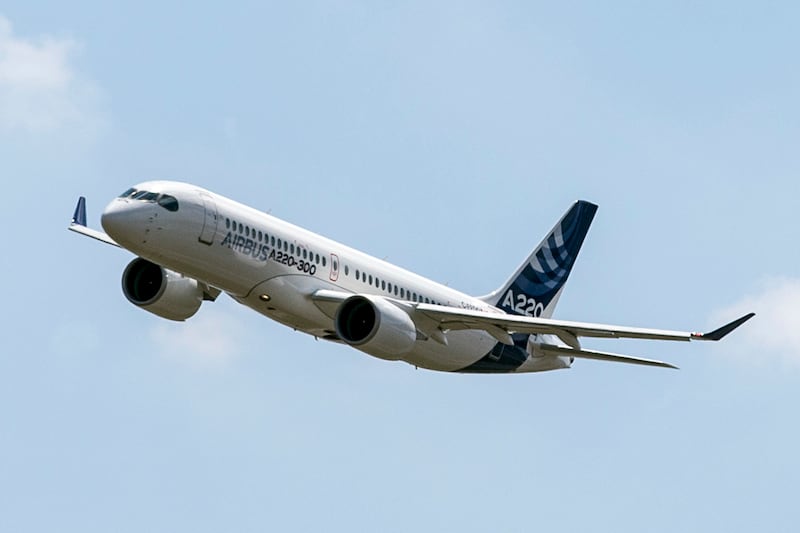
Airbus Canada has signed a deal to supply AirAsia with a massive order of 150 of its Canadian-made A220 jets in a multibillion-dollar coup for Quebec’s aviation industry.
Unveiled Wednesday, the agreement with the low-cost Malaysian airline marks the largest single firm order for the narrow-body planes — assembled north of Montreal in Mirabel — in the manufacturer’s history.
The first A220-300 is expected to roll off the line in the first quarter of 2028, said AirAsia CEO Tony Fernandes, who aims to host the world’s largest A220 fleet.
The unprecedented deal underscores Quebec’s role as a key hub in global aviation, said Lars Wagner, who heads the commercial aircraft division at Airbus. The French-owned company bought a majority of Bombardier’s beleaguered C Series program in 2018 and rebranded it as the A220.
Prime Minister Mark Carney, who spoke alongside Quebec Premier Christine Fréchette at the announcement Wednesday, framed the deal as an example of the benefits that flow from diversifying trade beyond the United States.
In a time of tariffs and a ruptured world order, the agreement strengthens links between Canada and southeast Asian nations, he said, recalling a meeting he had with AirAsia’s chief executive in the Malaysian capital of Kuala Lumpur last fall.
“We shared a vision of deepening ties between those countries that, in this crisis that we’re still living through, are choosing to build in the face of adversity — countries that have the confidence to open up, to link their economies, to invest in their workers, to move forward, not turn back,” Carney told the audience at the Mirabel facility.
“Thank you for the trust you’re placing in Canadian workers, in Quebec, in Mirabel. You’re choosing the best at exactly the right time,” the prime minister told the AirAsia CEO, who was on hand on Wednesday.
Airbus has faced production challenges at its Montreal-area plant over the past few years, struggling to churn out more than seven jets per month on average — half of the threshold needed to break even.
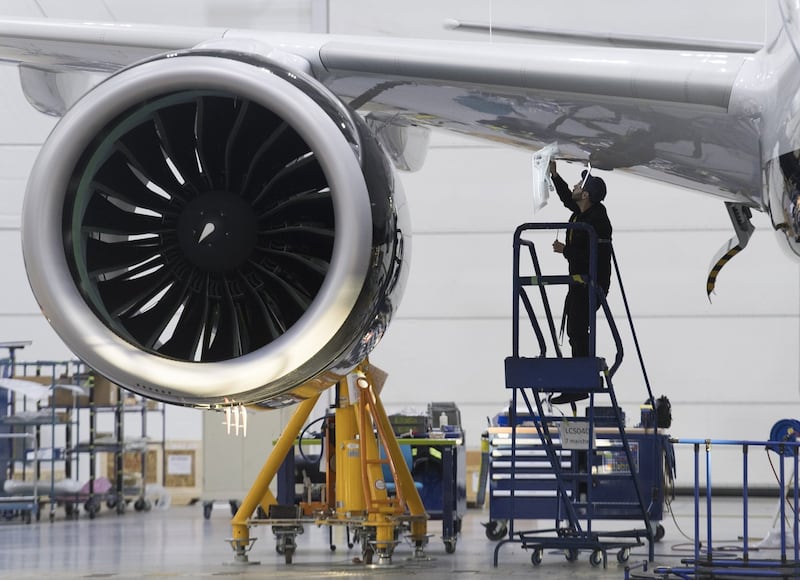
The French company has pointed to a range of supplier problems, citing shortages that run the gamut from wings to Pratt & Whitney engines.
“The jury’s still out as to whether the Canadian product that Carney’s so gushing about is able to be produced at a rate that is profitable for the manufacturers,” said John Gradek, who teaches aviation management at McGill University.
Airbus Canada CEO Guillaume Chevasson told reporters Wednesday the program remained “a few miles away” from profitability. He aims is to produce 13 planes per year by early 2028.
All 150 AirAsia planes will be assembled at the Mirabel site, Chevasson said, rather than in Mobile, Ala., where Airbus churns out A220s as well as wide-body A330 jets.
The Mirabel facility now employs nearly 5,000 workers, 2,500 of them hired in the past four years.
“In addition to showcasing us on the international stage, the aerospace industry has the power to bring new money into our economy while providing a livelihood for tens of thousands of workers,” said Éric Rancourt, who represents the International Association of Machinists and Aerospace Workers union in Quebec, in a statement.
Following the announcement, Carney and Wagner helped AirAsia’s CEO into a Montreal Canadiens jersey, after the prime minister presented Fernandes with a model plane decked out in its signature red-and-white livery, with “airasia.com” emblazoned on the side.
Risks remain for government. Quebec, which now owns 25 per cent of Airbus Canada, has written off its initial US$1-billion investment in the C Series as valueless. In October, it reduced by half the estimated value of a subsequent cash injection to US$300 million.
Given those difficulties, Western University professor Geraint Harvey said the announcement comes as “great news” for the governments and for workers in Quebec.
“One-hundred-fifty aircraft is a massive order. It is also an interesting move given the situation in the Middle East and the current volatility of fuel prices and the impact on commercial airlines,” Harvey said, noting that many airlines are slashing flight schedules rather than expanding.
AirAsia’s CEO seemed to anticipate the point.
“People will be wondering why are we buying so many planes during this latest crisis, but crises are an opportunity to make bold decisions and to go out there and be aggressive. And wars will not go on forever,” Fernandes said, referring to the U.S.-Israeli attack on Iran that resulted in the effective blockade of the Strait of Hormuz and soaring jet fuel prices.
The list price for the A220-300 is US$91.5 million. The parties did not specify a price tag for the purchase, though it would not be unusual for AirAsia to pay far less than the sticker price on such a large order — and in such turbulent times.
“I probably got a better price because no one is buying planes,” Fernandes said, noting the anxiety and flight schedule cuts rippling through the airline sector. “This is an opportunity to go against the grain.”
The A220-300 carries between 100 and 160 passengers on flights of up to 6,700 kilometres, or about seven hours.
Some 501 A220s had been delivered to about 25 operators across the globe as of March 30, Airbus said.
This report by The Canadian Press was first published May 6, 2026.
Christopher Reynolds, The Canadian Press
With a file from Stéphane Rolland

