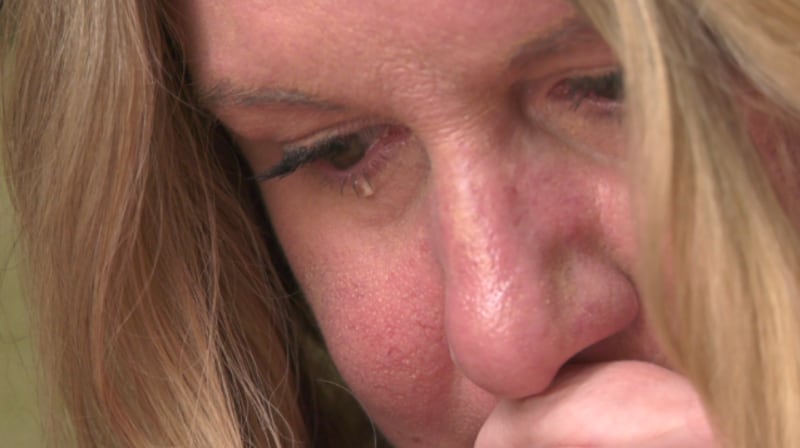
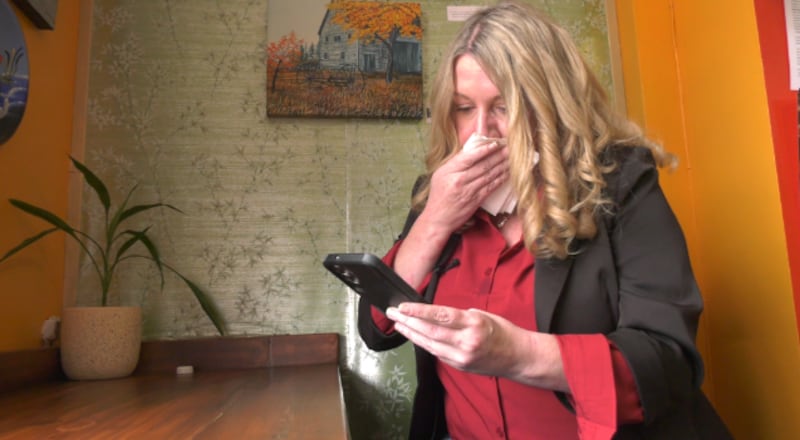
CHARLOTTETOWN - Jena Banks fights back tears scrolling through family photos of the daughter she says she barely recognizes from nine months ago.
Banks says the 13-year-old was an honour student, involved in community events and active at school, including on the yearbook committee. She describes her as polite, kind and close to family. But Banks says that changed after her daughter began spending time with people she believes have pulled her into unsafe situations. Now, the grade eight student has missed more than 100 days of school this year and rarely comes home.
“It’s every parent’s worst nightmare,” Banks said.
The teenager has also been out in downtown Charlottetown as late as 3 a.m., Banks added. Worried someone could try to rob or hurt her, the single mother has driven around at night, scouring streets to find her, but often has to wait until her daughter reaches out first.
“I can’t force her into a vehicle with me,” Banks said. “Until she calls me to come get her because she’s hungry, or she’s dirty, and sometimes she’s scared.”
Searching for help
When she could no longer manage it on her own, Banks sought support. She says she reached out to P.E.I. Child and Family Services, but was told officials couldn’t help bring her daughter home.
Banks says she also tried to access support through P.E.I.’s Bridge Situation Table, a program that connects people in high-risk situations with services. However, her daughter would have to voluntarily accept the help.
Charlottetown Police Services has done what it can, according to Banks, including linking her family with a youth worker. But when she calls for help, Banks says officers can generally conduct a wellness check and confirm they have located her daughter but can’t force her to come home.
“She should be home in her bed with her teddies, asleep and getting up and going to school,” Banks said.
Looking to Ontario
During her conversations with police, Banks says she met one officer who told her about a runaway-child provision in Ontario law.
Ontario’s Child, Youth and Family Services Act allows a justice of the peace to issue a warrant authorizing a peace officer or child protection worker to bring a minor younger than 16 to a safe place if they have withdrawn from someone’s care and control without consent, and there are reasonable and probable grounds to believe the child’s health or safety may be at risk.
Believing a similar rule in P.E.I. could help in her situation, Banks raised the issue with the Member of Legislative Assembly for her district, Carolyn Simpson, who represents Charlottetown-Hillsborough Park.
Bill 103
Simpson says once she saw Banks’s family had exhausted existing options and still had no clear way to bring her daughter home, her office conducted a legal review and concluded the case exposed a gap in P.E.I. legislation.
“Unfortunately, there is no law that currently gives police services the absolute power and discretion to say, ‘No, we need to intervene here, and let’s get this done,’” Simpson said.
According to Simpson, police can try to convince a young person to go home. But without grounds for arrest, detention or mental-health apprehension, she says there is no legal mechanism to require a child to return.
Bill 103, a private member’s bill introduced by Simpson, would amend the province’s Child, Youth and Family Services Act to add a new section for children who have left parental custody without consent.
It would allow the Director of Child Protection or a police officer to apply to the court, for a warrant to bring a child to a place of safety, if there are reasonable grounds to believe their well-being is, or is likely to be, endangered.
The warrant would authorize the Director or officers to enter and search premises where they believe the child is located and take the minor to a safe place. The bill says the child must then be returned to the custody of one or both parents as soon as reasonably possible, according to the parenting arrangements in place before the child left home.
“They would need to ensure that indeed, home is a safe place to bring the child back to, that the child isn’t running away from an unsafe environment,” Simpson said.
If officials believe a child would not be adequately protected at home, the bill says the case would be treated under existing child-protection provisions.
It would also allow the director or a police officer to act without a warrant if there are reasonable grounds to believe the child’s safety or well-being is in immediate danger, or that the child may leave or be taken from the area before a warrant can be obtained. Simpson says she has been told that process could happen quickly, potentially within hours.
“When children run away, that is a very devastating and scary time,” she said. “Of course, you need to get at the root cause, but parents have to be able to help their children. And right now, without this, their hands are simply tied.”
Charlottetown Police did not provide answers to questions by deadline, and the Department of Social Development and Seniors, which oversees Child and Family Services, says it won’t comment while the legislation is being debated.
Questions over children’s rights
B.C. has a different provision for lost or runaway children. Its Child, Family and Community Service Act allows child protection officials to take charge of a young person for up to 72 hours if they appear to be lost or have run away, while they try to locate a parent or guardian and arrange a safe place for them.
But Suzette Narbonne, managing lawyer at the Child and Youth Legal Centre in Vancouver, says the laws in B.C. and Ontario, along with the proposed P.E.I. bill, are missing an important piece.
“Where do we hear from the child in all this?” Narbonne said.
She says Bill 103 is an opportunity for P.E.I. to strike the right balance between protecting children and respecting their rights, but as written, could benefit from changes.
“Law enforcement can detain them, physically, even against their will,” Narbonne said. “At minimum, there should be a requirement for that child to be allowed to meet with a lawyer or an advocate within a very short time, once they have been apprehended and before they’re relocated.”
She adds that intervention should not push children into more dangerous behaviour, including trying harder not to be found the next time they leave.
“Let’s just make sure the harm you’re seeking to avoid isn’t actually made worse by ignoring fundamental rights,” she said.
Another parent speaks out
Bill 103 was brought forward for debate in the legislature Tuesday , where another parent pleaded with politicians to support it. Janet Payne, an adjunct professor in UPEI’s faculty of education, read an impact statement about her 13-year-old son. Payne said he began spending time with people who influenced him to try drugs and alcohol, steal from his parents and eventually move in with another family.
She said the danger escalated after that, and her son was officially reported missing six times, and on one occasion, was found sleeping in the entrance to a bank in Charlottetown. Payne told MLAs police said their hands were tied unless he was charged with a serious offence. She noted the bill won’t solve the broader problem, but called it a necessary first step.
During debate, Simpson said her office consulted police, who told her the bill would give them a tool to do their job.
She also said her office consulted Marvin Bernstein, P.E.I.’s child and youth advocate, who raised concerns about making sure children are not put in harm’s way by being returned home. Simpson said she believes the bill addresses that concern by requiring officials to ensure a child would be adequately protected before being returned to a parent. The bill is expected to return for further discussion next week.

